Lars Hannes Larsson - Böcker
Visar alla böcker från författaren Lars Hannes Larsson. Handla med fri frakt och snabb leverans.
2 produkter
2 produkter
536 kr
Skickas inom 10-15 vardagar
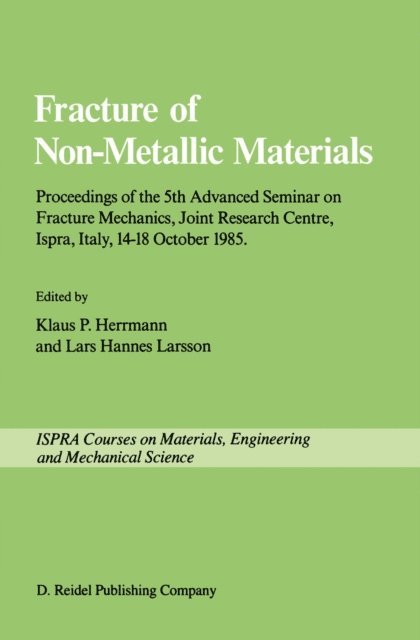
This book contains the lectures of the 5th Advanced Seminar on Fracture Mechanics (ASFM 5) held at the Joint Research Centre, Ispra, on 14-18 October 1985. The series of the ASFMs is one of the two main regularly scheduled international events sponsored by the European Group on Fracture (EGF) , alternating with the European Conferences of Fracture (ECFS). Whereas ECFs are held in a different place on even years (the last. ECF6,was in Amsterdam in June 1986), ASFMs are hosted at the JRC Ispra on odd years. This establishment belonging to the Commission of the European Communities performs research work of common interest to the EC Member countries. One of the activities of the JRC-Ispra is the organization of Ispra-Courses aiming at the transfer of knowledge and the strengthening of exchanges and ties between European scientific workers. ASFMs are designed to give an advanced level treatment in selected areas of fracture mechanics. Previous ASFMs had been devoted to elastic-plastic fracture mechanics and to subcritical crack growth due to fatigue, stress corrosion and creep. In the early stages of preparation of ASFM5 it was decided to concentrate on a new theme, the fracture phenomena and fracture mechanics of non-metallic materials. Whereas fracture mechanics started with the study of glass by Griffith, its later developments centered predominantly on metallic alloys. However, in recent years non-metallic materials have found increasing uses and correspondingly efforts have been made to develop testing and prediction methods for these materials.
536 kr
Skickas inom 10-15 vardagar
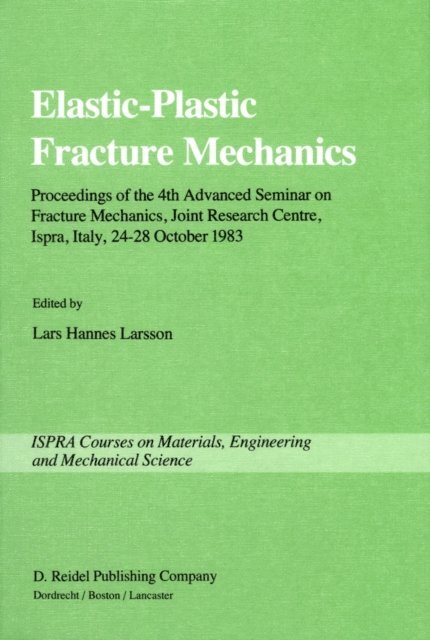
L. H. Larsson Introduction to the Advanced Seminar ASF114 on Elastic-Plastic Fracture Nechanics Ad Bakker The J-concept: Theoretical Basis and its Use in EPFM 13 Ad Bakker Case Studies on the Determination of Applied J-values 55 S. J. Garwood The Measurement of Critical Values of Crack Tip Opening Displacement (CTOD) and J on Parent Steels and "leldments ~or Use in Fracture Assessments 85 J. G. Blauel Ductile Fracture Material Characterization by J-R Curves 117 J. Bernard and G. Verzeletti Experimental Determination of Fracture Nechanics Parameters of Irradiated Materials 145 D. 1-1unz Surface Cracks 165 ~iJ. Dahl and D. Dormagen ~1icromechanisms of Crack Initiation and Crack Propagation 203 L. G. Lamain Numerical Analysis in EPFM 227 F. Mudry 11ethodology and Applications of Local Criteria for the Prediction of Ductile Tearing 263 D. Fran~ois Fracture and Damage 285 F. Hudry Cleavage Fracture and Transition: Application to the Warm Prestress Effect 303 A. R. Dowling, R. P. Harrison, K. Loosemore, R. P *. Ainsworth and 1. Milne I'/ORKSHOP 1 I'lorked Examples Using the CEGB Procedure for the Assessment of the Integrity of Structures Containing Defects 327 G.Rousselier WORKSHOP 2 The EPRI Method for Ductile Fracture Analysis 373 C. E. Turner WORKSHOP 3 The COD Method for Assessing the Significance of Defects 397 C. E. Turner WORKSHOP 4 A J-based Fracture Safe Estimation Procedure, EnJ, with Applications Including Estimation of the Maximum Load for Ductile Tearing 411 F. Nilsson and B.