Lauren Horn Griffin - Böcker
Visar alla böcker från författaren Lauren Horn Griffin. Handla med fri frakt och snabb leverans.
3 produkter
3 produkter
414 kr
Skickas inom 7-10 vardagar
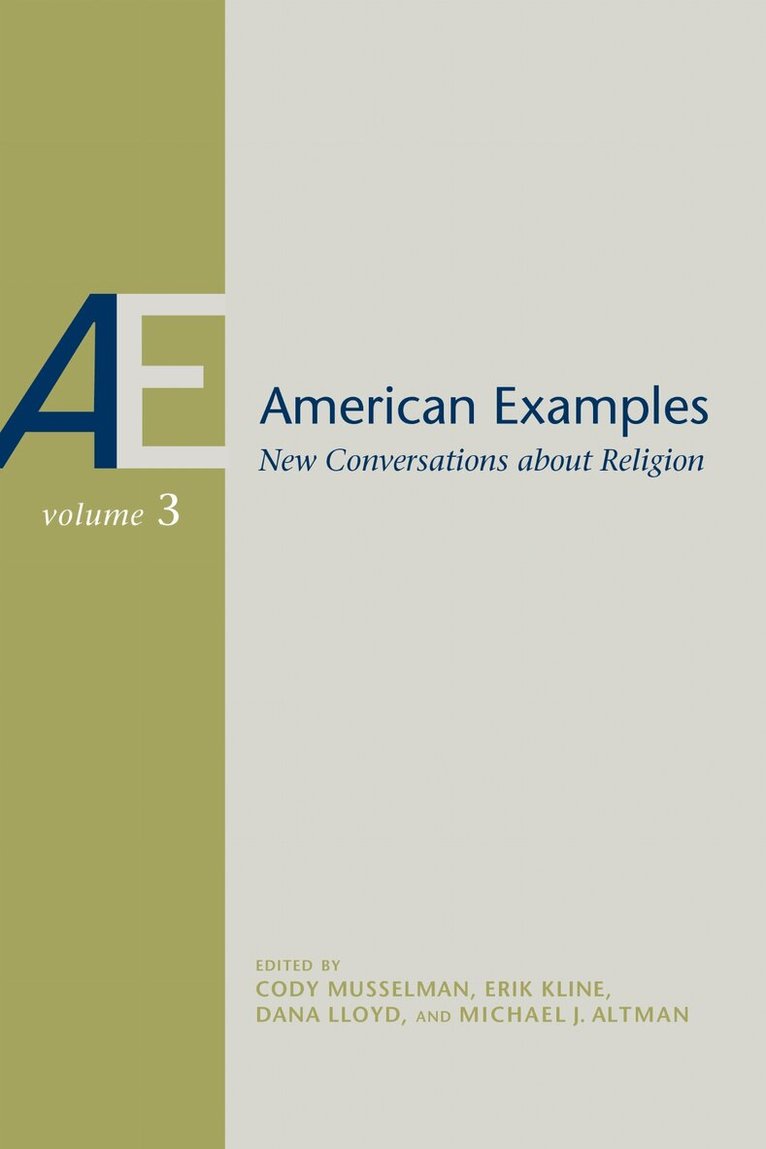
American Examples: New Conversations about Religion, Volume Three, is the third in a series of annual anthologies produced by the American Examples workshop hosted by the Department of Religious Studies at the University of Alabama. In the latest volume from this innovative academic project, ten topically and methodologically diverse scholars vividly reimagine the meaning and applications of American religious history. These ten chapters use case studies from America, broadly conceived, to ask trenchant theoretical questions that are of interest to scholars and students within and beyond the subfield of American religious history.
1 177 kr
Skickas inom 5-8 vardagar
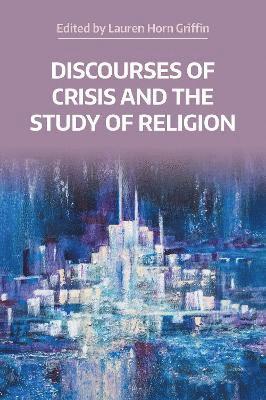
Since the beginning of the COVID-19 pandemic, the 2020s have been consistently framed as a time crisis. Rather than take this at face value, asking how religious people may handle a crisis or what religion can offer people who feel they are in crisis, this volume asks what happens when we classify something as a crisis, and what is at stake in linking these "crises" to "religion." Discourses of Crisis and the Study of Religion highlights how these terms and categories, though seemingly self-evident, serve particular social and political ends. After an opening section that explores the deployment of crisis rhetoric in various aspects of higher education, this volume structures the critical approach to the category of crisis through four distinct sections: Language, Lexicon, Locus, and Locution. The section on language examines the various rhetorical and theoretical frameworks for "crisis." The third section, Lexicon, considers the question of method in the study of religion, interrogating the ways in which perceived crises mark shifts in how we do our work. The section on locus takes up the concept of data for religion and crisis, analyzing examples of how the construction of "crisis" can force moments of decision, adaptation, and reaction. Examples compare instances from North America, Brazil, Mexico, and Russia. The final section, Locution, brings together senior scholars to assess recent approaches to "the role of religion in crisis" and offers alternatives to that framework in the field of religious studies. The volume concludes with an epilogue reflecting on how scholars themselves theorize (or choose not to theorize) crises in regard to their own lives. This volume, focusing on discourses of crisis during a time that is constantly mediated as "in crisis," shows us ways of doing religious studies that are up to the challenge of reflecting on the problems, strategies, and political structures through which we construct our social worlds.
345 kr
Skickas
Since the beginning of the COVID-19 pandemic, the 2020s have been consistently framed as a time crisis. Rather than take this at face value, asking how religious people may handle a crisis or what religion can offer people who feel they are in crisis, this volume asks what happens when we classify something as a crisis, and what is at stake in linking these "crises" to "religion." Discourses of Crisis and the Study of Religion highlights how these terms and categories, though seemingly self-evident, serve particular social and political ends. After an opening section that explores the deployment of crisis rhetoric in various aspects of higher education, this volume structures the critical approach to the category of crisis through four distinct sections: Language, Lexicon, Locus, and Locution. The section on language examines the various rhetorical and theoretical frameworks for "crisis." The third section, Lexicon, considers the question of method in the study of religion, interrogating the ways in which perceived crises mark shifts in how we do our work. The section on locus takes up the concept of data for religion and crisis, analyzing examples of how the construction of "crisis" can force moments of decision, adaptation, and reaction. Examples compare instances from North America, Brazil, Mexico, and Russia. The final section, Locution, brings together senior scholars to assess recent approaches to "the role of religion in crisis" and offers alternatives to that framework in the field of religious studies. The volume concludes with an epilogue reflecting on how scholars themselves theorize (or choose not to theorize) crises in regard to their own lives. This volume, focusing on discourses of crisis during a time that is constantly mediated as "in crisis," shows us ways of doing religious studies that are up to the challenge of reflecting on the problems, strategies, and political structures through which we construct our social worlds.