Law Commission of Canada – författare
Visar alla böcker från författaren Law Commission of Canada. Handla med fri frakt och snabb leverans.
8 produkter
8 produkter
Inbunden, Engelska, 2002
1 057 kr
Skickas inom 5-8 vardagar
At their simplest level, human relationships are about ties between people. These ties, however, are anything but simple; rather, they are complex interdependencies whose dynamic reciprocity of obligations and interests is not always represented in our legal thinking. This collection explores the intersection of interdependency and the law, and contemplates some of the key issues at stake in the way the law interprets and addresses human relationships.Part of a series that questions fundamental concepts of law, this book looks critically at the legal concepts that have framed these relationships: contract, fiduciary duty, the "duty to act fairly," the impartiality of decision makers, and privileged communication. Many of these obscure the element of interdependency. The authors argue that interdependency is a fruitful critical - and human - framework by which to re-evaluate some of our traditional legal concepts.The book will be of interest to law and society scholars and students, as it presents a different critical framework through which to analyze traditional human relationships.
Häftad, Engelska, 2003
369 kr
Skickas inom 5-8 vardagar
At their simplest level, human relationships are about ties between people. These ties, however, are anything but simple; rather, they are complex interdependencies whose dynamic reciprocity of obligations and interests is not always represented in our legal thinking. This collection explores the intersection of interdependency and the law, and contemplates some of the key issues at stake in the way the law interprets and addresses human relationships.Part of a series that questions fundamental concepts of law, this book looks critically at the legal concepts that have framed these relationships: contract, fiduciary duty, the "duty to act fairly," the impartiality of decision makers, and privileged communication. Many of these obscure the element of interdependency. The authors argue that interdependency is a fruitful critical - and human - framework by which to re-evaluate some of our traditional legal concepts.The book will be of interest to law and society scholars and students, as it presents a different critical framework through which to analyze traditional human relationships.
Häftad, Engelska, 2005
367 kr
Skickas inom 11-20 vardagar
We all have notions of what it means to commit a crime. Most of us are very much aware of the behaviours which, by law, constitute crime. Rarely, however, do we stop to consider why certain activities and behaviours are deemed criminal and others are not.What Is A Crime? examines how we define criminal conduct in contemporary society, and how we respond to it once it has been identified.Drawing from diverse scholarly traditions, including law, sociology, criminology and socio-legal studies, this rich collection of essays looks at the processes of defining crime and considers the varied and complex implications of our decisions to criminalize certain unwanted behaviour. From the perspective of various case studies, the contributors reflect on the social processes that inform definitions of crime, criminal law, and its enforcement, while illuminating the subjective nature of crime and questioning the role of law in dealing with complex social issues.What Is A Crime? will be of interest to a broad spectrum of readers with an interest in the governance of crime and its control in contemporary society. Students and scholars of law, sociology, political science, philosophy, and criminology will find this book invaluable in furthering their understanding of the processes of defining and responding to crime and criminal behaviour. It will also hold sway with policymakers, criminal justice practitioners, and anyone with a stake in our current approaches to crime.
Häftad, Engelska, 2006
337 kr
Skickas inom 11-20 vardagar
The study and practice of risk analysis, risk management, and thecommunication of risk has been the subject of heated debates. This isno less so when law is added to the mix. Despite the law'sconstant search for certainty, the concept of risk itself is inherentlyuncertain. From the precautionary principle to the role of researchethics boards, risk remains a value-laden term, difficult to define andeven more difficult to address.This book looks at law and risk in a variety of contexts andprovides insight into how courts use and interpret risk and how the lawallocates risk, as well as examining the regulation of riskyactivities. To demonstrate the linkages between law and risk, theessays tackle some difficult topics, including dangerous offenders, sexoffender notification, drug courts, genetic research, pesticide use,child pornography, and tobacco advertising.This careful consideration of whether the law adequately andappropriately responds to risk will be of interest to students andscholars of law and the social sciences, as well as to lawpractitioners and lawmakers.
Inbunden, Engelska, 2006
1 039 kr
Skickas inom 11-20 vardagar
Long confined to the study of nationality, citizenship was not always considered a major concern of social scientists. In recent decades, however, the concept of citizenship has generated significant interest and intellectual debate in a variety of academic contexts. Globalization is changing the relationships between actors on the national and international stage and shifting the balance of power between them. These changes have spawned a wealth of scholarship across social science disciplines.The essays in Law and Citizenship add to this lively discourse and provide a framework for analyzing citizenship in an increasingly globalized world. A number of fundamental issues are addressed: How are traditional notions of citizenship erecting borders against those who are excluded? What are the impacts of changing notions of state, borders, and participation on our concepts of citizenship? Within territorial borders, to what extent are citizens able to participate, given that the principles of accountability, transparency, and representativeness remain ideals?There are numerous implications of the concept of citizenship for law and public policy in a number of different fields. International law, both private and public, poverty law, immigration law, constitutional law, history, political science, and sociology all reflect concepts of citizenship. Law and Citizenship will appeal to scholars and students in law and politics as well as those interested in the idea of citizenship in contemporary society.
Häftad, Engelska, 2007
344 kr
Skickas inom 5-8 vardagar
Long confined to the study of nationality, citizenship was not always considered a major concern of social scientists. In recent decades, however, the concept of citizenship has generated significant interest and intellectual debate in a variety of academic contexts. Globalization is changing the relationships between actors on the national and international stage and shifting the balance of power between them. These changes have spawned a wealth of scholarship across social science disciplines.The essays in Law and Citizenship add to this lively discourse and provide a framework for analyzing citizenship in an increasingly globalized world. A number of fundamental issues are addressed: How are traditional notions of citizenship erecting borders against those who are excluded? What are the impacts of changing notions of state, borders, and participation on our concepts of citizenship? Within territorial borders, to what extent are citizens able to participate, given that the principles of accountability, transparency, and representativeness remain ideals?There are numerous implications of the concept of citizenship for law and public policy in a number of different fields. International law, both private and public, poverty law, immigration law, constitutional law, history, political science, and sociology all reflect concepts of citizenship. Law and Citizenship will appeal to scholars and students in law and politics as well as those interested in the idea of citizenship in contemporary society.
Häftad, Engelska, 2006
196 kr
Tillfälligt slut
Justice and its “place” within society are highly contested, both in terms of how they are conceptualized and how they are applied. As citizens, we frequently discuss and debate what it means to live in a just society. We lobby for law reform to seek more or better justice. We participate in protests to raise awareness of social justice. Yet, what is the actual “place” of justice in contemporary society? Drawing from several disciplines–including law, criminology, women’s studies, art, and geography–and interrogating many sites–such as provinces, courtrooms and the street–the authors critically examine law and space. In the process they raise fundamental questions about the equivalency drawn between law and justice in orthodox liberal thought.This collection stems from the first annual Nathalie Des Rosiers Audacity of Imagination Award, sponsored by the Law Commission of Canada, the Canadian Federation for the Humanities and Social Sciences, and the Department of Justice Canada. The award is for graduate students who are actively engaged in original and innovative research in pursuit of masters or doctoral degrees in law or the social sciences and humanities. The goal is to stimulate critical and multidisciplinary discussion and debate about fundamental issues of law and society.
Häftad, Engelska, 2007
224 kr
Tillfälligt slut
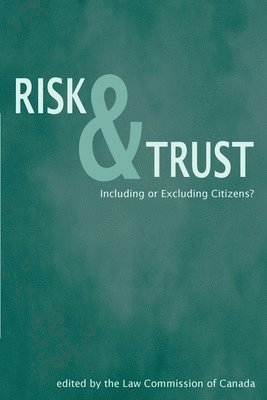
In recent years politicians, academics and social commentators have discussed and debated aspects of the "risk society." For some, embracing a risk frame fulfils a socially productive role in that it helps identify and manage a range of harms and fears. However, as this multidisciplinary collection illustrates, peeling back the veneer of this often highly technocratic discourse reveals a series of moral judgments about the constitution of risk and its role in organizing contemporary society. Exploring a broad range of case studies - including young women in conflict with the law, child soldiers, welfare recipients, genetic testing, biotechnology and new technologies - the contributors explore whether the concept of risk has undermined our sense of trust in society, effectively eroding the definition of citizenship, marginalizing particular people and groups, needlessly heightening societal fears and rendering invisible social inequalities.