Leanne Wiseman – författare
Visar alla böcker från författaren Leanne Wiseman. Handla med fri frakt och snabb leverans.
5 produkter
5 produkter
Häftad, Engelska, 2020
1 213 kr
Skickas inom 7-10 vardagar
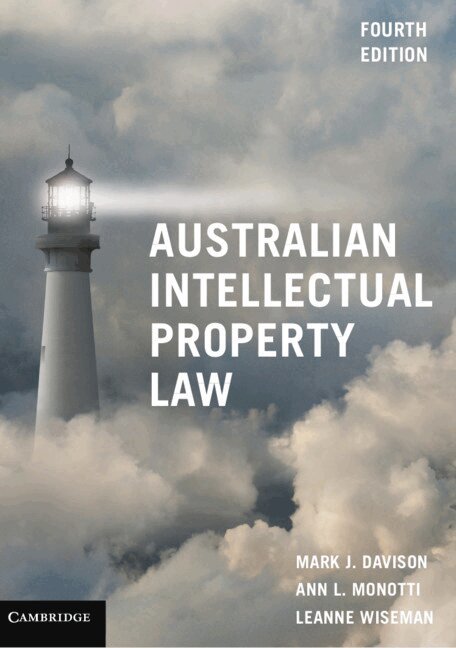
The fourth edition of Australian Intellectual Property Law provides a detailed and comprehensive, yet concise and accessible discussion of intellectual property law in Australia. This edition has been thoroughly revised to cover the most recent developments in intellectual property law, including significant case law and discussion of the proposed and enacted amendments to the Copyright Act 1968 (Cth), the Patents Act 1990 (Cth) and the Plant Breeder's Rights Act 1994 (Cth). The text has been restructured, but continues to provide a complete discussion of the black-letter aspects of the law. Commencing with copyright, then followed by design law, confidential information, patents, plant breeder's rights, then finally trade marks. The work ends with a chapter on enforcing legal rights and civil remedies. Written by highly-respected intellectual property law researchers this text is an invaluable resource for both undergraduate and postgraduate students, academics and other professionals working with intellectual property.
E-bok
Engelska, 20201 441 kr
Läs direkt efter köp
The fourth edition of Australian Intellectual Property Law provides a detailed and comprehensive, yet concise and accessible discussion of intellectual property law in Australia. This edition has been thoroughly revised to cover the most recent developments in intellectual property law, including significant case law and discussion of the proposed and enacted amendments to the Copyright Act 1968 (Cth), the Patents Act 1990 (Cth) and the Plant Breeder''s Rights Act 1994 (Cth). The text has been restructured, but continues to provide a complete discussion of the black-letter aspects of the law. Commencing with copyright, then followed by design law, confidential information, patents, plant breeder''s rights, then finally trade marks. The work ends with a chapter on enforcing legal rights and civil remedies. Written by highly-respected intellectual property law researchers this text is an invaluable resource for both undergraduate and postgraduate students, academics and other professionals working with intellectual property.
E-bok
PDF, Engelska, 20201 441 kr
Läs direkt efter köp
The fourth edition of Australian Intellectual Property Law provides a detailed and comprehensive, yet concise and accessible discussion of intellectual property law in Australia. This edition has been thoroughly revised to cover the most recent developments in intellectual property law, including significant case law and discussion of the proposed and enacted amendments to the Copyright Act 1968 (Cth), the Patents Act 1990 (Cth) and the Plant Breeder''s Rights Act 1994 (Cth). The text has been restructured, but continues to provide a complete discussion of the black-letter aspects of the law. Commencing with copyright, then followed by design law, confidential information, patents, plant breeder''s rights, then finally trade marks. The work ends with a chapter on enforcing legal rights and civil remedies. Written by highly-respected intellectual property law researchers this text is an invaluable resource for both undergraduate and postgraduate students, academics and other professionals working with intellectual property.
E-bok
Engelska, 20121 780 kr
Läs direkt efter köp
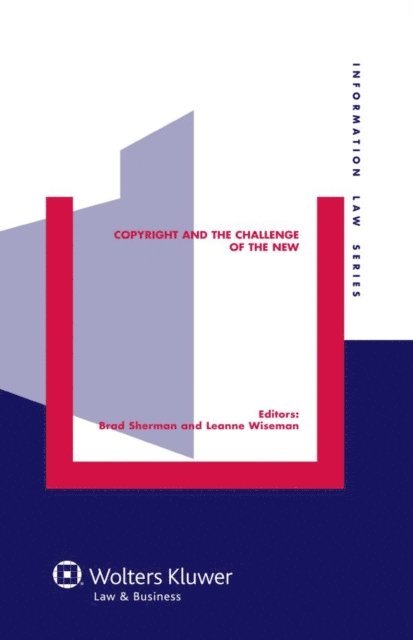
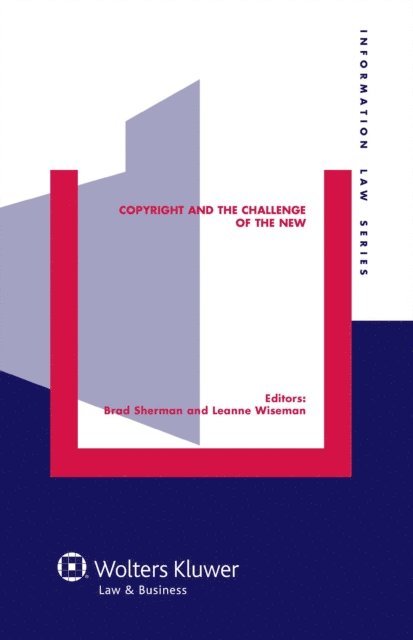
Copyright is not, as is often thought, something that is periodically ‘extended’ to cover a new field or medium; rather, copyright redefines itself whenever its efficacy is challenged. While many factors have contributed to this process, the most consistent has been the challenges created by new technologies. The contributing authors build upon this insight to show that copyright law is, and has always been, a creature of technology. Each chapter focuses on a specific technology or group of technologies – photography, telegraphy, the phonogram, radio, film, the photocopier, the tape player, television, and computer programs – emphasizing the changes that each technology instigated and the challenges and opportunities it created. Perhaps the most profound insight of this extraordinary book is the authors’ claim – ably supported in a series of intriguing chapters – that the way the law responds and reacts to new technologies is always mediated by the political, social, economic, and cultural environment in which the interaction occurs. For example, these chapters describe and explain how: statutory schemes of remuneration arose from failures to effectively police new forms of piracy; persistent litigation and lobbying by copyright owners forces legislatures and courts to devise new laws; content (e.g., sporting events) generates new rules of access to broadcasts; and ‘fair copying’ (e.g., by libraries) is the necessary exception that proves the rule. As well as providing insight into the ways that copyright law interacted with old technologies when they were new, the book also offers important insights into problems and issues currently confronting copyright law and policy such as the appropriate scope of copyright and the relation between copyright and the public interest. With the broad perspectives opened by these essays, academics, practitioners and policymakers in the field will find themselves well equipped to deal with the problems that will inevitably be created by technologies in the future.
E-bok
PDF, Engelska, 20121 717 kr
Läs direkt efter köp
Copyright is not, as is often thought, something that is periodically ‘extended’ to cover a new field or medium; rather, copyright redefines itself whenever its efficacy is challenged. While many factors have contributed to this process, the most consistent has been the challenges created by new technologies. The contributing authors build upon this insight to show that copyright law is, and has always been, a creature of technology. Each chapter focuses on a specific technology or group of technologies – photography, telegraphy, the phonogram, radio, film, the photocopier, the tape player, television, and computer programs – emphasizing the changes that each technology instigated and the challenges and opportunities it created.
Perhaps the most profound insight of this extraordinary book is the authors’ claim – ably supported in a series of intriguing chapters – that the way the law responds and reacts to new technologies is always mediated by the political, social, economic, and cultural environment in which the interaction occurs. For example, these chapters describe and explain how: ;
statutory schemes of remuneration arose from failures to effectively police new forms of piracy;persistent litigation and lobbying by copyright owners forces legislatures and courts to devise new laws;content (e.g., sporting events) generates new rules of access to broadcasts; and‘fair copying’ (e.g., by libraries) is the necessary exception that proves the rule.As well as providing insight into the ways that copyright law interacted with old technologies when they were new, the book also offers important insights into problems and issues currently confronting copyright law and policy such as the appropriate scope of copyright and the relation between copyright and the public interest. With the broad perspectives opened by these essays, academics, practitioners and policymakers in the field will find themselves well equipped to deal with the problems that will inevitably be created by technologies in the future.