Lee E. Preston - Böcker
Visar alla böcker från författaren Lee E. Preston. Handla med fri frakt och snabb leverans.
10 produkter
10 produkter
684 kr
Skickas inom 3-6 vardagar
Authors Collins and Preston, who have collaborated on earlier studies of industrial organization and marketing, are here concerned with the relationship between business concentration and profitability in American manufacturing industries. Economic theory states that prices are higher and price-cost margins wider under conditions of monopoly than under those of competition. the problem in applying this theoretical conclusion to empirical analysis and economic policy is that a gap exists between the theoretical concept of monopoly on the one hand and the measurement of concentration on the other. A number of earlier studies have analyzed samples of available data to relate measured concentration to profitability. the present study reviews these previous efforts and provides a common basis for comparison of them. It then analyzes statistical data for the year 1958 in order to obtain an extensive new collection of empirical results. This analysis focuses specifically on the inter-industry variability of price-cost margins, and seeks to explain this variability in terms of differences in concentration and other variables. This title is part of UC Press's Voices Revived program, which commemorates University of California Press's mission to seek out and cultivate the brightest minds and give them voice, reach, and impact. Drawing on a backlist dating to 1893, Voices Revived makes high-quality, peer-reviewed scholarship accessible once again using print-on-demand technology. This title was originally published in 1968.
776 kr
Skickas inom 7-10 vardagar
Authors Collins and Preston, who have collaborated on earlier studies of industrial organization and marketing, are here concerned with the relationship between business concentration and profitability in American manufacturing industries. Economic theory states that prices are higher and price-cost margins wider under conditions of monopoly than under those of competition. the problem in applying this theoretical conclusion to empirical analysis and economic policy is that a gap exists between the theoretical concept of monopoly on the one hand and the measurement of concentration on the other. A number of earlier studies have analyzed samples of available data to relate measured concentration to profitability. the present study reviews these previous efforts and provides a common basis for comparison of them. It then analyzes statistical data for the year 1958 in order to obtain an extensive new collection of empirical results. This analysis focuses specifically on the inter-industry variability of price-cost margins, and seeks to explain this variability in terms of differences in concentration and other variables. This title is part of UC Press's Voices Revived program, which commemorates University of California Press's mission to seek out and cultivate the brightest minds and give them voice, reach, and impact. Drawing on a backlist dating to 1893, Voices Revived makes high-quality, peer-reviewed scholarship accessible once again using print-on-demand technology. This title was originally published in 1968.
Rules of the Game in the Global Economy
Policy Regimes for International Business
Inbunden, Engelska, 1992
1 640 kr
Skickas inom 10-15 vardagar
This work analyzes the evolution of "international policy regimes" affecting the development and management of international business. The authors explain the nature of international regimes, and show how the interlinked processes of global economic integration and multinational enterprise expansion make the development of regimes both inevitable and desirable. They then examine several major types of regimes currently in place, including those that have emerged from global or regional institutions such as the United Nations and the European Community, as well as those dealing with functional areas such as international trade and payments, sea and air transportation, and environmental issues. They conclude with an assessment of the critical similarities and differences among existing regimes, the most likely direction and scope of future regime development and the important implications of regime evolution for international management.
Rules of the Game in the Global Economy
Policy Regimes for International Business
Inbunden, Engelska, 1997
552 kr
Skickas inom 10-15 vardagar
This text analyzes the evolution of international policy regimes affecting the development and management of international business. The authors explain the nature of international regimes, and show how the interlinked processes of global economic integration and multinational enterprise expansion make the development of regimes both inevitable and desirable. They then examine several major types of regime currently in place, including those that have emerged from global or regional institutions such as the United Nations (UN) and the European Community (EC), as well as those dealing with functional areas such as international trade and payments, sea and air transportation, telecommunications, and environmental issues. They conclude with an assessment of the critical similarities and differences among existing regimes, the most likely direction and scope of future regime development, and the important implications of regime evolution for international management.
Rules of the Game in the Global Economy
Policy Regimes for International Business
Häftad, Engelska, 1997
552 kr
Skickas inom 10-15 vardagar
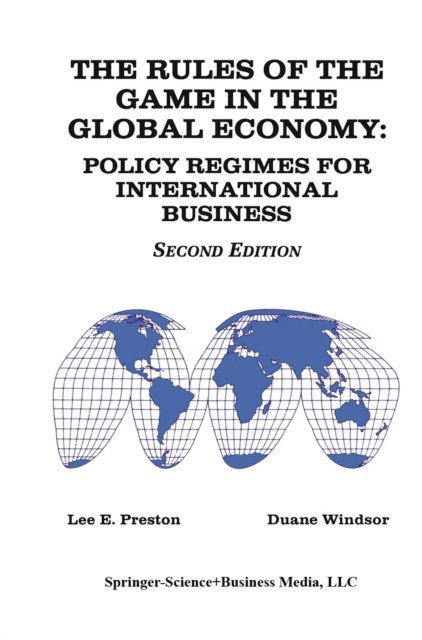
Analyzing the evolution of international policy regimes affecting the development and management of international business, this text attempts to explain the nature of international regime. The idea is to show how the interlinked processes of global economic integration and multinational enterprise expansion make the development of regimes both inevitable and desirable. Lee Preston examines several major types of regime currently in place, including those that have emerged from global or regional institutions such as the United Nations (UN) and the European Community (EC), those dealing with functional areas such as international trade and payments, sea and air transportation, telecommunications, and environmental issues. The text concludes with an assessment of the critical similarities and differences among existing regimes, the most likely direction and scope of future regime development, and the important implications of regime evolution for international management.The following revisions are contained in this edition: updated data and tables to include more recent developments and examples, wherever possible and appropriate; specific attention is given to the evolution of new institutional arrangements, such as the European Union, NAFTA, and WTO; an increased emphasis on the importance to business and economic activity of environmental regimes as reflected in the issues raised at the 1992 Earth Summit in Rio de Janeiro and related developments; the reorganization of some sections of the text, and the introduction of a separate chapter on telecommunications and services.
1 938 kr
Skickas inom 10-15 vardagar
The modern corporation is an institution of enormous economic power and social impact. Corporations have grown in size and numbers all over the world because of their ability to mobilize productive resources and create new wealth. The evolution of the corporation has given rise to new opportunities and challenges that require a redefinition of the corporation and its objectives.The legitimacy of the corporation as an institution, its "license to operate" within society, depends not only on its success in wealth creation but also on its ability to meet the expectations of diverse constituents who contribute to its existence and success. These constituencies and interests are the corporation's stakeholders—resource providers, customers, suppliers, alliance partners, and social and political actors. Consequently, the corporation must be seen as an institution engaged in mobilizing resources to create wealth and benefits for all its stakeholders. This book presents a stakeholder view of the corporation in both theoretical and practical terms. Its central proposition is that organizational wealth is created (or destroyed) through a corporation's interactions with its stakeholders. Effective stakeholder management develops and utilizes relationships between a corporation and its stakeholders for mutual benefit, thereby accomplishing the fundamental purpose of wealth creation. Following the empirical maxim that "Corporations are what they do," the authors examine the stakeholder management practices of three major corporations: Cummins Engine Company, Motorola, and the Royal Dutch/Shell Group. These companies are very different, and their current stakeholder management policies and practices have evolved in very different ways. However, they share a common commitment to humanistic values and to continuous learning. Their varied experiences illustrate some of the opportunities and challenges of stakeholder management, and confirm the appropriateness of the stakeholder view of the corporation as a basis for strategy and policy.
481 kr
Skickas inom 7-10 vardagar
The modern corporation is an institution of enormous economic power and social impact. Corporations have grown in size and numbers all over the world because of their ability to mobilize productive resources and create new wealth. The evolution of the corporation has given rise to new opportunities and challenges that require a redefinition of the corporation and its objectives.The legitimacy of the corporation as an institution, its "license to operate" within society, depends not only on its success in wealth creation but also on its ability to meet the expectations of diverse constituents who contribute to its existence and success. These constituencies and interests are the corporation's stakeholders—resource providers, customers, suppliers, alliance partners, and social and political actors. Consequently, the corporation must be seen as an institution engaged in mobilizing resources to create wealth and benefits for all its stakeholders. This book presents a stakeholder view of the corporation in both theoretical and practical terms. Its central proposition is that organizational wealth is created (or destroyed) through a corporation's interactions with its stakeholders. Effective stakeholder management develops and utilizes relationships between a corporation and its stakeholders for mutual benefit, thereby accomplishing the fundamental purpose of wealth creation. Following the empirical maxim that "Corporations are what they do," the authors examine the stakeholder management practices of three major corporations: Cummins Engine Company, Motorola, and the Royal Dutch/Shell Group. These companies are very different, and their current stakeholder management policies and practices have evolved in very different ways. However, they share a common commitment to humanistic values and to continuous learning. Their varied experiences illustrate some of the opportunities and challenges of stakeholder management, and confirm the appropriateness of the stakeholder view of the corporation as a basis for strategy and policy.
399 kr
Skickas inom 7-10 vardagar
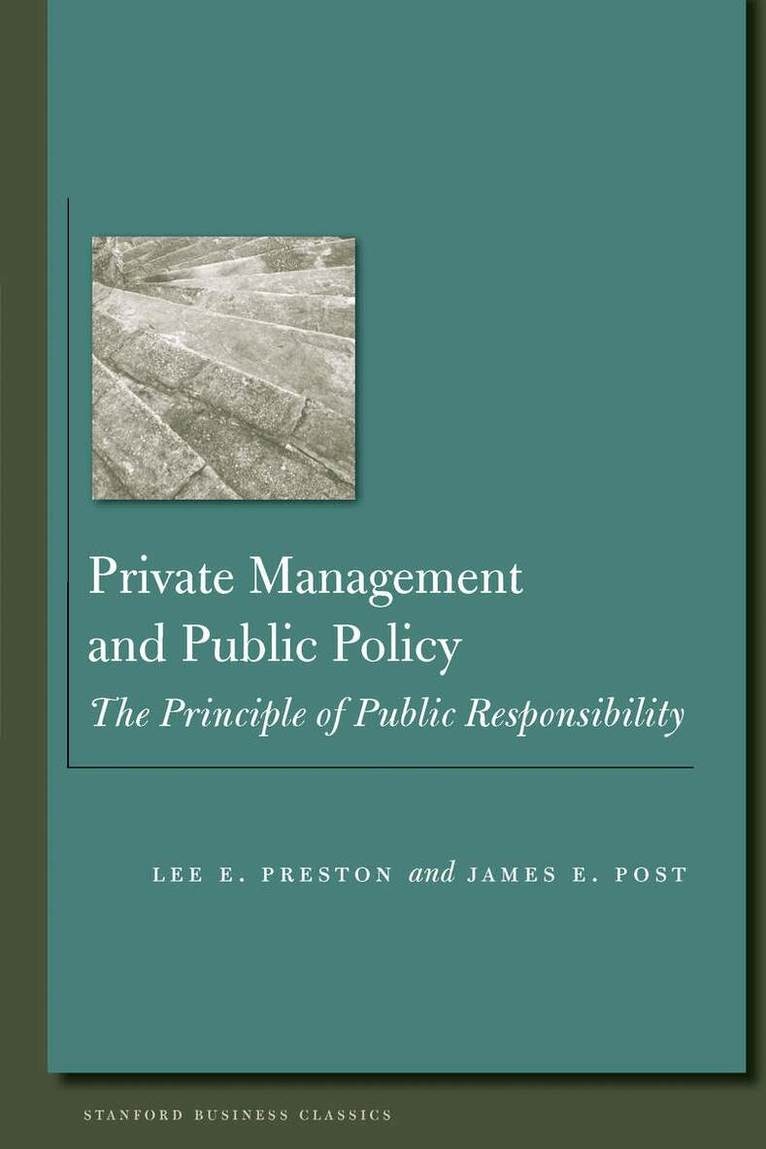
Private Management and Public Policy is a landmark work at the intersection of business and society. First published in 1975, it focuses on the management processes that companies use to respond to social issues. The text develops the "principle of public responsibility" as an alternative to the notion that firms have unlimited accountability. And, it presents one of the first systems-based approaches to corporate responsibility, providing theoretical support for business involvement in public policy. Arguably, the book's major contribution is its broad outline of an alternative theory of the firm in society—one that offers the possibility of overcoming traditional public and private dichotomies.
625 kr
Skickas inom 5-8 vardagar
This book is comprised of essays and research reports for the search for well-founded knowledge that can undergird the collective understanding of ethics and values in the business world. After surveying the research activities of business ethics scholars in this collection of papers, some progress has been made to provide perspective and guidance for the work of professional corporate managers, fresh insights that may lead to new theoretical breakthroughs and an empirical, experience-based foundation of knowledge to guide those who teach present and future corporate leaders. Thereby this book also offers guidance to researchers who intend to take the field of ethical issues in business forward using empirical methods.
Rules of the Game in the Global Economy
Policy Regimes for International Business
Häftad, Engelska, 2010
1 593 kr
Skickas inom 10-15 vardagar
This book analyzes the evolution of 'international policy regimes' affecting the development and management of international business. The authors explain the nature of international regimes, and show how the interlinked processes of global economic integration and multinational enterprise expansion make the development of regimes both inevitable and desirable. They then examine several major types of regimes currently in place, including those that have emerged from global or regional institutions such as the United Nations (UN) and the European Community (EC), as well as those dealing with functional areas such as international trade and payments, sea and air transportation, and environmental issues. They conclude with an assessment of the critical similarities and differences among existing regimes, the most likely direction and scope of future regime development and the important implications of regime evolution for international management.