Lei Ying – författare
Visar alla böcker från författaren Lei Ying. Handla med fri frakt och snabb leverans.
6 produkter
6 produkter
Del 153 - Harvard-Yenching Institute Monograph Series
Our Shared Karma
Buddhism, Literature, and the Modern Chinese Revolution
Inbunden, Engelska, 2026
801 kr
Kommande
Our Shared Karma reveals the profoundly Buddhist beginning of the modern Chinese revolution. It is the first monograph to critique the secularist assumption that has tacitly governed the received narrative of China’s modern transformation, and also the first book-length study in English to approach modern Chinese literature from the perspective of Buddhist studies. Probing the intersection of literature, religion, and politics at the turn of the twentieth century, Our Shared Karma highlights a revolution of the mind that dwells at the core of the Chinese quest for modernity. It illuminates a shared horizon of meaning between Buddhism-inspired progressive intellectuals—such as Liang Qichao, Zhang Taiyan, and Lu Xun—and reform-minded Buddhists—such as Yang Wenhui, Taixu, and Ouyang Jingwu—at a historical juncture of radical epistemic openness and escalating momentum for change. In recovering the Buddhist face of modern Chinese literature, Our Shared Karma unveils at the same time a different, and revolutionary, face of modern Chinese Buddhism. The dual discovery pays homage to an existential courage embodied by these extraordinary seekers and seers, as they braved their karma and groped for light in a dark and tumultuous world.
Inbunden, Engelska, 2013
662 kr
Skickas inom 7-10 vardagar
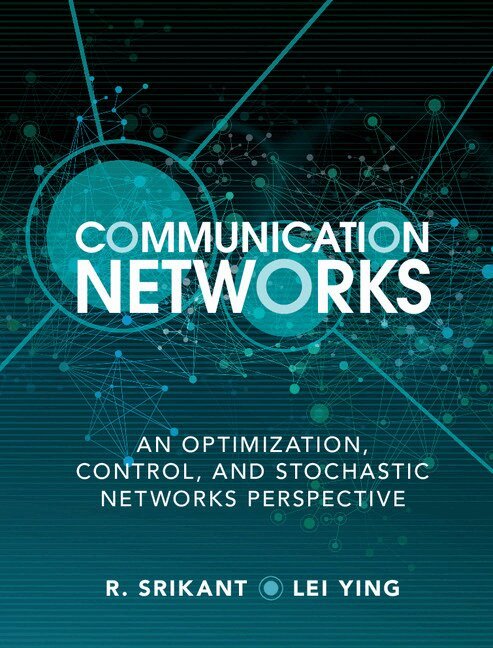
Provides a modern mathematical approach to the design of communication networks for graduate students, blending control, optimization, and stochastic network theories. A broad range of performance analysis tools are discussed, including important advanced topics that have been made accessible to students for the first time. Taking a top-down approach to network protocol design, the authors begin with the deterministic model and progress to more sophisticated models. Network algorithms and protocols are tied closely to the theory, illustrating the practical engineering applications of each topic. The background behind the mathematical analyses is given before the formal proofs and is supported by worked examples, enabling students to understand the big picture before going into the detailed theory. End-of-chapter problems cover a range of difficulties, with complex problems broken into several parts, and hints to many problems are provided to guide students. Full solutions are available online for instructors.
E-bok
PDF, Engelska, 2013760 kr
Läs direkt efter köp
Provides a modern mathematical approach to the design of communication networks for graduate students, blending control, optimization, and stochastic network theories. A broad range of performance analysis tools are discussed, including important advanced topics that have been made accessible to students for the first time. Taking a top-down approach to network protocol design, the authors begin with the deterministic model and progress to more sophisticated models. Network algorithms and protocols are tied closely to the theory, illustrating the practical engineering applications of each topic. The background behind the mathematical analyses is given before the formal proofs and is supported by worked examples, enabling students to understand the big picture before going into the detailed theory. End-of-chapter problems cover a range of difficulties, with complex problems broken into several parts, and hints to many problems are provided to guide students. Full solutions are available online for instructors.
E-bok
Engelska, 2013733 kr
Läs direkt efter köp
Provides a modern mathematical approach to the design of communication networks for graduate students, blending control, optimization, and stochastic network theories. A broad range of performance analysis tools are discussed, including important advanced topics that have been made accessible to students for the first time. Taking a top-down approach to network protocol design, the authors begin with the deterministic model and progress to more sophisticated models. Network algorithms and protocols are tied closely to the theory, illustrating the practical engineering applications of each topic. The background behind the mathematical analyses is given before the formal proofs and is supported by worked examples, enabling students to understand the big picture before going into the detailed theory. End-of-chapter problems cover a range of difficulties, with complex problems broken into several parts, and hints to many problems are provided to guide students. Full solutions are available online for instructors.
Häftad, Engelska, 2018
575 kr
Skickas inom 10-15 vardagar
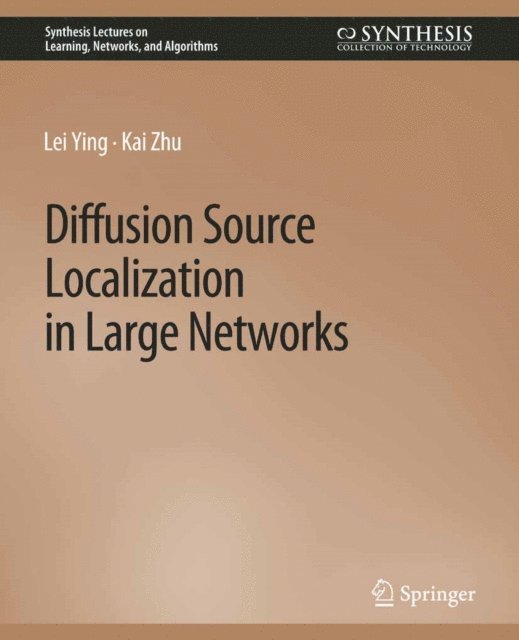
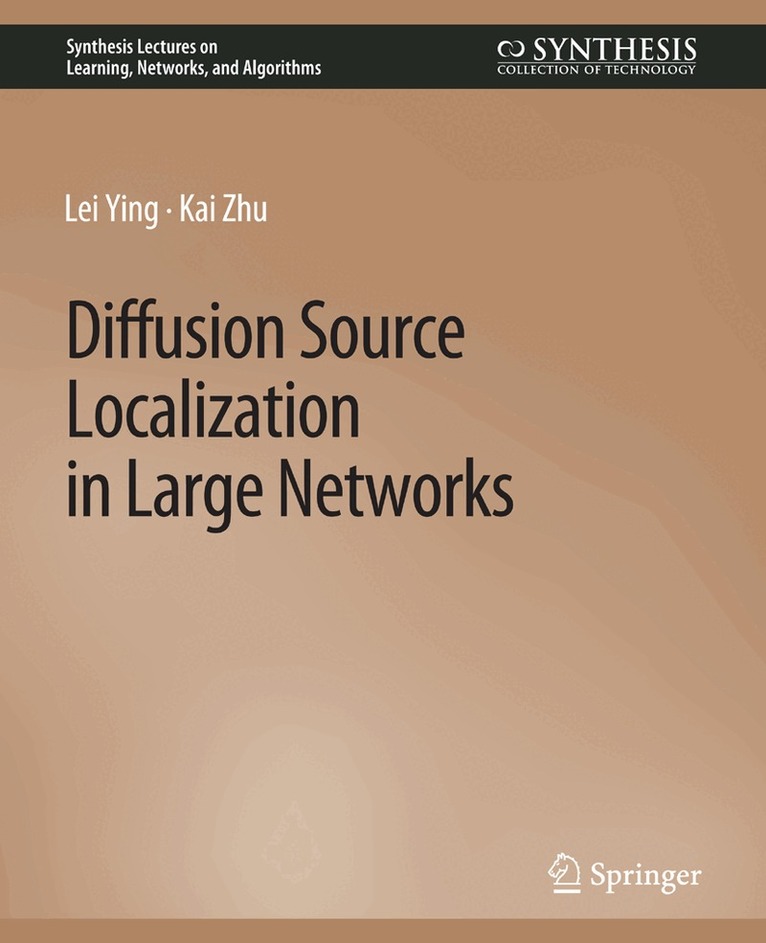
Diffusion processes in large networks have been used to model many real-world phenomena, including how rumors spread on the Internet, epidemics among human beings, emotional contagion through social networks, and even gene regulatory processes. Fundamental estimation principles and efficient algorithms for locating diffusion sources can answer a wide range of important questions, such as identifying the source of a widely spread rumor on online social networks. This book provides an overview of recent progress on source localization in large networks, focusing on theoretical principles and fundamental limits. The book covers both discrete-time diffusion models and continuous-time diffusion models. For discrete-time diffusion models, the book focuses on the Jordan infection center; for continuous-time diffusion models, it focuses on the rumor center. Most theoretical results on source localization are based on these two types of estimators or their variants. This book also includes algorithms that leverage partial-time information for source localization and a brief discussion of interesting unresolved problems in this area.
E-bok
PDF, Engelska, 2022687 kr
Läs direkt efter köp
Diffusion processes in large networks have been used to model many real-world phenomena, including how rumors spread on the Internet, epidemics among human beings, emotional contagion through social networks, and even gene regulatory processes. Fundamental estimation principles and efficient algorithms for locating diffusion sources can answer a wide range of important questions, such as identifying the source of a widely spread rumor on online social networks. This book provides an overview of recent progress on source localization in large networks, focusing on theoretical principles and fundamental limits. The book covers both discrete-time diffusion models and continuous-time diffusion models. For discrete-time diffusion models, the book focuses on the Jordan infection center; for continuous-time diffusion models, it focuses on the rumor center. Most theoretical results on source localization are based on these two types of estimators or their variants. This book also includes algorithms that leverage partial-time information for source localization and a brief discussion of interesting unresolved problems in this area.