
Leif Holmstrom – författare
Visar alla böcker från författaren Leif Holmstrom. Handla med fri frakt och snabb leverans.
11 produkter
11 produkter
E-bok
PDF, Engelska, 20125 158 kr
Läs direkt efter köp
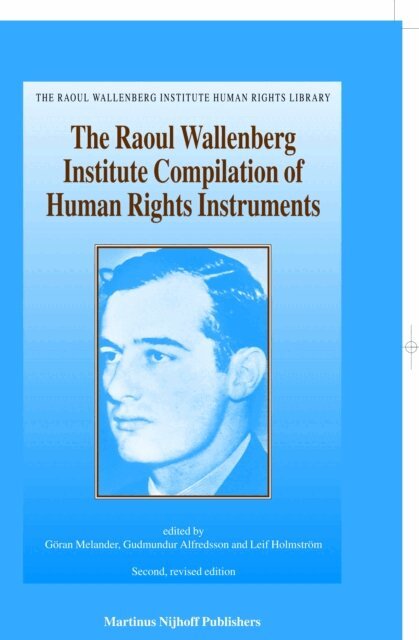
In 1997, The Raoul Wallenberg Institute Compilation of Human Rights Instruments was published by Martinus Nijhoff Publishers as the first volume in the series "e;The Raoul Wallenberg Institute Human Rights Library"e;. In 2004, the second edition of that Compilation was published, and the present publication is the third, revised edition of the book.Since the second edition of the Compilation went out of print, major human rights treaties have entered, or are about to enter, into force, and a number of non-treaty instruments have been adopted. The dynamic development in international human rights law and the increasing number of instruments have brought about a revision in the selection of instruments to be included in this new edition of the Compilation. Like in the previous editions, the selection of instruments is based on the experience acquired by staff of the Raoul Wallenberg Institute; most of the reproduced texts are the subject of frequent references in courses, seminars and workshops organized by the Institute. The chosen treaties and non-treaty instruments are either universal or regional; some of them are of a general nature while others have specific or specialized contents. They cover, among others, civil, political, economic, social, cultural and solidarity rights
E-bok
PDF, Engelska, 20145 018 kr
Läs direkt efter köp
The primary focus of this book is the laws of war, also referred to as the international law of armed conflict and international humanitarian law. There are two aspects to the laws of war, jus ad bellum, the rules governing resort to armed conflict, and jus in bello, the rules governing the conduct of armed conflict. The purpose of the book is to inform police officials about the latter. It is also written for other State officials, including the military, who may carry out police operations, educators and trainers of police and those who monitor or investigate police or otherwise seek to hold them accountable.In addition to considering rules of behaviour in actual armed conflict, the book focuses on police conduct in those forms of conflict that fall below the armed conflict threshold, that is to say situations of internal disturbance and tension. Whilst the laws of war are not legally applicable in such situations, it is argued here that some of its principles and provisions should form an important element in the strategy and tactics of policing civil disturbances, especially when they are serious in terms of scale or intensity of violence.
E-bok
PDF, Engelska, 201911 386 kr
Läs direkt efter köp
This unique collection is being published on the occasion of the 40th anniversary of the human rights procedure adopted in 1978 by the UNESCO Executive Board and also on the occasion of the 70th anniversary of the Universal Declaration of Human Rights. It provides an overview of the UNESCO procedure for the examination of communications alleging violations of human rights in UNESCO's fields of competence - education, science, culture, communication and information. For the first time since the establishment of this procedure, all cases submitted to the Committee on Conventions and Recommendations from 1978 to 1988 which have been considered by the Committee, a total of more 350 cases concerning 60 States altogether, are being made public. The Committee operates under a procedure that stipulates confidentiality for 20 years. The cases are presented in chronological order and each includes a summary of facts as well as the Committee's discussion and decision. Tables of cases and statistics are included. This book is designed for all those who are concerned about and interested in human rights primarily. It will be a useful and practical tool for students, law professors, academics, human rights experts and human rights activists, and will be accessible to the general public involved in human rights and humanitarian affairs. It aims to provide the reader with a better understanding of UNESCO's role in the protection of human rights through discreet action and consultation.
E-bok
PDF, Engelska, 20216 699 kr
Läs direkt efter köp
The International Convention on the Elimination of All Forms of Racial Discrimination was adopted thirty-five years ago, on 21 December 1965, by the General Assembly of the United Nations, and entered into force on 4 January 1969. It was the first of the universal human rights treaties with a treaty-monitoring body to be adopted and enter into force. At present, 156 States have ratified or acceded to this Convention. Under article 9 of the Convention, each State party has to submit a report within one year after the entry into force of the Convention for that State and thereafter every two years and whenever so requested. The Committee on the Elimination of Racial Discrimination has been formed to monitor the implementation of the Convention. At its fortieth session, in 1991, the Committee initiated the practice of adopting concluding observations by the Committee as a whole on each report it considered, and at its forty-third session, in 1993, the Committee started to use a standard format for the presentation of its concluding observations. The Committee makes a general evaluation of the report and of the dialogue with the delegation, and it makes note of positive developments that may have occurred during the period under review, of factors and difficulties impeding the implementation of the Convention, and of principal subjects of concern. It also makes suggestions and recommendations to the State party concerned. The present volume contains concluding observations adopted by the Committee on the Elimination of Racial Discrimination at its forty-third to fifty-seventh sessions (1993-2000). Foreword by Mrs. Mary Robinson, United Nations High Commissioner for Human Rights.
E-bok
PDF, Engelska, 20214 865 kr
Läs direkt efter köp
The Convention on the Rights of the Child was adopted ten years ago, on 20 November 1989, by the General Assembly of the United Nations. It entered into force on 2 September 1990. At present, 191 States have ratified or acceded to this Convention, which makes it the most widely accepted human rights treaty ever. Under article 44 of the Convention, each State party has to submit an initial report within two years of the entry into force of the Convention for that State and thereafter a periodic report every five years. The Committee on the Rights of the Child has been formed to monitor the implementation of the Convention. At its second session, in 1992, the Committee decided that it would adopt, at the end of the consideration of each State party's report, concluding observations reflecting the main points of discussion and indicating issues that would require a specific follow-up. The concluding observations provide a general evaluation of the report and of the dialogue with the delegation, and make note of positive developments that may have occurred during the period under review, factors and difficulties affecting the implementation of the Convention, and of specific issues of concern relating to the application of the provisions of the Convention. They also include suggestions and recommendations to the State party concerned. The present volume contains all concluding observations (as well as corresponding preliminary observations) adopted by the Committee on the Rights of the Child at its third to seventeenth sessions (1993-1998) on reports from 81 States parties in total. Foreword by Mrs. Mary Robinson, United Nations High Commissioner for Human Rights.
E-bok
PDF, Engelska, 20212 841 kr
Läs direkt efter köp
E-bok
PDF, Engelska, 20211 848 kr
Läs direkt efter köp
Human rights law protects the rights and freedoms of individuals and groups within societies. Police officials are uniquely placed to ensure respect for, and secure protection of, those rights and freedoms. Those who exercise power on behalf of the people they serve need to be aware of the human rights standards they are required to meet, and the best practice in their fields of activity. The texts identified as essential for the police in this publication serve as a valuable aid to meeting both of these needs. The present compilation of international human rights instruments is a significant addition to the small, but increasing, number of publications on human rights and policing. Essential Texts on Human Rights for the Police is divided into three parts, each one with an introduction outlining the scope and contents of the instruments. Part I includes the Universal Declaration of Human Rights and universal treaties, Part II regional treaties, and Part III non-treaty instruments. In all, 24 international instruments are reproduced. The present publication is intended to be used in human rights education and training programmes for police and other officials exercising police powers. It can be used by teachers and resource persons as a principal source of reference for such programmes or as a supplement to teaching manuals. It can also serve as a source of reference and guidance to operational police officials and to anyone wishing to be aware of the standards to which police should adhere. Essential Texts on Human Rights for the Police is published in cooperation with the Human Rights Centre, University of Essex, and the Raoul Wallenberg Institute of Human Rights and Humanitarian Law.
E-bok
PDF, Engelska, 20215 439 kr
Läs direkt efter köp
Thirty-five years ago, on 16 December 1966, the General Assembly of the United Nations adopted without a vote the two International Covenants on Human Rights. Together with the Universal Declaration of Human Rights, the International Cove-nant on Economic, Social and Cultural Rights and the International Covenant on Civil and Political Rights, including its two Optional Protocols, form what is often referred to as the International Bill of Human Rights. Both Covenants entered into force ten years later. At present, 145 States have ratified or acceded to the Interna-tional Covenant on Economic, Social and Cultural Rights.Under articles 16 and 17 of the Covenant, each State party undertakes to submit re-ports for the consideration by the Economic and Social Council under a programme established by the Council. However, in 1985, the Council decided to set up the Committee on Economic, Social and Cultural Rights to discharge that function - to monitor the implementation of the Covenant by States parties. At its sixth session, in 1991, the Committee adopted criteria for formulating concluding observations after the consideration of a State party report, and at its eighth session, in 1993, the Com-mittee started to use a standard format for the presentation of its concluding observations. The Committee makes a general evaluation of the report and of the dialogue with the delegation, makes note of positive aspects, factors and difficulties impeding the implementation, and of principal subjects of concern. It also makes suggestions and recommendations to the State party concerned.The present volume contains concluding observations adopted by the Committee on Economic, Social and Cultural Rights at its eighth to twenty-seventh sessions (1993-2001). Foreword by Mrs. Mary Robinson, the then United Nations High Commissioner for Human Rights.
E-bok
PDF, Engelska, 20211 832 kr
Läs direkt efter köp
E-bok
PDF, Engelska, 20065 197 kr
Läs direkt efter köp
The purpose of this book is to review and summarize international cases identified as being essential for the police. The cases embody the jurisprudence of courts and bodies established under international law to secure compliance with international human rights and humanitarian standards, and they are essential for the police, and anyone seeking to understand the theory and practice of policing, because they have a direct bearing on the exercise of police powers and the performance of police functions. Part I provides a general introduction; Parts II and III concern police powers and respect for human rights, and police functions and protection of human rights. Part IV deals with police behaviour in times of armed conflict, disturbance and tension. Introductions to the parts and their respective chapters outline scope and contents.
E-bok
PDF, Engelska, 20083 011 kr
Läs direkt efter köp
Human rights law protects the rights and freedoms of individuals and groups within societies. Police officials are uniquely placed to ensure respect for, and secure protection of, those rights and freedoms. Those who exercise power on behalf of the people they serve need to be aware of the human rights standards they are required to meet, and the best practice in their fields of activity. The texts identified as essential for the police in this publication serve as a valuable aid to meeting both of these needs. In a democracy governed by the rule of law, good policing is crucially dependent upon compliance with the standards they embody. Furthermore, these standards, which protect human rights and set out good professional practice for police, lie at the core of democratic policing.Essential Texts on Human Rights for the Police is divided into three parts, each one with an introduction outlining the scope and contents of the instruments. Part I includes the Universal Declaration of Human Rights and universal treaties, Part II regional treaties and Part III non-treaty instruments. In all, 36 international instruments are reproduced. The present publication is intended to be used in human rights education and training programmes for police and other officials exercising police powers. It can be used by teachers and resource persons as a principal source of reference for such programmes or as a supplement to teaching manuals. It can also serve as a source of reference and guidance to operational police officials and to anyone wishing to be aware of the standards to which police should adhere. This second, revised edition of Essential Texts on Human Rights for the Police is more comprehensive than the first and includes 14 treaties and non-treaty instruments not reproduced in the previous edition of the book. It is a companion volume to Essential Cases on Human Rights for the Police: Reviews and Summaries of International Cases, by the same authors.