Lela MA(c)lon – författare
757 kr
Läs direkt efter köp
In the context of growing public interest in sustainability, Corporate Social Responsibility (CSR) has not brought about the expected improvement in terms of sustainable business. Self-regulation has been unable to provide appropriate answers for unsustainable business frameworks, despite empirical proof that sustainable behaviour is entirely in corporate enlightened self-interest. The lack of success of the soft law approach suggests that hard law regulation may be needed after all. This book discusses these options, alongside the issue of shareholder primacy and its externalities in corporate, social, and natural environment.
To escape the "prisoner’s dilemma" European corporations and their global counterparts have found themselves in, help is needed in the form of EU hard law to advocate sustainability through mandatory rules. This book argues that the necessity of these laws is based on the first-mover’s advantage of such corporate law approach towards sustainable development. In the current EU law environment, where codification of corporate law is sought for, forming and defining a general EU policy could not only help corporations embrace this self-enlightened behaviour but could also build the necessary "EU corporate citizenship" atmosphere. Considering the developments in the field of CSR as attempts to mitigate negative externalities resulting from inappropriate shareholder primacy use, the book is centred around a discussion of the shareholder primacy paradigm, its legal position and its (un)suitability for modern global business.
Going beyond solely legal analysis, juxtaposing legal principles and argumentation with economic theoretic approaches and, more importantly, real-life examples, this book is accessible to both professionals and academics working within the fields of business, economics, corporate governance and corporate law.
757 kr
Läs direkt efter köp
In the context of growing public interest in sustainability, Corporate Social Responsibility (CSR) has not brought about the expected improvement in terms of sustainable business. Self-regulation has been unable to provide appropriate answers for unsustainable business frameworks, despite empirical proof that sustainable behaviour is entirely in corporate enlightened self-interest. The lack of success of the soft law approach suggests that hard law regulation may be needed after all. This book discusses these options, alongside the issue of shareholder primacy and its externalities in corporate, social, and natural environment.
To escape the "prisoner’s dilemma" European corporations and their global counterparts have found themselves in, help is needed in the form of EU hard law to advocate sustainability through mandatory rules. This book argues that the necessity of these laws is based on the first-mover’s advantage of such corporate law approach towards sustainable development. In the current EU law environment, where codification of corporate law is sought for, forming and defining a general EU policy could not only help corporations embrace this self-enlightened behaviour but could also build the necessary "EU corporate citizenship" atmosphere. Considering the developments in the field of CSR as attempts to mitigate negative externalities resulting from inappropriate shareholder primacy use, the book is centred around a discussion of the shareholder primacy paradigm, its legal position and its (un)suitability for modern global business.
Going beyond solely legal analysis, juxtaposing legal principles and argumentation with economic theoretic approaches and, more importantly, real-life examples, this book is accessible to both professionals and academics working within the fields of business, economics, corporate governance and corporate law.
758 kr
Läs direkt efter köp
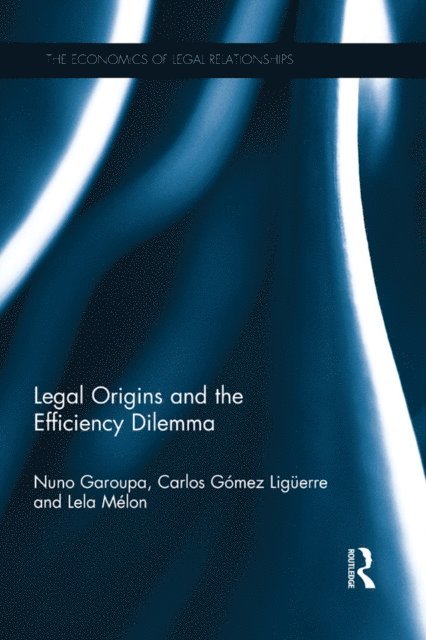
Economists advise that the law should seek efficiency. More recently, it has been suggested that common law systems are more conducive of economic growth than code-based civil law systems. This book argues that there is no theory to support such statements and provides evidence that rejects a ''one-size-fits-all'' approach. Both common law and civil law systems are reviewed to debunk the relationship between the efficiency of the common law hypothesis and the alleged inferiority of codified law systems.
Legal Origins and the Efficiency Dilemma has six aims: explaining the efficiency hypothesis of the common law since Posner’s 1973 book; summarizing the legal origins theory in the context of economic growth; debunking their relationship; discussing the meaning of ''common law'' and the problems with the efficiency hypothesis by comparing laws across English speaking jurisdictions; illustrating the shortcomings of the legal origins theory with a comparative law and economics analysis; and concluding there is no theory and evidence to support the economic superiority of common law systems. Based on previous pieces by the authors, this book expands their work by including new areas of analysis (such as trusts), detailing previous analysis (such as French law versus common law in the areas of contract, property and torts), and updating for recent developments in the academic discourse.
This volume is of interest to academics and students who study microeconomics, comparative law and foundations of law, as well as legal policy analysts.
758 kr
Läs direkt efter köp
Economists advise that the law should seek efficiency. More recently, it has been suggested that common law systems are more conducive of economic growth than code-based civil law systems. This book argues that there is no theory to support such statements and provides evidence that rejects a ''one-size-fits-all'' approach. Both common law and civil law systems are reviewed to debunk the relationship between the efficiency of the common law hypothesis and the alleged inferiority of codified law systems.
Legal Origins and the Efficiency Dilemma has six aims: explaining the efficiency hypothesis of the common law since Posner’s 1973 book; summarizing the legal origins theory in the context of economic growth; debunking their relationship; discussing the meaning of ''common law'' and the problems with the efficiency hypothesis by comparing laws across English speaking jurisdictions; illustrating the shortcomings of the legal origins theory with a comparative law and economics analysis; and concluding there is no theory and evidence to support the economic superiority of common law systems. Based on previous pieces by the authors, this book expands their work by including new areas of analysis (such as trusts), detailing previous analysis (such as French law versus common law in the areas of contract, property and torts), and updating for recent developments in the academic discourse.
This volume is of interest to academics and students who study microeconomics, comparative law and foundations of law, as well as legal policy analysts.