Leonardo Pasquali - Böcker
Visar alla böcker från författaren Leonardo Pasquali. Handla med fri frakt och snabb leverans.
3 produkter
3 produkter
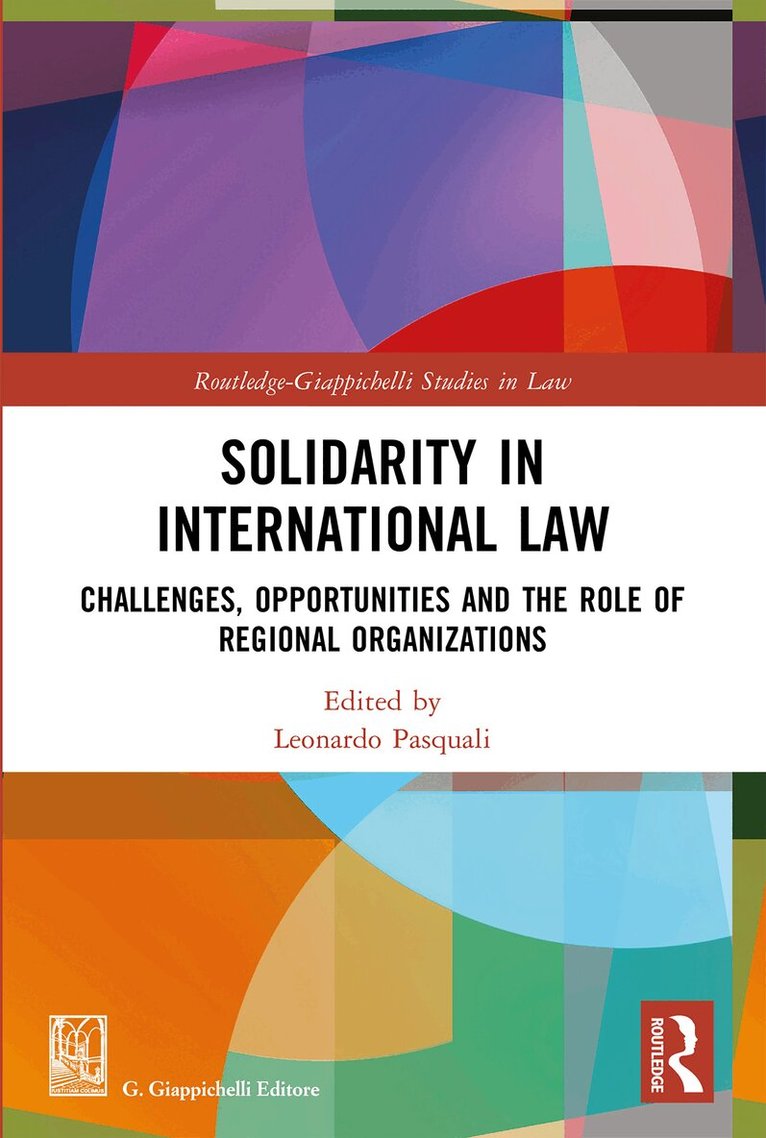
Solidarity in International Law
Challenges, Opportunities and The Role of Regional Organizations
Inbunden, Engelska, 2022
1 894 kr
Skickas inom 10-15 vardagar
The principle of solidarity is particularly important now because it is in juxtaposition to some current self-centered trends in politics: the crises that have upset the world in recent years, such as migrations, hegemonic aspirations, pandemics, and wars, have made self-evident the inadequacy of such selfish politics. It therefore seems very useful to understand the role that solidarity could play in contemporary scenarios. This book thus collects various contributions on the principle of solidarity in international law. Firstly, it reconstructs the foundations of solidarity in law and investigates the origins of the principle. Subsequently, it tries to ascertain if solidarity exists as a principle in international law and, if so, what its scope is. The book then examines the eventual implementation of the principle of solidarity in regional organizations law: the question is whether solidarity is more effective and if it is actually better fulfilled when relationships between states get stronger, such as in regional and sub-regional organizations. Such implementation is notable in EU Law, but the analysis also involves other regional and sub-regional organizations, namely the African Union, ECOWAS, the League of Arab States, and MERCOSUR. This book takes into account not only some distinctive areas of solidarity, such as migration law, or specific institutional contexts where solidarity is a declared principle, objective or value, for example, the European Union, but it also considers whether, and to what extent, the manifestations of solidarity differ in disparate settings, trying to discover the reasons behind such divergences. The book will be of interest to researchers and academics in the areas of International Law, International Organizations Law, European Law, Human Rights Law, Business Law, and Constitutional Law.
Solidarity in International Law
Challenges, Opportunities and The Role of Regional Organizations
Häftad, Engelska, 2024
527 kr
Skickas inom 10-15 vardagar
The principle of solidarity is particularly important now because it is in juxtaposition to some current self-centered trends in politics: the crises that have upset the world in recent years, such as migrations, hegemonic aspirations, pandemics, and wars, have made self-evident the inadequacy of such selfish politics. It therefore seems very useful to understand the role that solidarity could play in contemporary scenarios. This book thus collects various contributions on the principle of solidarity in international law. Firstly, it reconstructs the foundations of solidarity in law and investigates the origins of the principle. Subsequently, it tries to ascertain if solidarity exists as a principle in international law and, if so, what its scope is. The book then examines the eventual implementation of the principle of solidarity in regional organizations law: the question is whether solidarity is more effective and if it is actually better fulfilled when relationships between states get stronger, such as in regional and sub-regional organizations. Such implementation is notable in EU Law, but the analysis also involves other regional and sub-regional organizations, namely the African Union, ECOWAS, the League of Arab States, and MERCOSUR. This book takes into account not only some distinctive areas of solidarity, such as migration law, or specific institutional contexts where solidarity is a declared principle, objective or value, for example, the European Union, but it also considers whether, and to what extent, the manifestations of solidarity differ in disparate settings, trying to discover the reasons behind such divergences. The book will be of interest to researchers and academics in the areas of International Law, International Organizations Law, European Law, Human Rights Law, Business Law, and Constitutional Law.
EU Values and International Law
How the EU Upholds and Promotes its Values in the Wider World through its International Agreements
Inbunden, Engelska, 2026
2 495 kr
Kommande
This book provides an in-depth and timely analysis of a relevant and controversial issue: the relationship between European Union values and international law. It examines whether and to what extent the EU succeeds in influencing international law by upholding and promoting its values (listed in Article 2 of the Treaty on European Union) globally, as explicitly provided for in Article 3(5) and in Article 21 of the Treaty on European Union, through its international agreements. In particular, the book focuses on the free trade agreements concluded by the Union with States and other regional organisations. The reason for this choice is based on the assumption that this is the area where the EU can make the most effective use of its soft power, which derives from its commercial strength and namely from the attractiveness of the access to its internal market. What makes this volume unique is its approach to the topic, tracing the historical and philosophical foundations of European values, both from a historical perspective and through comparative legal analysis. This solid foundation enables the reader to gain an in-depth understanding of the values that the Union seeks to promote in the wider world. Thus, the analysis looks at how selected core values—such as democracy and the rule of law, peace and security, human rights and minority protection, sustainable development, data protection, dispute settlement, and respect for international law—are incorporated and promoted through EU free trade agreements. It investigates both the impact of individual agreements on the domestic legal orders of partner States and the cumulative effect of EU FTAs on the broader development of international law, questioning whether they contribute to shaping a rules-based multilateral order aligned with EU normative commitment. This reflection is particularly relevant and necessary in today's international context, which is marked by crises that challenge the very notion of a global order based on common principles and values.This book offers a valuable resource for practitioners and academics, particularly those interested in international law, EU law, international trade law, as well as history of law, constitutional law, comparative law and international relations. In addition, the book contains policy recommendations, which makes it particularly useful for decision-makers and policy advisors.