Lewandowska-Tomaszczyk Barbara Lewandowska-Tomaszczyk – författare
Visar alla böcker från författaren Lewandowska-Tomaszczyk Barbara Lewandowska-Tomaszczyk. Handla med fri frakt och snabb leverans.
15 produkter
15 produkter
E-bok
Engelska, 2017953 kr
Läs direkt efter köp
E-bok
Engelska, 2016944 kr
Läs direkt efter köp
E-bok
PDF, Engelska, 2020718 kr
Läs direkt efter köp
718 kr
Läs direkt efter köp
E-bok
PDF, Engelska, 20121 321 kr
Läs direkt efter köp
E-bok
PDF, Engelska, 2014910 kr
Läs direkt efter köp
E-bok
PDF, Engelska, 2017944 kr
Läs direkt efter köp
E-bok
PDF, Engelska, 2016910 kr
Läs direkt efter köp
E-bok
PDF, Engelska, 2016944 kr
Läs direkt efter köp
E-bok
Engelska, 2016910 kr
Läs direkt efter köp
E-bok
Engelska, 2014910 kr
Läs direkt efter köp
E-bok
Engelska, 20221 305 kr
Läs direkt efter köp
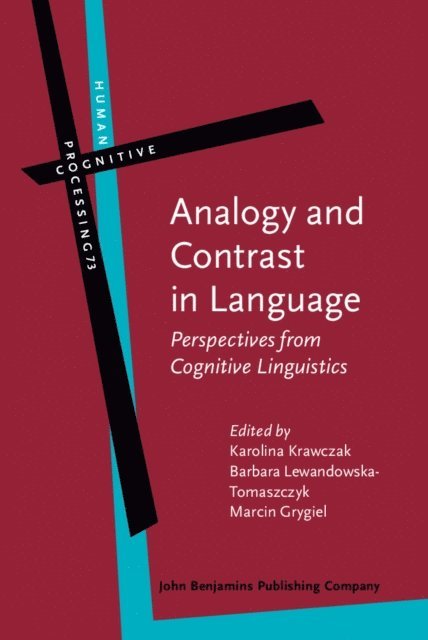
Within cognitive and functional approaches to language structure and grammaticality, analogy and contrast represent two fundamental human cognitive capacities, which, up to now, have mostly been examined separately. This volume seeks to bridge that gap and in doing so it brings together cutting-edge theoretical and empirical research in the field. The chapters in this book examine analogy and contrast across a variety of languages (English, Finnish, Hungarian, Polish, Russian), for different language phenomena (constructions, lexical semantics, morphology, sentence structure, text organization), and with the use of various methods (corpus linguistics, discourse analysis, experimental methods, qualitative analysis, quantitative analysis). This state-of-the-art research presented in the book should be of interest to specialists within Cognitive Linguistics, corpus linguistics, construction grammar, discourse analysis, translation studies, metaphor research, and cross-cultural research.
E-bok
PDF, Engelska, 20161 258 kr
Läs direkt efter köp
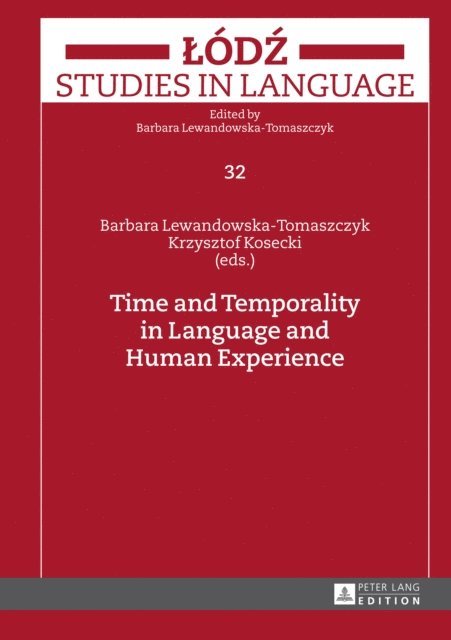
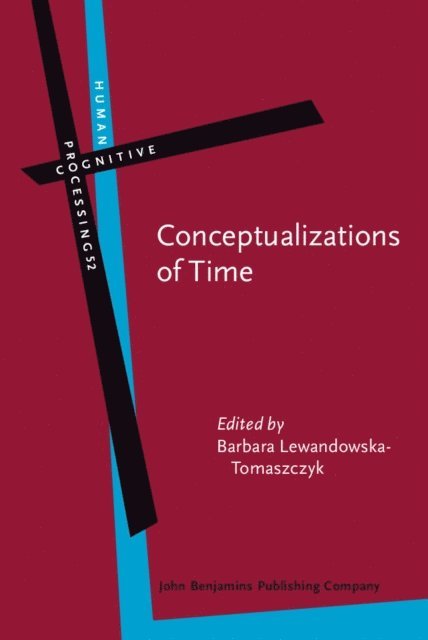
As time cannot be observed directly, it must be analyzed in terms of mental categories, which manifest themselves on various linguistic levels. In this interdisciplinary volume, novel approaches to time are proposed that consider temporality without time, on the one hand, and the coding of time in language, including sign language, and gestures, on the other. The contributions of the volume demonstrate that time is conceptualized not only in terms of space but in terms of other domains of human experience as well. Renowned specialists in the study of time, the authors of this volume investigate this fascinating topic from a variety of perspectives – philosophical, linguistic, anthropological, (neuro)psychological, and computational – demonstrating a familiarity with both classical and recent approaches to the study of time and including up-to-date corpus-based methods of study.The volume will be of interest to philosophers, linguists (including specialists in cognitive linguistics, corpus linguistics, and computational linguistics), anthropologists, (neuro)psychologists, translators, language teachers, and graduate students.
E-bok
PDF, Engelska, 19902 107 kr
Läs direkt efter köp
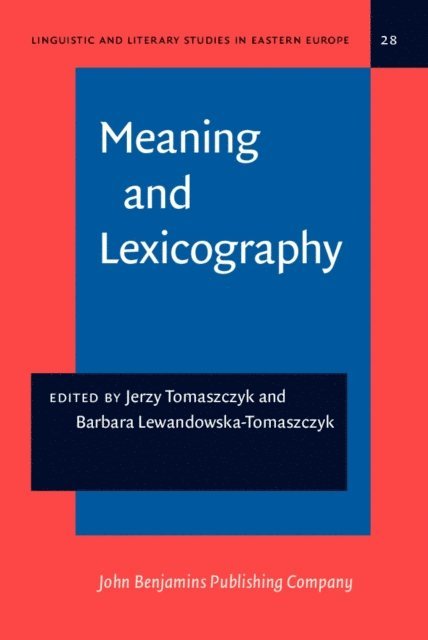
While lexicology, lexical semantics, and lexicography all share an interest in lexical items, they often tend to be regarded as three separate albeit interrelated fields. Indeed, the extent to which the interrelationship is recognized and taken into account in lexicographic practice is the moot point. The conference which produced the papers offered in this volume was designed to bring their practioners together and thus gives an impetus to closer cooperation among them, It is the editors'' conviction that the practical activity of lexicography should learn more from its sister fields. People working in lexicography, lexical semantics, etc. may find some of the insights arrived at in the more practically oriented descriptions pertinent and useful.
E-bok
PDF, Engelska, 20081 384 kr
Läs direkt efter köp
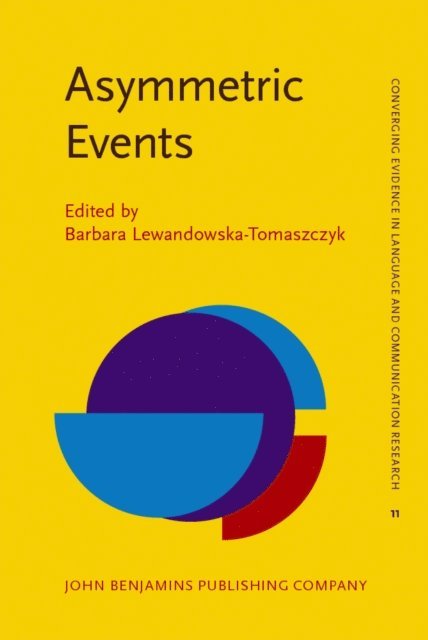
The book introduces the concept of asymmetric events, an important concept in language and cognition, which, for the first time in linguistic literature, is identified in a more systematic way and analyzed in a number of different languages, including typologically or genetically unrelated ones. Asymmetric events are two or more events of unequal status in an utterance and papers in the volume present ways in which a linguistic description of main events in a sentence is different (morphologically, syntactically, discursively) from a description of backgrounded events. The prototypical asymmetries involving perception, cognition, and language are identified in subordination, nominalization and modification of various kinds but they extend to coordinate structures, serial verbs, spatial language and viewing arrangement, as well as part - whole relations. The perspective is broadly cognitive and functional, the authors use different though complementing methodologies, some include corpus data, and the asymmetries are shown to have a variety of stylistic and ideological implications.An in-depth analysis of manifold asymmetries in structure and function of diverse languages makes this volume of interest to linguists of different persuasion, philosophers, cognitive researchers, discourse analysts and students of language and cognition.