Lisette Schuitemaker – författare
Visar alla böcker från författaren Lisette Schuitemaker. Handla med fri frakt och snabb leverans.
6 produkter
6 produkter
Häftad, Engelska
369 kr
Skickas inom 3-6 vardagar
E-bok
Engelska, 2019102 kr
Läs direkt efter köp
An exploration of the self-fulfilling lives of people who, by chance or choice, have no children of their own • Investigates the life choices people make around having children and alternate ways of finding purpose in life • Based on a global survey and more than 50 in-depth interviews with childless and childfree women and men aged 19 to 91 from different cultures and walks of life • Enables readers to place their own circumstances in a larger context as they gain insight in the worldwide trend of people who lead a self-fulfilling, childless life Not having children is on the rise in many countries across the globe. August 1st has been named International Childfree Day, with a Childfree Woman and Man of the Year Award. Yet being childless is a subject not much talked about--the focus tends to be on having families and raising children, in rural, town, or city life. Let’s talk about not having children, about what people like us do with our time, about how we spend our money, and--most of all--how we find purpose and fulfilment in our lives. Never attracted to family life herself, Lisette Schuitemaker began openly discussing why people didn’t have children and how that was for them, resulting in intimate conversations with childless women and men and surprising insights. Inspired to delve further, she interviewed non-parenting people aged 19 to 91 across the globe. She found that no story was like the other and that many had been waiting to be listened to with sensitivity. She heard stories across the spectrum, from exhilarating to painful, from people still on the fence to the childfree who have always known starting a family was not for them. Complementing her interview findings with a worldwide survey and recent research, the author paints a rich picture of the individual lives of childless and childfree women and men. This book is for everyone who has not gone the way of parenthood, who has close family or friends who lead self-directed lives without offspring, and for all those who are still contemplating this essential life choice. The stories in this book also testify that not having children of your own in no way means the joys (and trials) of children pass you by altogether. This book shows that it is ok to celebrate not only the parenting way of life and the children who come to those who love them, but also those who are brave enough to follow the lesser known path of non-parenting.
Ljudbok
Engelska, 2019277 kr
Lyssna direkt efter köp
An exploration of the self-fulfilling lives of people who, by chance or choice, have no children of their own • Investigates the life choices people make around having children and alternate ways of finding purpose in life • Based on a global survey and more than 50 in-depth interviews with childless and childfree women and men aged 19 to 91 from different cultures and walks of life • Enables readers to place their own circumstances in a larger context as they gain insight in the worldwide trend of people who lead a self-fulfilling, childless life Not having children is on the rise in many countries across the globe. August 1st has been named International Childfree Day, with a Childfree Woman and Man of the Year Award. Yet being childless is a subject not much talked about--the focus tends to be on having families and raising children, in rural, town, or city life. Let’s talk about not having children, about what people like us do with our time, about how we spend our money, and--most of all--how we find purpose and fulfilment in our lives. Never attracted to family life herself, Lisette Schuitemaker began openly discussing why people didn’t have children and how that was for them, resulting in intimate conversations with childless women and men and surprising insights. Inspired to delve further, she interviewed non-parenting people aged 19 to 91 across the globe. She found that no story was like the other and that many had been waiting to be listened to with sensitivity. She heard stories across the spectrum, from exhilarating to painful, from people still on the fence to the childfree who have always known starting a family was not for them. Complementing her interview findings with a worldwide survey and recent research, the author paints a rich picture of the individual lives of childless and childfree women and men. This book is for everyone who has not gone the way of parenthood, who has close family or friends who lead self-directed lives without offspring, and for all those who are still contemplating this essential life choice. The stories in this book also testify that not having children of your own in no way means the joys (and trials) of children pass you by altogether. This book shows that it is ok to celebrate not only the parenting way of life and the children who come to those who love them, but also those who are brave enough to follow the lesser known path of non-parenting.
Ljudbok
Engelska, 2019243 kr
Lyssna direkt efter köp
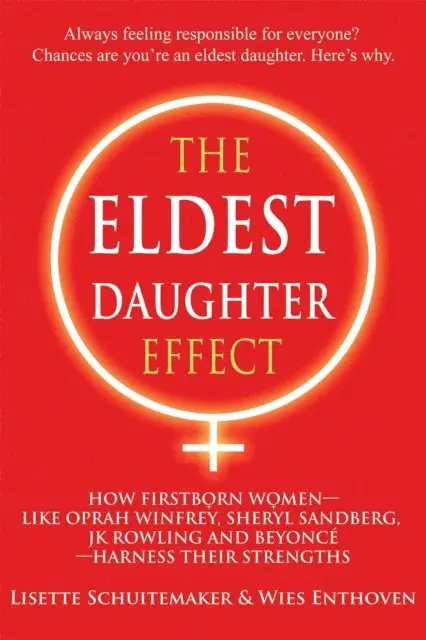
"What do Angela Merkel, Hillary Rodham Clinton, Christine Lagarde, Oprah Winfrey, Sheryl Sandberg, JK Rowling and Beyoncé have in common?" was the headline in the English newspaper The Observer in 2014. "Other than riding high in Forbes list of the world’s most powerful women," journalist Tracy McVeigh wrote in answer to her own question, "they are also all firstborn children in their families. Firstborn children really do excel." So what does it mean to be an eldest daughter? Firstborns Lisette Schuitemaker and Wies Enthoven set out to discover the big five qualities that characterize all eldest daughters to some degree. Eldest daughters are responsible, dutiful, thoughtful, expeditious and caring. Firstborns are more intelligent than their siblings, more proficient verbally and more motivated to perform. Yet at the same time they seriously doubt that they are good enough. Being an eldest daughter can have certain advantages, but the overbearing sense of responsibility often gets in the way. Parents may worry about their ‘difficult’ eldest girl who wants to be perfect in everything she does whilst her siblings may not always understand her. "The Eldest Daughter Effect" shows how firstborn girls become who they are and offers insights that can give them more freedom to move. And parents will gain a better understanding of their firstborn children and can support them more fully on their way.
E-bok
Engelska, 2017102 kr
Läs direkt efter köp
Reading this book, you get the sense that Lisette Schuitemaker sees right through you. As if she knows that you gorge on chocolate at times, that you go crazy if people know something you don’t, that you are bound to hit the slow cashier one day. Or that in truth you’re not here at all with your thoughts. And how ardently you hope that one day someone will truly love you the way you are. You, me, all of us have drawn some conclusions in our childhood: impressions we got as a young child and the conclusions we jumped to about ourselves, the world and our place in it. These childhood conclusions still produce habitual thoughts that mark our behaviors. “Why didn’t I know this before and why don’t we all know this?’ were the questions that prompted the author to share her insights. Illustrated with examples from her private practice she shows how childhood conclusions are at work in all of us--and how we can turn them around into a positive outlook on ourselves and others. The five childhood conclusions tell you exactly what you think about yourself. And how you could think differently. And gain so much more freedom for living your life. This book is for anyone who is curious where their habitual thoughts arise from.
E-bok
Engelska, 2016102 kr
Läs direkt efter köp
"What do Angela Merkel, Hillary Rodham Clinton, Christine Lagarde, Oprah Winfrey, Sheryl Sandberg, JK Rowling and Beyoncé have in common?" was the headline in the English newspaper The Observer in 2014. "Other than riding high in Forbes list of the world’s most powerful women," journalist Tracy McVeigh wrote in answer to her own question, "they are also all firstborn children in their families. Firstborn children really do excel." So what does it mean to be an eldest daughter? Firstborns Lisette Schuitemaker and Wies Enthoven set out to discover the big five qualities that characterize all eldest daughters to some degree. Eldest daughters are responsible, dutiful, thoughtful, expeditious and caring. Firstborns are more intelligent than their siblings, more proficient verbally and more motivated to perform. Yet at the same time they seriously doubt that they are good enough. Being an eldest daughter can have certain advantages, but the overbearing sense of responsibility often gets in the way. Parents may worry about their ‘difficult’ eldest girl who wants to be perfect in everything she does whilst her siblings may not always understand her. "The Eldest Daughter Effect" shows how firstborn girls become who they are and offers insights that can give them more freedom to move. And parents will gain a better understanding of their firstborn children and can support them more fully on their way.