Liviu I. Nicolaescu - Böcker
Visar alla böcker från författaren Liviu I. Nicolaescu. Handla med fri frakt och snabb leverans.
10 produkter
10 produkter
Del 30 - De Gruyter Studies in Mathematics
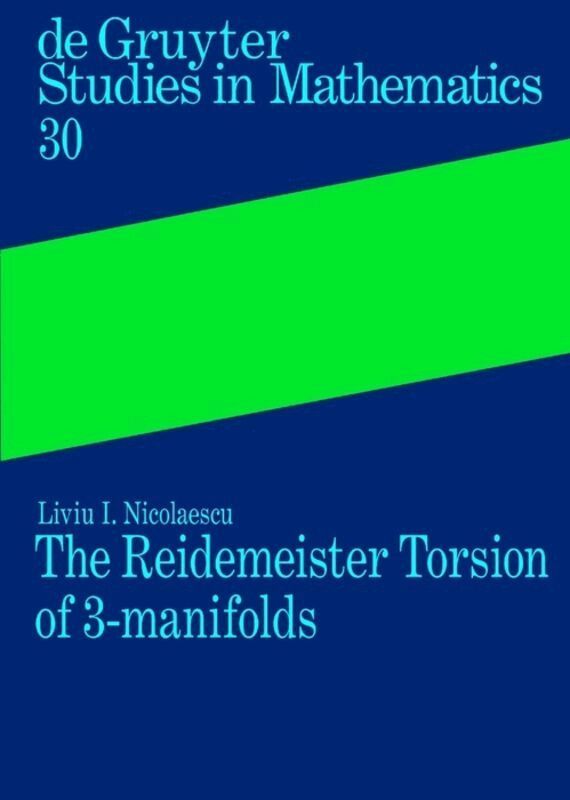
Reidemeister Torsion of 3-Manifolds
Inbunden, Engelska, 2003
2 547 kr
Skickas inom 5-8 vardagar
This is a state-of-the-art introduction to the work of Franz Reidemeister, Meng Taubes, Turaev, and the author on the concept of torsion and its generalizations. Torsion is the oldest topological (but not with respect to homotopy) invariant that in its almost eight decades of existence has been at the center of many important and surprising discoveries. During the past decade, in the work of Vladimir Turaev, new points of view have emerged, which turned out to be the "right ones" as far as gauge theory is concerned.The book features mostly the new aspects of this venerable concept. The theoretical foundations of this subject are presented in a style accessible to those, who wish to learn and understand the main ideas of the theory. Particular emphasis is upon the many and rather diverse concrete examples and techniques which capture the subleties of the theory better than any abstract general result. Many of these examples and techniques never appeared in print before, and their choice is often justified by ongoing current research on the topology of surface singularities.The text is addressed to mathematicians with geometric interests who want to become comfortable users of this versatile invariant.
1 223 kr
Skickas inom 5-8 vardagar
The object of this book is to introduce the reader to some of the most important techniques of modern global geometry. In writing it we had in mind the beginning graduate student willing to specialize in this very challenging field of mathematics. The necessary prerequisite is a good knowledge of the calculus with several variables, linear algebra and some elementary point-set topology.We tried to address several issues. 1. The Language; 2. The Problems; 3. The Methods; 4. The Answers.Historically, the problems came first, then came the methods and the language while the answers came last. The space constraints forced us to change this order and we had to painfully restrict our selection of topics to be covered. This process always involves a loss of intuition and we tried to balance this by offering as many examples and pictures as often as possible. We test most of our results and techniques on two basic classes examples: surfaces (which can be easily visualized) and Lie groups (which can be elegantly algebraized). When possible we present several facets of the same issue.We believe that a good familiarity with the formalism of differential geometry is absolutely necessary in understanding and solving concrete problems and this is why we presented it in some detail. Every new concept is supported by concrete examples interesting not only from an academic point of view.Our interest is mainly in global questions and in particular the interdependencegeometry ↔ topology, local ↔ global.We had to develop many algebraico-topological techniques in the special context of smooth manifolds. We spent a big portion of this book discussing the DeRham cohomology and its ramifications: Poincaré duality, intersection theory, degree theory, Thom isomorphism, characteristic classes, Gauss-Bonnet etc. We tried to calculate the cohomology groups of as many as possible concrete examples and we had to do this without relying on the powerful apparatus of homotopy theory (CW-complexes etc.). Some of the proofs are not the most direct ones but the means are sometimes more interesting than the ends. For example in computing the cohomology of complex grassmannians we returned to classical invariant theory and used some brilliant but unadvertised old ideas.In the last part of the book we discuss elliptic partial differential equations. This requires a familiarity with functional analysis. We painstakingly described the proofs of elliptic Lp and Hölder estimates (assuming some deep results of harmonic analysis) for arbitrary elliptic operators with smooth coefficients. It is not a “light meal” but the ideas are useful in a large number of instances. We present a few applications of these techniques (Hodge theory, uniformization theorem). We conclude with a close look to a very important class of elliptic operators namely the Dirac operators. We discuss their algebraic structure in some detail, Weizenböck formulæ and many concrete examples.
2 160 kr
Skickas inom 3-6 vardagar
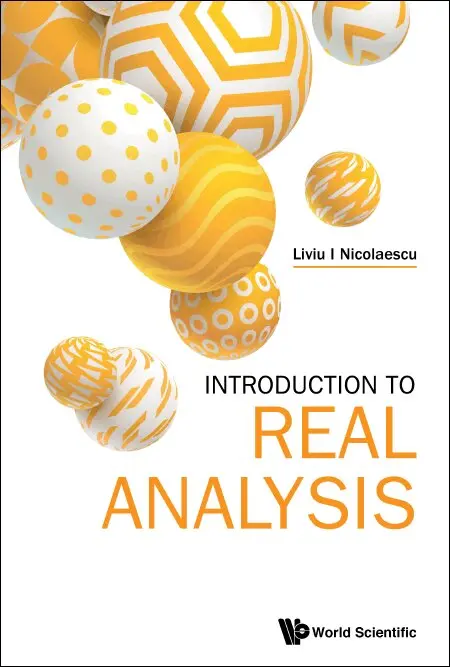
This is a text that develops calculus "from scratch", with complete rigorous arguments. Its aim is to introduce the reader not only to the basic facts about calculus but, as importantly, to mathematical reasoning. It covers in great detail calculus of one variable and multivariable calculus. Additionally it offers a basic introduction to the topology of Euclidean space. It is intended to more advanced or highly motivated undergraduates.
1 055 kr
Skickas inom 5-8 vardagar
This is a text that develops calculus "from scratch", with complete rigorous arguments. Its aim is to introduce the reader not only to the basic facts about calculus but, as importantly, to mathematical reasoning. It covers in great detail calculus of one variable and multivariable calculus. Additionally it offers a basic introduction to the topology of Euclidean space. It is intended to more advanced or highly motivated undergraduates.
2 686 kr
Skickas inom 3-6 vardagar
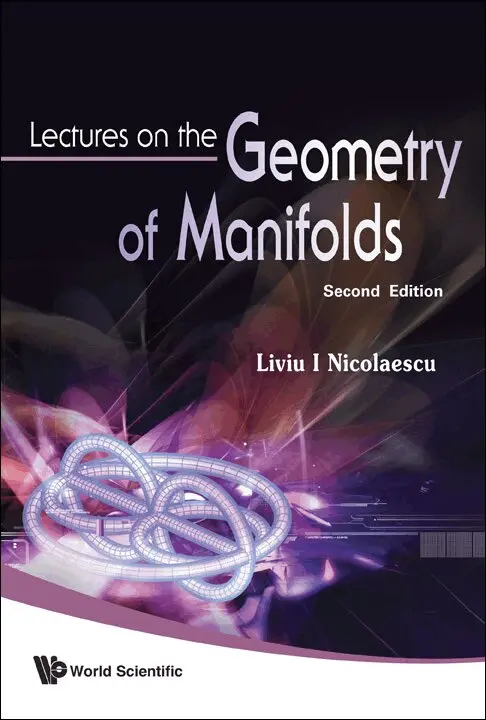
The goal of this book is to introduce the reader to some of the main techniques, ideas and concepts frequently used in modern geometry. It starts from scratch and it covers basic topics such as differential and integral calculus on manifolds, connections on vector bundles and their curvatures, basic Riemannian geometry, calculus of variations, DeRham cohomology, integral geometry (tube and Crofton formulas), characteristic classes, elliptic equations on manifolds and Dirac operators. The new edition contains a new chapter on spectral geometry presenting recent results which appear here for the first time in printed form.
1 227 kr
Skickas
The goal of this book is to introduce the reader to some of the main techniques, ideas and concepts frequently used in modern geometry. It starts from scratch and it covers basic topics such as differential and integral calculus on manifolds, connections on vector bundles and their curvatures, basic Riemannian geometry, calculus of variations, DeRham cohomology, integral geometry (tube and Crofton formulas), characteristic classes, elliptic equations on manifolds and Dirac operators. The new edition contains a new chapter on spectral geometry presenting recent results which appear here for the first time in printed form.
2 028 kr
Skickas inom 3-6 vardagar
This book grew out of the notes for a one-semester basic graduate course in probability. As the title suggests, it is meant to be an introduction to probability and could serve as textbook for a year long text for a basic graduate course. It assumes some familiarity with measure theory and integration so in this book we emphasize only those aspects of measure theory that have special probabilistic uses.The book covers the topics that are part of the culture of an aspiring probabilist and it is guided by the author's personal belief that probability was and is a theory driven by examples. The examples form the main attraction of this subject. For this reason, a large book is devoted to an eclectic collection of examples, from classical to modern, from mainstream to "exotic". The text is complemented by nearly 200 exercises, quite a few nontrivial, but all meant to enhance comprehension and enlarge the reader's horizons.While teaching probability both at undergraduate and graduate level the author discovered the revealing power of simulations. For this reason, the book contains a veiled invitation to the reader to familiarize with the programing language R. In the appendix, there are a few of the most frequently used operations and the text is sprinkled with (less than optimal) R codes. Nowadays one can do on a laptop simulations and computations we could only dream as an undergraduate in the past. This is a book written by a probability outsider. That brings along a bit of freshness together with certain "naiveties".
2 962 kr
Skickas inom 3-6 vardagar
The goal of this book is to introduce the reader to some of the most frequently used techniques in modern global geometry. Suited to the beginning graduate student willing to specialize in this very challenging field, the necessary prerequisite is a good knowledge of several variables calculus, linear algebra and point-set topology.The book's guiding philosophy is, in the words of Newton, that “in learning the sciences examples are of more use than precepts”. We support all the new concepts by examples and, whenever possible, we tried to present several facets of the same issue.While we present most of the local aspects of classical differential geometry, the book has a “global and analytical bias”. We develop many algebraic-topological techniques in the special context of smooth manifolds such as Poincaré duality, Thom isomorphism, intersection theory, characteristic classes and the Gauss-Bonnet theorem.We devoted quite a substantial part of the book to describing the analytic techniques which have played an increasingly important role during the past decades. Thus, the last part of the book discusses elliptic equations, including elliptic Lpand Hölder estimates, Fredholm theory, spectral theory, Hodge theory, and applications of these. The last chapter is an in-depth investigation of a very special, but fundamental class of elliptic operators, namely, the Dirac type operators.The second edition has many new examples and exercises, and an entirely new chapter on classical integral geometry where we describe some mathematical gems which, undeservedly, seem to have disappeared from the contemporary mathematical limelight.
1 285 kr
Skickas inom 5-8 vardagar
The goal of this book is to introduce the reader to some of the most frequently used techniques in modern global geometry. Suited to the beginning graduate student willing to specialize in this very challenging field, the necessary prerequisite is a good knowledge of several variables calculus, linear algebra and point-set topology.The book's guiding philosophy is, in the words of Newton, that “in learning the sciences examples are of more use than precepts”. We support all the new concepts by examples and, whenever possible, we tried to present several facets of the same issue.While we present most of the local aspects of classical differential geometry, the book has a “global and analytical bias”. We develop many algebraic-topological techniques in the special context of smooth manifolds such as Poincaré duality, Thom isomorphism, intersection theory, characteristic classes and the Gauss-Bonnet theorem.We devoted quite a substantial part of the book to describing the analytic techniques which have played an increasingly important role during the past decades. Thus, the last part of the book discusses elliptic equations, including elliptic Lpand Hölder estimates, Fredholm theory, spectral theory, Hodge theory, and applications of these. The last chapter is an in-depth investigation of a very special, but fundamental class of elliptic operators, namely, the Dirac type operators.The second edition has many new examples and exercises, and an entirely new chapter on classical integral geometry where we describe some mathematical gems which, undeservedly, seem to have disappeared from the contemporary mathematical limelight.
844 kr
Skickas inom 3-6 vardagar
This book grew out of the notes for a one-semester basic graduate course in probability. As the title suggests, it is meant to be an introduction to probability and could serve as textbook for a year long text for a basic graduate course. It assumes some familiarity with measure theory and integration so in this book we emphasize only those aspects of measure theory that have special probabilistic uses.The book covers the topics that are part of the culture of an aspiring probabilist and it is guided by the author's personal belief that probability was and is a theory driven by examples. The examples form the main attraction of this subject. For this reason, a large book is devoted to an eclectic collection of examples, from classical to modern, from mainstream to "exotic". The text is complemented by nearly 200 exercises, quite a few nontrivial, but all meant to enhance comprehension and enlarge the reader's horizons.While teaching probability both at undergraduate and graduate level the author discovered the revealing power of simulations. For this reason, the book contains a veiled invitation to the reader to familiarize with the programing language R. In the appendix, there are a few of the most frequently used operations and the text is sprinkled with (less than optimal) R codes. Nowadays one can do on a laptop simulations and computations we could only dream as an undergraduate in the past. This is a book written by a probability outsider. That brings along a bit of freshness together with certain "naiveties".