M. Grosser – författare
Visar alla böcker från författaren M. Grosser. Handla med fri frakt och snabb leverans.
7 produkter
7 produkter
Inbunden, Engelska, 2001
1 082 kr
Skickas inom 10-15 vardagar
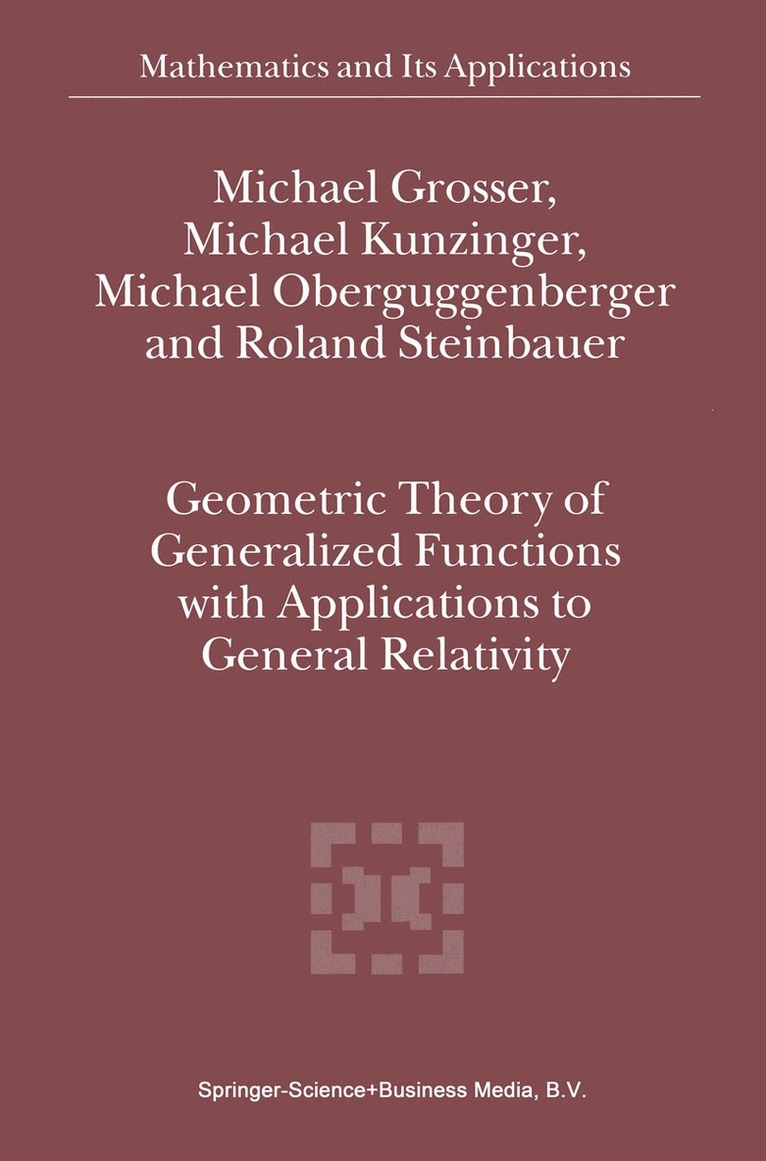
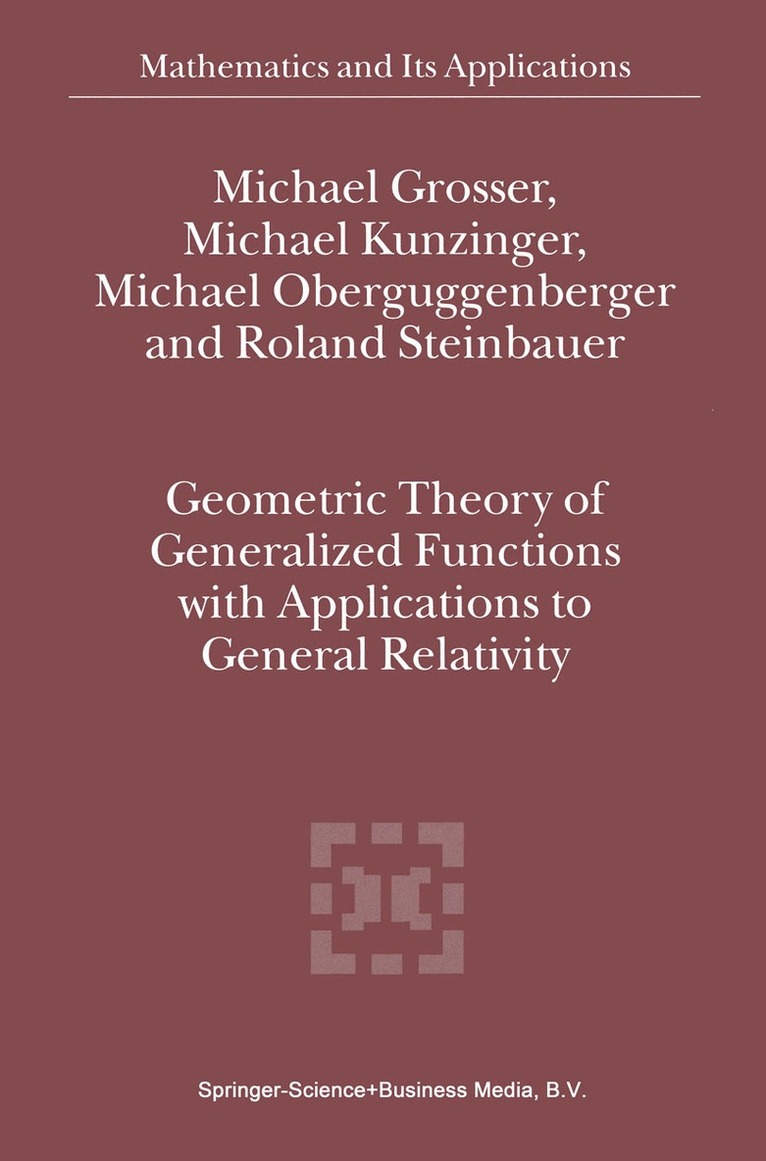
This work provides a comprehensive introduction to the non-linear theory of generalized functions (in the sense of Colombeau's construction) on differentiable manifolds. Particular emphasis is laid on a diffeomorphism invariant geometric approach to embedding the space of Schwartz distributions into algebras of generalized functions. The foundations of a "non-linear distributional geometry" are developed, supplying a solid base for an increasing number of applications of algebras of generalized functions to questions of a primarily geometric mature, in particular in mathematical physics. Applications of the resulting theory to symmetry-group analysis of differential equations and the theory of general relativity are presented in separate chapters. These features distinguish the present volume from earlier introductory texts and monographs on the subject.
E-bok
PDF, Tyska, 2019398 kr
Läs direkt efter köp
Del 717 - Lecture Notes in Mathematics
Bidualräume und Vervollständigungen von Banachmoduln
Häftad, Tyska, 1979
358 kr
Skickas inom 10-15 vardagar
E-bok
PDF, Tyska, 2006306 kr
Läs direkt efter köp
Del 12 - Quellen Und Forschungen Zur Agrargeschichte
Anleitung Zu Der Landwirtschaft. Oeconomia
Zwei Frühe Deutsche Landwirtschaftsschriften
Inbunden, Tyska, 1965
459 kr
Skickas inom 5-8 vardagar
Häftad, Engelska, 2010
1 082 kr
Skickas inom 10-15 vardagar
This work provides the first comprehensive introduction to the nonlinear theory of generalized functions (in the sense of Colombeau's construction) on differentiable manifolds. Particular emphasis is laid on a diffeomorphism invariant geometric approach to embedding the space of Schwartz distributions into algebras of generalized functions. The foundations of a 'nonlinear distributional geometry' are developed, supplying a solid base for an increasing number of applications of algebras of generalized functions to questions of a primarily geometric mature, in particular in mathematical physics. Applications of the resulting theory to symmetry group analysis of differential equations and the theory of general relativity are presented in separate chapters. These features distinguish the present volume from earlier introductory texts and monographs on the subject. Audience: The book will be of interest to graduate students as well as to researchers in functional analysis, partial differential equations, differential geometry, and mathematical physics.
E-bok
PDF, Engelska, 20131 367 kr
Läs direkt efter köp
Over the past few years a certain shift of focus within the theory of algebras of generalized functions (in the sense of J. F. Colombeau) has taken place. Originating in infinite dimensional analysis and initially applied mainly to problems in nonlinear partial differential equations involving singularities, the theory has undergone a change both in in ternal structure and scope of applicability, due to a growing number of applications to questions of a more geometric nature. The present book is intended to provide an in-depth presentation of these develop ments comprising its structural aspects within the theory of generalized functions as well as a (selective but, as we hope, representative) set of applications. This main purpose of the book is accompanied by a number of sub ordinate goals which we were aiming at when arranging the material included here. First, despite the fact that by now several excellent mono graphs on Colombeau algebras are available, we have decided to give a self-contained introduction to the field in Chapter 1. Our motivation for this decision derives from two main features of our approach. On the one hand, in contrast to other treatments of the subject we base our intro duction to the field on the so-called special variant of the algebras, which makes many of the fundamental ideas of the field particularly transpar ent and at the same time facilitates and motivates the introduction of the more involved concepts treated later in the chapter.