
M. L. Bose – författare
Visar alla böcker från författaren . Handla med fri frakt och snabb leverans.
2 produkter
2 produkter
E-bok
Engelska, 2010460 kr
Läs direkt efter köp
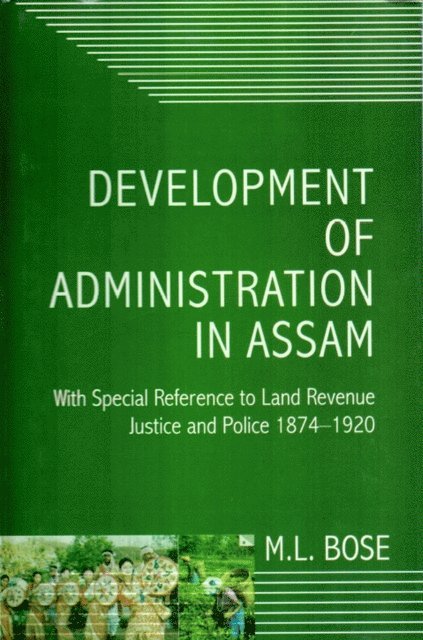
The Development of Administration in Assam between 1874-1920 is a significant study in the growth of government in the smallest north-eastern state of India. This province was tagged along with the Bengal Government in 1826 after the first Anglo-Burmese War; it contained in its territory the present constituents of the North Eastern Council barring Tripura. The province was the habitat of many colourful but most primitive tribes around highly developed populations on the two river valleys of the Brahmaputra and the Barak. Though the people in the valleys were culturally more advanced than those on the surrounding hills they belonged to distinct linguistic communities, tribes and sub-tribes which numbered not less than a thousand and spoke separate dialects. The topography and climatic conditions varied as much as did the kaleidoscopic tribes. It presented a microscopic view of the Indian civilisation the most distinctive feature of which is unity in variety. The problem of administraion of such a remote and heterogeneous population spread over inacessible hills untrodden by educated people tribes who did not know what government was in modern political society, can be easily understood by students of political science. The British conquered without any knowledge of the territory and the people grappled with the problem of administration over almost a hundred years and beginning with a rough and ready Non-regulation system gradually brought the people under their government and made them know what was administration and law in the modern world. The impact of government on the people is outside the scope of this work. But it shows the introduction of British administration over the entire length and breadth of the province. In 1920 the province was made fit for an advanced type of Regulation Government. The Chelmsford Reforms Committee recommended the formation of Governor''s province in this North Eastern part of the Indian Empire.
E-bok
Engelska, 20182 888 kr
Läs direkt efter köp
Gandhi was born on October 2, 1869, at Porbandar. Mohandas or Mohan was youngest of the three sons of Putlibai and Karamchand Gandhi. Gandhi was shot to death in Delhi in January 1948 by a Hindu fundamentalist. In January 1948, Gandhi carried out yet another fast, this time to bring about peace in the city of Delhi. On January 30, 12 days after that fast ended, Gandhi was on his way to an evening prayer meeting in Delhi when he was shot to death by Nathuram Godse, a Hindu fanatic enraged by Mahatma''s efforts to negotiate with Jinnah and other Muslims. The next day, roughly 1 million people followed the procession as Gandhi''s body was carried in state and cremated on the banks of the holy Yamuna River.