M. Lesieur – författare
Visar alla böcker från författaren M. Lesieur. Handla med fri frakt och snabb leverans.
4 produkter
4 produkter
Inbunden, Engelska, 2005
1 785 kr
Skickas inom 7-10 vardagar
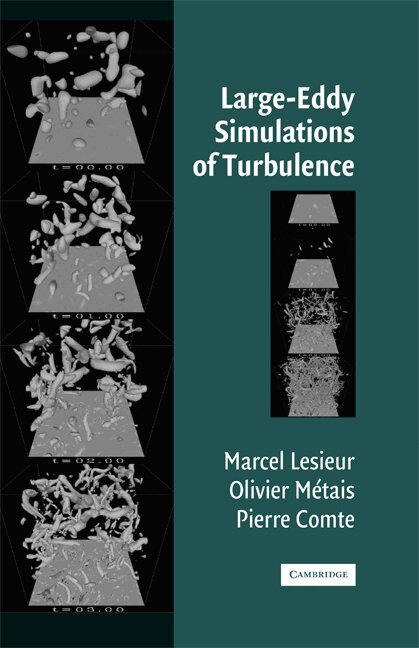
Large-Eddy Simulations of Turbulence is an ideal introduction for people new to LES [large-eddy simulation], direct numerical simulation and Reynolds-averaged Navier-Stokes simulation, and as a reference for researchers. Of particular interest in the text are the detailed discussion, in Chapter 2, of vorticity, pressure, and the velocity gradient tensor, quantities useful for probing the results of a simulation, particularly when looking for coherent vortices and coherent structures. Chapters 4 and 5 feature an in-depth discussion of spectral subgrid-scale modeling. Although physical-space models are generally more readily applied, spectral models give insight into the requirements and limitations in subgrid-scale modeling and backscattering. A third special feature is the detailed discussion in Chapter 7, of large-eddy simulation of compressible flows previously only available in articles scattered throughout the literature. This will be of interest to those dealing with supersonic flows, combustion, astrophysics, and other related topics.
Inbunden, Engelska, 2002
2 174 kr
Skickas inom 10-15 vardagar
The phenomenon of turbulence in fluid mechanics has been known for many centuries. Indeed, it was for instance discussed by the Latin poet Lucretius who described in "de natura rerum" how a small perturbation ("clinamen") could be at the origin of the development of a turbulent order in an initially laminar river made of randomly agitated atoms. More recently, Leonardo da Vinci drew vortices. Analogous vortices were sketched by the Japonese school of artists called Utagawa in the 19th century, which certainly influenced van Gogh in "The Starry Night". However, and notwithstanding decisive contributions made by Benard, Reynolds, Prandtl, von Karman, Richardson and Kolmogorov, the problem is still wide open: there is no exact derivation of the famous so called Kolmogorov k 5'3 cascade towards small scales, nor of the value of the transitional Reynolds number for turbulence in a pipe. Besides these fundamental aspects, turbulence is associated with essential practical questions in hydraulics, aerodynamics (drag reduction for cars, trains and planes), combustion (improvement of engine efficiency and pollution reduction), acoustics (the reduction of turbulence induced noise is an essential issue for plane reactors), environmental and climate studies (remember the huge damage caused by severe storms in Europe at the end of 1999), and astrophysics (Jupiter's Great Red Spot and solar granulation are manifestations of turbulence). Therefore, there is an urgent need to develop models that allow us to predict and control turbulence effects.
E-bok
PDF, Engelska, 20032 741 kr
Läs direkt efter köp
The phenomenon of turbulence in fluid mechanics has been known for many centuries. Indeed, it was for instance discussed by the Latin poet Lucretius who described in "de natura rerum" how a small perturbation ("clinamen") could be at the origin of the development of a turbulent order in an initially laminar river made of randomly agitated atoms. More recently, Leonardo da Vinci drew vortices. Analogous vortices were sketched by the Japonese school of artists called Utagawa in the 19th century, which certainly influenced van Gogh in "The Starry Night". However, and notwithstanding decisive contributions made by Benard, Reynolds, Prandtl, von Karman, Richardson and Kolmogorov, the problem is still wide open: there is no exact derivation of the famous so called Kolmogorov k 5''3 cascade towards small scales, nor of the value of the transitional Reynolds number for turbulence in a pipe. Besides these fundamental aspects, turbulence is associated with essential practical questions in hydraulics, aerodynamics (drag reduction for cars, trains and planes), combustion (improvement of engine efficiency and pollution reduction), acoustics (the reduction of turbulence induced noise is an essential issue for plane reactors), environmental and climate studies (remember the huge damage caused by severe storms in Europe at the end of 1999), and astrophysics (Jupiter''s Great Red Spot and solar granulation are manifestations of turbulence). Therefore, there is an urgent need to develop models that allow us to predict and control turbulence effects.
Del 74 - Les Houches - Ecole d'Ete de Physique Theorique
New trends in turbulence. Turbulence: nouveaux aspects
Les Houches Session LXXIV 31 July - 1 September 2000
Häftad, Engelska, 2010
2 174 kr
Skickas inom 10-15 vardagar
The phenomenon of turbulence in fluid mechanics has been known for many centuries. Indeed, it was for instance discussed by the Latin poet Lucretius who described in "de natura rerum" how a small perturbation ("clinamen") could be at the origin of the development of a turbulent order in an initially laminar river made of randomly agitated atoms. More recently, Leonardo da Vinci drew vortices. Analogous vortices were sketched by the Japonese school of artists called Utagawa in the 19th century, which certainly influenced van Gogh in "The Starry Night". However, and notwithstanding decisive contributions made by Benard, Reynolds, Prandtl, von Karman, Richardson and Kolmogorov, the problem is still wide open: there is no exact derivation of the famous so called Kolmogorov k 5'3 cascade towards small scales, nor of the value of the transitional Reynolds number for turbulence in a pipe. Besides these fundamental aspects, turbulence is associated with essential practical questions in hydraulics, aerodynamics (drag reduction for cars, trains and planes), combustion (improvement of engine efficiency and pollution reduction), acoustics (the reduction of turbulence induced noise is an essential issue for plane reactors), environmental and climate studies (remember the huge damage caused by severe storms in Europe at the end of 1999), and astrophysics (Jupiter's Great Red Spot and solar granulation are manifestations of turbulence). Therefore, there is an urgent need to develop models that allow us to predict and control turbulence effects.