M. Soundarapandian – författare
Visar alla böcker från författaren M. Soundarapandian. Handla med fri frakt och snabb leverans.
6 produkter
6 produkter
E-bok
Engelska, 2002703 kr
Läs direkt efter köp
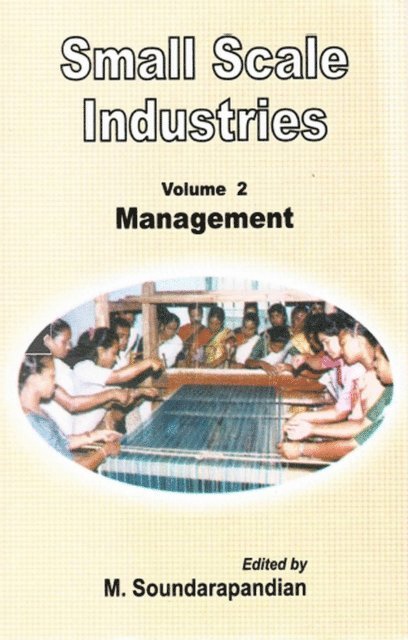
The papers in this set of two volumes, presented at a national seminar, organized by the Department of Rural Industries and Management, Gandhigram Rural Institute provide a deep insight into the problems and management of small scale industries in India and try to find out ways and means for their promotion. Volume one, while dealing with the problems of SSIs, discusses availability and source of raw materials, inventory, production process and problems relating to marketing, advertisement, sales promotion, technology and new economic policy. Volume two, takes a close look at the management of small scale industries based on agriculture, minerals, textile, forest, polymer and chemicals. It-also emphasizes on training for the executives in the SSIs and development of managerial skills for the rural entrepreneurs
E-bok
Engelska, 20064 450 kr
Läs direkt efter köp
Islam came on the scene, with a message, philosophy and code of conduct, perfect by all means, with its advent, the new faith revolutionised the contemporary world in a very short span of time. It also brought along with its beliefs and practices, a new culture, which gradually build a new civilization, now known as Islamic Civilization. Islam has made a great contribution to the development and growth of human civilization, education and intellect in particular and the whole society, in general. This is a well-known fact now that Muslims were leading the world of knowledge and wisdom when Europe was still a dark continent, far behind in education and science. In the early era of Islam the Muslims were in full command of the science and technology of the times. They not only unearthed adopted and preserved the lost treasure of the Greek wisdom, but also promoted it to new heights. Muslim academics and scientists were among the leading lights of that period of history. They contributed a lot to the growth of all branches of knowledge he that Philosophy, Logic literature, Geography, History Physics, Chemistry, Mathematics or Medicine. Islam is a scientific and progressive religion All its teachings have a scientific and logical approach. Islam directs all its followers to learn, gain knowledge and master the arts and sciences c: the contemporary world. Islam, as a living faith stands for spreading light and eliminating darkness from the world. They contributed a lot to the growth of all branches of knowledge and thus enriched the new civilization. This series, unique in its presentation, is perhaps first of its kind, to take all the great developments and changes over the centuries. All the significant aspects have been covered in these volumes. This multi-volume study is based on original (Holy Quran and Traditions) and other authentic sources: Arabic, Persian and Urdu books and manuscripts. For further comprehension and comparative study, English books by Muslim scholars and as well as Western writers have also been consulted at length. The painstaking research and thorough study of thousands of pages by a team of scholars over a period of time, has resulted in an authentic, comprehensive, exhaustive, exclusive, lengthy and still interesting work, which, is bound to fill a big vacuum in Islamic Studies and as well as the treasure of Knowledge about Culture and Civilization.
E-bok
Engelska, 20104 450 kr
Läs direkt efter köp
True to its ideology and philosophy, Islam as a Faith and religion stands for total submission to Almighty, who is the creator of universe and supreme authority for all the worlds. He is also the master of the Day of Judgment. Today, Islam is known as the progressive religion, promoted and preached by Prophet Muhammad (Pbuh), who declared oneness of God and invited people to a Faith, which called for belief in unity of God and the prophet hood of Muhammad (Pbuh) himself. But, one significant fact is misunderstood by most of the people, that Prophet Muhammad (Pbuh) is not the founder of Islam. Islam in fact was introduced, through Prophet Adam (Pbuh) at the time of the creation of the world, itself. Islam maintains that Almighty Allah''s oneness is absolute and he is the only source of all creation and disposes of all lives and events. Islam stresses upon the prophet hood of Had rat Muhammad (Pbuh), who came to this planet as the benefactor and merciful for all the human beings. Islam''s God is God of all the people-not only the believers; and Holy Prophet (Pbuh) is kind and merciful for the whole mankind-not only for his followers. Islam also calls for the fraternity and brotherhood of its followers, forming a single community, termed as Ummah. Islam declares that there would be a Day of Judgment on the last day of this world, termed as Qiyamat. On that day virtues would be rewarded and evils would be punished for. This encyclopedic study is an asset for scholars, religious experts and as well as students.
E-bok
Engelska, 20134 450 kr
Läs direkt efter köp
Industrial minerals include both common and uncommon minerals and some rocks. Construction raw materials such as aggregates are included. Industrial minerals can be categorized according to their market characteristics as bulk minerals, either within or outside a vertically integrated industry, national or regional commodities, internationally traded commodities, dual-purpose metal ores, or very high-value minerals. Bulk minerals are almost entirely used for construction. Industrial minerals are geological materials which are mined for their commercial value, which are not fuel and are not sources of metals. They are used in their natural state or after beneficiation either as raw materials or as additives in a wide range of applications. The evaluation of raw materials to determine their suitability for use as industrial minerals requires technical task-work, mineral processing trials and end-product evaluation; free to download evaluation manuals are available for the following industrial minerals: limestone, flake graphite, diatomite, kaolin, bentonite and construction materials. Typical examples of industrial rocks and minerals are limestone, clays, sand, gravel, diatomite, kaolin, bentonite, silica, barite, gypsum, and talc. Some examples of applications for industrial minerals reconstruction, ceramics, paints, electronics, filtration, plastics, glass, detergents and paper. In some cases, even organic materials (peat) and industrial products or by-products are categorized under industrial minerals, as well as metallic compounds mainly utilized in nonmetallic form. In some cases, organic substances (such as peat) are categorized as industrial minerals. This case, however, violates the technical definition of a “mineral.” A substance must be a mineral before it may be categorized as an industrial mineral. Peat is a geologic substance mined for its economic value but that does not mandate that it be referred to as a mineral or as an industrial mineral. This encyclopaedia covers the entire spectrum of mineralogy and consolidates its applications in various fields.

E-bok
Engelska, 20216 675 kr
Läs direkt efter köp
Molecular biology concerns the molecular basis of biological activity between biomolecules in the various systems of a cell, including the interactions between DNA, RNA, and proteins and their biosynthesis, as well as the regulation of these interactions. Writing in Nature in 1961, William Astbury described molecular biology as: Molecular biology is a branch of science concerning biological activity at the molecular level. The field of molecular biology overlaps with biology and chemistry and in particular, genetics and biochemistry. A key area of molecular biology concerns understanding how various cellular systems interact in terms of the way DNA, RNA and protein synthesis function. Contemporary molecular biology is concerned principally with understanding the mechanisms responsible for transmission and expression of the genetic information that ultimately governs cell structure and function. All cells share a number of basic properties, and this underlying unity of cell biology is particularly apparent at the molecular level. Such unity has allowed scientists to choose simple organisms (such as bacteria) as models for many fundamental experiments, with the expectation that similar molecular mechanisms are operative in organisms as diverse as E. coli and humans. Numerous experiments have established the validity of this assumption, and it is now clear that the molecular biology of cells provides a unifying theme to understanding diverse aspects of cell behavior.
Engelska, 2024
1 820 kr
Skickas inom 5-8 vardagar