M. Zuhair Nashed – författare
2 359 kr
Skickas inom 10-15 vardagar
544 kr
Skickas inom 10-15 vardagar
687 kr
Läs direkt efter köp
2 782 kr
Läs direkt efter köp
Lattice Point Identities and Shannon-Type Sampling demonstrates that significant roots of many recent facets of Shannon''s sampling theorem for multivariate signals rest on basic number-theoretic results.
This book leads the reader through a research excursion, beginning from the Gaussian circle problem of the early nineteenth century, via the classical Hardy-Landau lattice point identity and the Hardy conjecture of the first half of the twentieth century, and the Shannon sampling theorem (its variants, generalizations and the fascinating stories about the cardinal series) of the second half of the twentieth century. The authors demonstrate how all these facets have resulted in new multivariate extensions of lattice point identities and Shannon-type sampling procedures of high practical applicability, thereby also providing a general reproducing kernel Hilbert space structure of an associated Paley-Wiener theory over (potato-like) bounded regions (cf. the cover illustration of the geoid), as well as the whole Euclidean space.
All in all, the context of this book represents the fruits of cross-fertilization of various subjects, namely elliptic partial differential equations, Fourier inversion theory, constructive approximation involving Euler and Poisson summation formulas, inverse problems reflecting the multivariate antenna problem, and aspects of analytic and geometric number theory.
Features:
New convergence criteria for alternating series in multi-dimensional analysis
Self-contained development of lattice point identities of analytic number theory
Innovative lattice point approach to Shannon sampling theory
Useful for students of multivariate constructive approximation, and indeed anyone interested in the applicability of signal processing to inverse problems.
2 758 kr
Läs direkt efter köp
Lattice Point Identities and Shannon-Type Sampling demonstrates that significant roots of many recent facets of Shannon''s sampling theorem for multivariate signals rest on basic number-theoretic results.
This book leads the reader through a research excursion, beginning from the Gaussian circle problem of the early nineteenth century, via the classical Hardy-Landau lattice point identity and the Hardy conjecture of the first half of the twentieth century, and the Shannon sampling theorem (its variants, generalizations and the fascinating stories about the cardinal series) of the second half of the twentieth century. The authors demonstrate how all these facets have resulted in new multivariate extensions of lattice point identities and Shannon-type sampling procedures of high practical applicability, thereby also providing a general reproducing kernel Hilbert space structure of an associated Paley-Wiener theory over (potato-like) bounded regions (cf. the cover illustration of the geoid), as well as the whole Euclidean space.
All in all, the context of this book represents the fruits of cross-fertilization of various subjects, namely elliptic partial differential equations, Fourier inversion theory, constructive approximation involving Euler and Poisson summation formulas, inverse problems reflecting the multivariate antenna problem, and aspects of analytic and geometric number theory.
Features:
New convergence criteria for alternating series in multi-dimensional analysis
Self-contained development of lattice point identities of analytic number theory
Innovative lattice point approach to Shannon sampling theory
Useful for students of multivariate constructive approximation, and indeed anyone interested in the applicability of signal processing to inverse problems.
1 483 kr
Skickas inom 5-8 vardagar
979 kr
Läs direkt efter köp
2 156 kr
Skickas inom 10-15 vardagar
609 kr
Skickas inom 10-15 vardagar
598 kr
Skickas inom 10-15 vardagar
764 kr
Läs direkt efter köp
The authors introduce geomathematics as an active research area to a wider audience.
Chapter 1 presents an introduction to the Earth as a system to apply scientific methods. Emphasis is laid on transfers from virtual models to reality and vice versa.
In the second chapter geomathematics is introduced as a new scientific area which nevertheless has its roots in antiquity. The modern conception of geomathematics is outlined from different points of view and its challenging nature is described as well as its interdisciplinarity. Geomathematics is shown as the bridge between the real world and the virtual world. The complex mathematical tools are shown from a variety of fields necessary to tackle geoscientific problems in the mathematical language.
Chapter 3 contains some exemplary applications as novel exploration methods. Particular importance is laid on the change of language when it comes to translate measurements to mathematical models. New solution methods like the multiscale mollifier technique are presented. Further applications discussed are aspects of reflection seismics.
Chapter 4 is devoted to the short description of recent activities in geomathematics.The Appendix (Chapter 5) is devoted to the GEM – International Journal on Geomathematics founded ten years ago. Besides a detailed structural analysis of the editorial goals an index of all papers published in former issues is given.
867 kr
Skickas inom 10-15 vardagar
1 069 kr
Läs direkt efter köp
2 156 kr
Skickas inom 10-15 vardagar
2 741 kr
Läs direkt efter köp
Written by leading experts, this book provides a clear and comprehensive survey of the “status quo” of the interrelating process and cross-fertilization of structures and methods in mathematical geodesy. Starting with a foundation of functional analysis, potential theory, constructive approximation, special function theory, and inverse problems, readers are subsequently introduced to today’s least squares approximation, spherical harmonics reflected spline and wavelet concepts, boundary value problems, Runge-Walsh framework, geodetic observables, geoidal modeling, ill-posed problems and regularizations, inverse gravimetry, and satellite gravity gradiometry. All chapters are self-contained and can be studied individually, making the book an ideal resource for both graduate students and active researchers who want to acquaint themselves with the mathematical aspects of modern geodesy.
867 kr
Skickas inom 10-15 vardagar
764 kr
Läs direkt efter köp
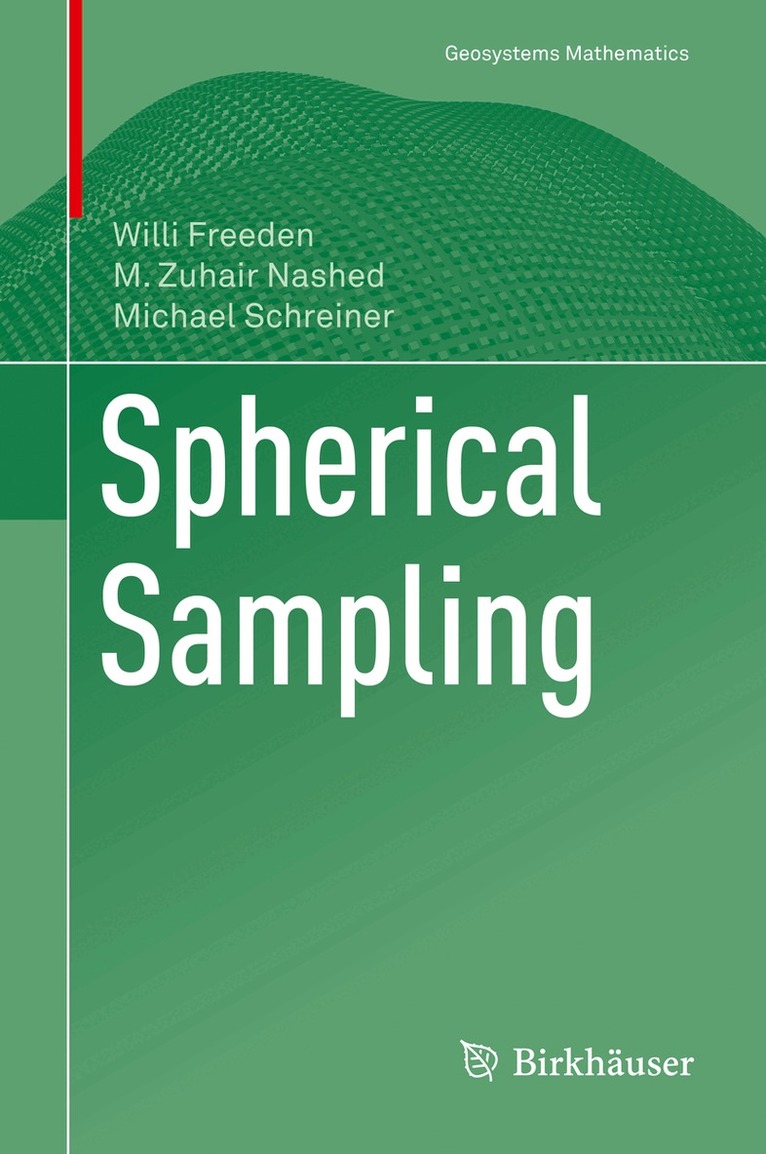
This book presents, in a consistent and unified overview, results and developments in the field of today´s spherical sampling, particularly arising in mathematical geosciences. Although the book often refers to original contributions, the authors made them accessible to (graduate) students and scientists not only from mathematics but also from geosciences and geoengineering. Building a library of topics in spherical sampling theory it shows how advances in this theory lead to new discoveries in mathematical, geodetic, geophysical as well as other scientific branches like neuro-medicine. A must-to-read for everybody working in the area of spherical sampling.
7 726 kr
Skickas inom 10-15 vardagar
8 282 kr
Läs direkt efter köp
During the last three decades geosciences and geo-engineering were influenced by two essential scenarios: First, the technological progress has changed completely the observational and measurement techniques. Modern high speed computers and satellite based techniques are entering more and more all geodisciplines. Second, there is a growing public concern about the future of our planet, its climate, its environment, and about an expected shortage of natural resources. Obviously, both aspects, viz. efficient strategies of protection against threats of a changing Earth and the exceptional situation of getting terrestrial, airborne as well as spaceborne data of better and better quality explain the strong need of new mathematical structures, tools, and methods. Mathematics concerned with geoscientific problems, i.e., Geomathematics, is becoming increasingly important.
The ‘Handbook Geomathematics’ as a central reference work in this area comprises the following scientific fields: (I) observational and measurement key technologies (II) modelling of the system Earth (geosphere, cryosphere, hydrosphere, atmosphere, biosphere) (III) analytic, algebraic, and operator-theoretic methods (IV) statistical and stochastic methods (V) computational and numerical analysis methods (VI) historical background and future perspectives.
6 345 kr
Skickas inom 10-15 vardagar
6 870 kr
Läs direkt efter köp
During the last three decades geosciences and geo-engineering were influenced by two essential scenarios: First, the technological progress has changed completely the observational and measurement techniques. Modern high speed computers and satellite based techniques are entering more and more all geodisciplines. Second, there is a growing public concern about the future of our planet, its climate, its environment and about an expected shortage of natural resources. Obviously, both aspects, viz. efficient strategies of protection against threats of a changing Earth and the exceptional situation of getting terrestrial, airborne as well as space borne data of better and better quality explain the strong need of new mathematical structures, tools and methods. Mathematics concerned with geoscientific problems, i.e., Geomathematics, is becoming increasingly important.
The ‘Handbook of Geomathematics’ deals with the qualitative and quantitative properties for the current and possible structures of the system Earth. As a central reference work it comprises the following geoscientific fields: (I) observational and measurement key technologies (II) modelling of the system Earth (geosphere, cryosphere, hydrosphere, atmosphere, biosphere) (III) analytic, algebraic and operator-theoretic methods (IV) statistical and stochastic methods (V) computational and numerical analysis methods (VI) historical background and future perspectives.
Frontiers In Entropy Across The Disciplines - Panorama Of Entropy: Theory, Computation, And Applications
2 613 kr
Skickas inom 3-6 vardagar