Maarten Otte – författare
Visar alla böcker från författaren Maarten Otte. Handla med fri frakt och snabb leverans.
6 produkter
6 produkter
1918 – The Americans Under French Command
The Champagne-Argonne Offensives: Blanc Mont, Marines and African-Americans
Häftad, Engelska, 2026
204 kr
Skickas
Pershing’s aim had always been to fight the Germans with an independent American Army (the AEF, the American Expeditionary Forces) instead of dividing his divisions between the allies. When the Germans launched the first attack of their Spring Offensives on 21 March 1918, he was still far away from the creation of this independent army. During the first three months of 1918 only a few divisions could be considered as available for immediate action. On 26 March 1918 Foch was selected as the Supreme Allied Commander. Two days later, to solve immediate allied manpower problems and to check the German assault, General Pershing temporarily placed all American forces at the disposal of Supremo Foch. It was agreed that the availability of American troops would only last so long as was needed to check the German advance.This book deals with three lesser known battles fought by five divisions of the AEF that took place in the Champagne/Marne Region between the City of Reims and the Argonne Forest. The narrative includes actions of the 2nd, 36th, 42nd, 92nd and the 93rd Divisions. The latter two were made up of African-American troops.The five tours are ideal for visitors who have a few hours to spare coming from or going to the St. Mihiel, Meuse-Argonne and Verdun battlefields from one of Paris’s airports. They cover a lesser known area and each tour will not take more than a few hours. The starting points are all situated a little north of the A4, the Paris-Metz motorway. The tours also bridge the gap between the better known Chemin des Dames and Meuse-Argonne battlefields.
American Expeditionary Forces in the Great War
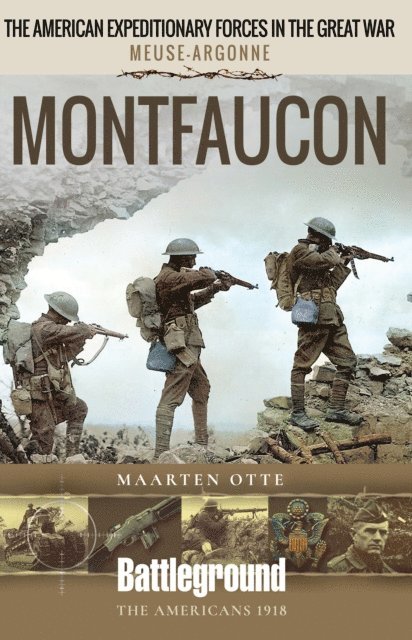
The Meuse Argonne 1918: Breaking the Line
Häftad, Engelska, 2018
163 kr
Tillfälligt slut
Although the Meuse-Argonne Offensive, which began in late September 1918 and continued through to the Armistice, was not the first major action fought by the AEF, it was the greatest in which it engaged in the Great War. Indeed, the casualty count in the fighting at the Meuse-Argonne makes it the bloodiest battle in American military history. The Argonne was an area that had been heavily fought over, particularly in the early part of the war; its eastern part, towards the Meuse, then became enveloped in the first great attritional battle of the war, Verdun. The area is marked by extensive woodlands and rolling countryside; however, unlike the Somme, it is interspersed with numerous waterways, deep ravines and higher ridges, along with significant hills, such as at Montfaucon. To be frank, the opening stages of the Offensive were marked by considerable unforced difficulties for the Americans, who after all were facing a far from strong enemy opposition (however formidable the defensive line might have been). Errors were made, logistical problems multiplied, command was often less than satisfactory.In many respects this should not have come as a surprise: this was an army that was relatively new to the Western Front, which was being reinforced at an awesome rate (approximately 300,000 men a month by July) and whose senior commanders had never before faced the challenges of modern warfare, themselves evolving at a dizzying rate. Maarten Otte gives a background narrative to events before the opening of the Offensive and its development. Taking each of the US corps in turn, he then provides tours that will help the visitor to understand the fighting and the problems that were faced. This opening book on the Meuse-Argonne takes the reader, more or less, to the date when General Pershing handed over command of the US First Army to Major General Liggard in mid October, a change in command that marked a significant improvement in the American performance as they pushed the Germans ever backwards. The Great War battlefield of the Argonne is marked by numerous physical remains of the war, some fine (some might argue over grandiose) monuments and by the stunning American cemetery at Romagne, the second largest in the world administered by the American Battle Monuments Commission.There is much to see in a battlefield that has been largely neglected in the decades since the Second World War.
American Expeditionary Forces in the Great War
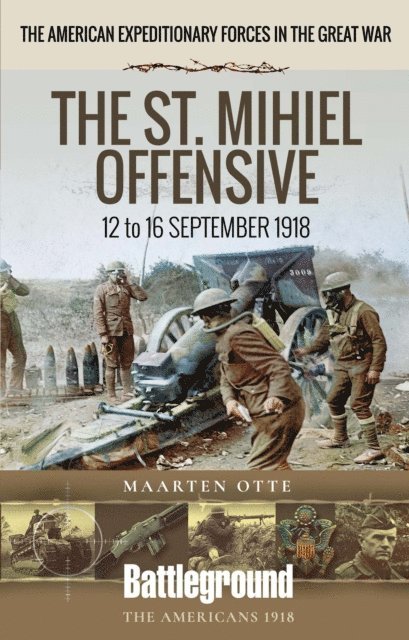
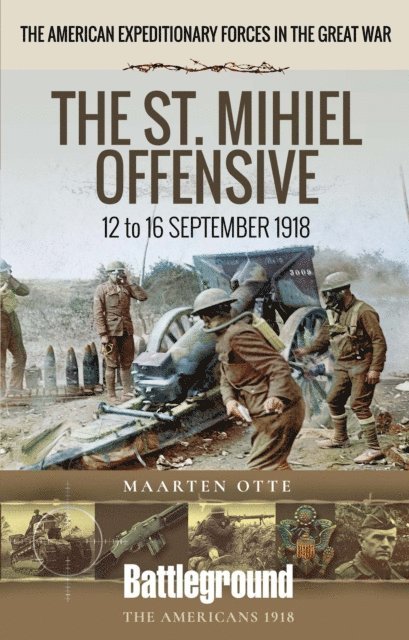
The St. Mihiel Offensive 12 to 16 September 1918
Häftad, Engelska, 2019
173 kr
Skickas
The St Mihiel Offensive, which took place between the 12th and 16th September 1918, was the first full scale attack that was under the direct command of the Americans, in the person of General J Pershing. He combined his command of the First (at the time the only) American Army with that of Commander in Chief of the AEF, a tremendous burden.The St Mihiel Salient had its origins in the early fighting of the war and had been stabilised by the end of 1914, although there was fierce fighting there in the first half of 1915 as both sides jostled for position; the high ground of Les Eparges became notorious for the intensity of the mine warfare that took place below it, extensive remains of which can be seen today.The American attack (with the assistance of a French Corps) was an outstanding success and the Germans were forced into a rapid withdrawal to the Michel Line, a strongly defended position that formed the Hindenburg Line in this area. On the other hand, the success was in part assisted by the fact that the Germans intended to withdraw from the exposed position of the Salient back to this line, the only question being the timing of such a move. Historians argue about whether the move had actually begun or not; but the reality is that senior German officers knew that it was imminent and certainly some heavier artillery had already been pulled back.Pershing's original hope had been to continue the offensive to seize Metz, crucial rail links and economically vital areas to the German war effort. In fact any such attempt would have taken weeks of preparation, as even a casual examination of the Michel Line defences still existing today would show.It is probable that relatively easy success here led to overconfidence amongst some that the next offensive, the Meuse-Argonne - to the north and scheduled to begin on the 26th, would have a similar outcome. If so they were in for a rude awakening.This book is profusely illustrated with contemporary photographs and numerous maps, the narrative supplemented by a number of first hand accounts; the whole is supported by several walking and car tours.This is the latest in a series of Battleground books by Maarten Otte on the American Expeditionary Forces, with several more in preparation.
163 kr
Skickas
In 1870 France embarked on a war with Prussia and her allied German states that was to be a complete disaster. For Napoleon III, after his ignominious surrender with thousands of his troops from the Army of the Rhine and the Army of of Chalons, it meant his abdication and exile. For France it resulted in the humiliation of her army, a bitter civil war in Paris, the loss of two Provinces (Alsace and Lorraine) and a heavy indemnity.Maarten Otte provides background chapters to place the lead up to the war and the issues that were involved; he describes the make up of the opposing armies and some of their principal commanders.The campaign around Sedan was short, fought in the fag end days of August and early September 1870, though the war was to drag on for four months. The Sedan Campaign was fought over a relatively small area and the locations of some of the key battles have changed little, though some of those near the built up areas, such as Sedan itself, require some imagination.After the war several German regiments erected monuments and a surprising number remain today, often hidden away in isolated fields and copses. Several communal cemeteries have a number of German graves. Perhaps one of the most macabre of these is the ossuary in Bazeilles, where the visitor is able to see skeletons that still have shreds of uniform and footwear on them.A notable feature of this battlefield is to see memorials to the conflicts of the twentieth century - the Great War and the Second World War - Sedan was a focus of the most recent and most bloody western European wars.
173 kr
Skickas
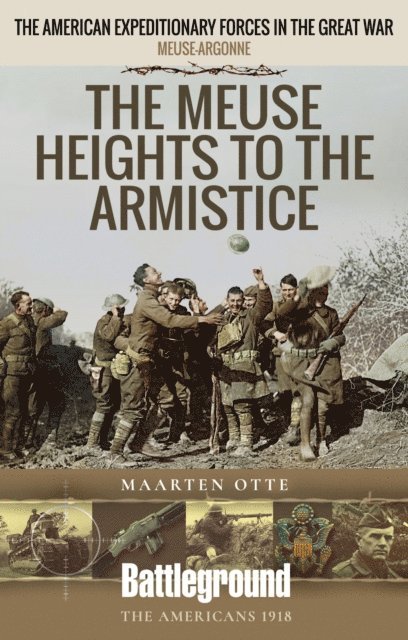
The Americans had considerable initial success when they launched their huge offensive against the Germans in the Meuse-Argonne in the last days of September 1918. However, not everything went smoothly and the attack became bogged down, held up by the several lines of the Hindenburg System and logistical challenges. A major additional obstacle was the presence of batteries of German artillery on the high ground on the right bank of the Meuse, almost untroubled by any significant assaults by the allied forces. These guns created severe problems for the American commanders and their troops.Eventually sufficient resources were allocated for an American-French attack on the right bank, with the aim of removing the German artillery and pushing the Germans off the Meuse Heights, part of the renewed offensive on the Left Bank and the Argonne Forest.The action often took place over ground that had already seen ferocious fighting during the Battle of Verdun in 1916 and the French offensive of late summer 1917. It also involved the very difficult achievement of getting large bodies of troops over the River Meuse and its associated canal.The terrain is rugged and, even then, quite heavily wooded. The American and French troops often had to fight uphill and in the face of German defences that had been developed over the previous twelve months. On the other hand, the quality of the defending troops was not high, as Germany faced so much pressure in other sectors, and included a significant number of Austro-Hungarian troops. Popular opinion tends to be dismissive of the fighting quality of these Austrian troops who, in fact, performed well.The tours take the visitor over some beautiful countryside, with stunning views over the Meuse and the Woevre Plain. There are significant vestiges of the war still to be seen, including numerous observation bunkers and shelters as well as trenches. An unusual feature of the area are the traces of part of the Maginot Line, notably bunkers (some of which are very large) and the rail infrastructure to support it, sometimes making use of lines that the Germans built during the First World War.One of these tours follows the fate of Henry Gunther, officially the last American soldier to be killed in action in the Great War. There is substantial myth about Gunther; the facts surrounding his death are examined, as well as placing his last action on the ground. There is a tour dedicated just to him.
170 kr
Skickas
BELLEAU WOODThe Battle of Belleau Wood has a prominent place in the history of the United States Marine Corps; it took place between 6 and 27 June 1918 (sometimes considered to be 1-26 June). However, when on 6 June 1918 the marines launched their attack on the wood, the biggest German threat here was nearly over.Its significance to the Corps is underlined by the presence not only of a monument to the 4th (Marine) Brigade of the US 2nd Division but also by a preserved part of the wood, which is situated to the rear of the Aisne-Marne American Cemetery. The fighting here marks the first major battle by the USMC in Europe.The battle came - although the participants were unaware of this - at the end of the the third great German offensive of Spring 1918, the Blucher-York Offensive, also known as the 3rd Battle of the Aisne, which was launched on 27 May and officially ended on 4 June. Like its predecessors that Spring, an offensive which had started with startling territorial gains had almost ground to a halt by the time that the 2nd Division, and thus the marines, were called in to assist the French Sixth Army in holding the line and in retaking, where possible, crucial positions.What started out as preventing the Germans from breaking through the French lines and pushing on to Paris ended in a three-weeks long slogging match in and around Belleau Wood. It was on French General Duch ne's instigation that the woods were attacked; but in reality the marines could have just held the line and been satisfied with that. As it was, they were flung into action with little time to prepare. The fighting in Belleau Wood was extremely brutal and involved several attacks and counter-attacks; neither side was willing to yield an inch of the terrain of a feature that had local strategic significance, particularly to the Germans. Although the offensive locally here came to an end and the initial German threat in the area was nearly overcome, the focal point of the fighting moved to Villers Cotter ts, twenty-five kilometres north-east of Belleau. The Americans were not quite finished when Belleau Wood was finally captured, as the nearby village of Vaux was taken by an army brigade of the 2nd Division in a text book attack on 1 July.The USMC has always had a good publicity machine' and Belleau Wood was certainly well known to the wider American public in the war years, particularly as it was an early action by a formation of the AEF. Although largely forgotten since the Second World War - the memory perhaps kept alive by the unusual preserved remnant of the battlefield, Belleau Wood's reputation has been enhanced by increased interest in the war since the turn of the century. Nowadays, the battle is sometimes called a pivotal event in the First World War and an iconic battle in US Marine Corps history' by several American authors, which some of their European counterparts might regard as somewhat exaggerated.Although there have been several guide books on Belleau Wood published in recent years (a clear indication of American interest in the battle today), what differs in this book is the number of points to visit as well as the clear narrative that precedes the tours section. Not only are many new points of interest explored in Belleau itself, but the surrounding countryside is not forgotten. Headquarters, temporary burial sites and other features are included. The book is profusely illustrated by contemporary photographs and numerous maps, the narrative supplemented by a number of first hand accounts; the whole is supported by several walking and car tours.This is the latest in a series of Battleground books by Maarten Otte on the American Expeditionary Forces, with several more in preparation. The AEF's performance in the war is relatively little known, not least in the USA; Belleau Wood is one of the few engagements that still carries some resonance. It is fortunate that so many of the AEF's actions took place in parts of France that have seen little development and are in agricultural or wooded country, which means that traces of their fighting are relatively plentiful.