Magdalena Forowicz - Böcker
Visar alla böcker från författaren Magdalena Forowicz. Handla med fri frakt och snabb leverans.
2 produkter
2 produkter
1 977 kr
Skickas inom 5-8 vardagar
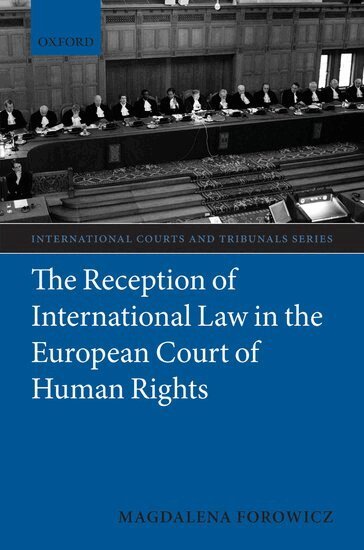
The growing number of international courts and tribunals and their burgeoning case law have fuelled concerns about the fragmentation of international law. This arises as a consequence of both the specialized regimes these courts create and the multiple ways in which they may interpret international law emanating from other sources.This book considers this issue by examining the busiest and arguably most successful international court, the European Court of Human Rights. More specifically, it focuses on the jurisprudence of the Court and its predecessor, the European Commission of Human Rights, covering a range of special human rights regimes, treaty law, and the case law of the International Court of Justice.The author assesses whether the Court has been able to adopt a coherent, comprehensive approach to the interpretation and evaluation of international law and thus the extent to which it has been able to contribute to the development and coherence of international law.
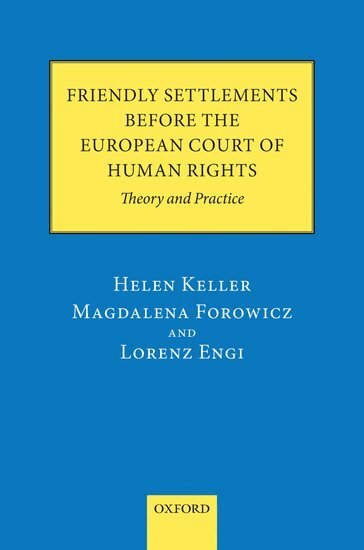
Friendly Settlements before the European Court of Human Rights
Theory and Practice
Inbunden, Engelska, 2010
2 098 kr
Skickas inom 5-8 vardagar
The friendly settlement procedure is an important tool for the reduction of the European Court of Human Rights' (ECtHR) case load. Recent practice demonstrates that this procedure is increasingly resorted to by applicants and Contracting States. This book evaluates this largely unexplored instrument from doctrinal as well as practical perspectives, making recommendations to render the negotiations before the ECtHR more efficient and professional. The book examines questions relating to the admissibility as well as to the practical manageability of friendly settlements. In contrast to ordinary civil proceedings, the friendly settlements procedure has a mixed legal character: while settlements are an inter-partes procedure, they are also binding under international law, as the ECtHR often hands them down in the form of a judgment. In this context, the question arises as to how far the proceedings can be 'privatised' and where the limits to the monetisation of human rights violation lie. This book evaluates possible abuses and identifies the precautions that need to be taken in the framework of friendly settlements. This issue is linked to the question of whether the legal framework which governs the conclusion of a friendly settlement should be formulated in a more concrete manner, given that the position of the parties is unequal and that the role of the Court is hardly defined in this context. Furthermore, the book empirically examines whether the friendly settlement procedure is as advantageous in comparison to ordinary proceedings as others have argued. It also questions whether the friendly settlements procedure can provide the applicant with 'more money faster'.