Mahaad Issa Shammas – författare
Visar alla böcker från författaren Mahaad Issa Shammas. Handla med fri frakt och snabb leverans.
3 produkter
3 produkter
Häftad, Engelska, 2025
1 474 kr
Skickas inom 10-15 vardagar
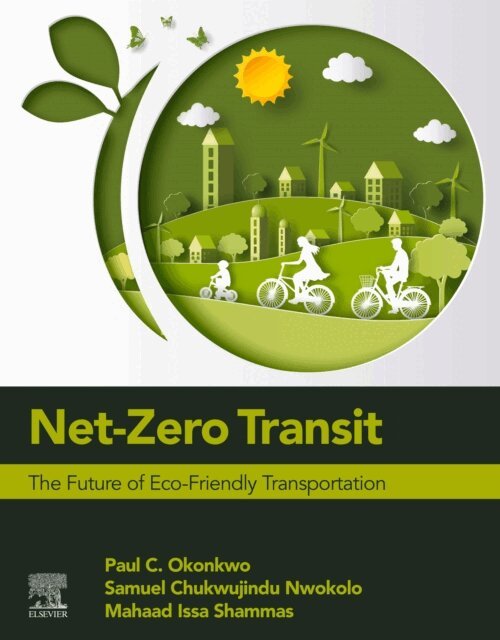
Net-Zero Transit: The Future of Eco-Friendly Transportation thoroughly examines the possible future of environmentally friendly transportation, presenting creative approaches and tactics to attain a transit sector with no net emissions. The book explores the convergence of technology, politics, and consumer behavior to provide a comprehensive perspective on achieving environmentally friendly transportation worldwide. The authors illustrate the practicality and advantages of adopting environmentally friendly transportation systems through the examination of real-life examples and the analysis of data.The authors offer practical assistance for establishing sustainable practices in the transit sector by emphasizing successful efforts and innovative solutions. In addition, they provide valuable perspectives on possible obstacles and hurdles that may occur throughout the shift towards achieving net-zero emissions, as well as suggestions for effectively addressing and surmounting them. It uses theoretical analysis and case studies to explore the benefits and challenges of transitioning to a zero-net-carbon transportation system. The economic, social, and environmental impacts of transitioning to net-zero transit are discussed, including the role of government policies, public-private partnerships, and community engagement. The analytical framework of this book encompasses several scenarios, such as the implementation of carbon policy, carbon pricing, carbon offset programs, climate-conscious car-flight-marine pooling, climate-conscious car-flight-marine green gridlock, pedal-walking power progress, and future-proof transportation. It employs real historical datasets from different countries and regions across the globe to forecast future emissions from various transportation modes using a range of machine learning techniques.This book is an invaluable resource for legislators, industry experts, and individuals seeking to promote environmentally friendly transportation solutions and contribute positively to the environment. Its detailed analysis offers actionable insights to policymakers and stakeholders in the transportation industry, enabling them to make well-informed decisions regarding measures to reduce emissions.Includes stimulating conversations regarding the ecological consequences of conventional transportation techniques and the pressing necessity for a transition towards environmentally sustainable transportationThoroughly examines the policy consequences and regulatory systems that endorse carbon-neutral transportationProvides practical suggestions for individuals, corporations, and governments seeking to decrease their carbon emissions by using innovative transportation solutionsRepresents a visionary aspiration for a future in which transportation is not just efficient and convenient but also environmentally sustainable and socially just
Häftad, Engelska, 2026
1 426 kr
Kommande
Technological Inclusion and Climate Innovation: Comparative Pathways for Just and Equitable Transitions Across Global Societies offers a groundbreaking, equity-focused roadmap that redefines climate innovation by integrating sociotechnical inclusion, institutional foresight, and comparative global metrics. Sections cover global disparities in climate exposure and technological capacity, social equity, governance, cultural interfaces, national strategies, geopolitics, smart cities, circular economies, digital climate governance, innovation ecosystems, climate education, and future scenarios. Novel indices such as the Inclusion-Readiness Nexus (IRN), Innovation Gradient Index (IGI), and Synergistic Transition Potential (STP) are introduced to assess and compare climate-tech inclusion.The work also presents strategic foresight models and policy roadmaps for equitable climate technology deployment aligned with Sustainable Development Goals. It is invaluable to interdisciplinary scholars, policymakers, strategists, and practitioners engaged in sustainability, technology, governance, and equity. It benefits environmental scientists, political scientists, urban planners, STS scholars, digital sociologists, global governance experts, climate policy researchers, innovation economists, and professionals in public-private partnerships, climate-tech startups, and multilateral organizations.Presents a justice-centered, sociotechnical framework that empowers readers to critically assess and design equitable climate innovation systems for inclusive global transitionsIntroduces seven novel, data-driven indices that enable practitioners and policymakers to diagnose gaps and strategically accelerate climate-tech inclusion across diverse national contextsProvides cross-regional comparative analytics and case studies that equip researchers and decision-makers with actionable insights to bridge digital divides and foster resilient, adaptive climate governance
Häftad, Engelska, 2027
1 618 kr
Kommande
Resilient Renewables: Restructuring Critical Mineral Supply Chains for a Fair and Sustainable Energy Future explores innovative strategies for transforming critical mineral supply chains to support a sustainable and equitable energy future. The book emphasizes the importance of advanced scenario modeling to assess and enhance supply chain resilience amid increasing global demand and geopolitical challenges. It discusses specific models-such as DSDE, REDDS, ISSCM, GCRE, RCO, and CARI-that are applied to key minerals like copper, lithium, nickel, cobalt, graphite, rare earths, and magnets. These frameworks help forecast future supply uncertainties, optimize resource management, and promote environmentally responsible practices, including recycling and circular economy approaches. The book also examines the geopolitical implications of critical mineral dependencies and proposes data-driven, climate-resilient solutions to ensure stable supplies. By integrating comprehensive modeling techniques with policy and technological insights, it offers a roadmap for building resilient, fair, and sustainable mineral supply chains to meet the energy demands of the future.Outlines the development and implementation of 16 cutting-edge, climate-aware, scenario-based computational models that allow actors to rapidly analyze, assess, and maximize mineral supply chains to meet diverse geopolitical, ecological, and technological circumstancesExamines comprehensive, sector-by-sector case studies for critical minerals such as copper, lithium, nickel, cobalt, graphite, and rare earth, that offer practical understanding specific to substantial-globe obstacles, such as water shortages, artisanal mining ethical issues, processing obstacles, and demand spikes triggered by EVs and green implementationProvides a critical assessment of regulatory, technological developments, and funding levers-including carbon tax induces, circular economy expanding routes, and transparency structures-empowering experts through the government, company, and educational institutions to develop flexible, legally sustainable, and future-prepared mineral tactics