Majid Khadduri – författare
Visar alla böcker från författaren Majid Khadduri. Handla med fri frakt och snabb leverans.
11 produkter
11 produkter
Inbunden, Engelska, 1997
864 kr
Skickas inom 5-8 vardagar
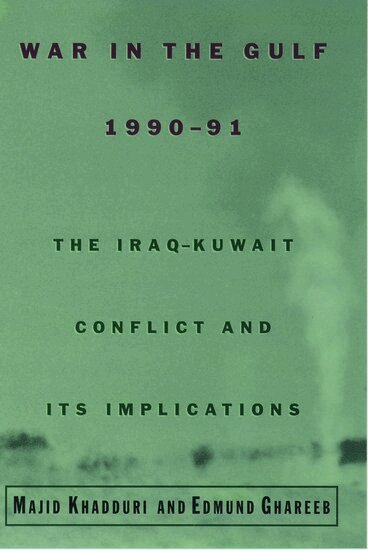
For most Americans, the war against Iraq lingers in memory as a vast morality play, a drama offering ready made heroes and villains: a glowering dictator in military uniform, hapless Kuwaiti refugees with tales of persecution, plucky pilots with high-tech wizardry, and a defiant American president, ringing Churchillian as he drew a line in the sand. But this characterization of the war is greatly oversimplified, a one-dimensional portrait, lacking in context and nuance. In War in the Gulf, 1990- 91, eminent scholars Majid Khadduri and Edmund Ghareeb paint a very different picture, one that brings historical depth to the portrait, and displays the actions of many of the participants in a new and revealing light.Khadduri and Ghareeb offer a far more accurate and complex portrait of the Iraq-Kuwait conflict, providing a wealth of background information not readily available before. They made a distinction between the differences between Iraq and Kuwait over frontiers, territory, and sovereignty and the method pursued by Iraqi leaders to resolve those differences. They explore, for instance, the history of relations between Iraq and Kuwait, revealing that Kuwait had once been a part of Basra (in southern Iraq) during the Ottoman rule, and only became a separate country while under British control (it was the British in fact who drew the much-disputed boundary line between Iraq and Kuwait). Khadduri and Ghareeb describe the many decades of struggle to resolve the boundary issue, examining the repeated attempts by other Arab states to mediate according to Islamic traditions of consultation and peaceful resolution within the faith. The authors also show how Saddam Husayn's war with Iran exacerbated the boundary tensions. Because of the decade-long war, Iraq badly needed oil revenue to repay wartime loans and to rebuild, but Kuwait persisted in pumping far beyond its OPEC quota, driving down prices, and costing Iraq billions of dollars of revenue. The book reveals how Kuwait spurned Arab attempts to mediate this clash over oil prices as well as the longstanding boundary dispute, frustrating efforts to resolve this crisis by peaceful means. In one particularly interesting section, the book examines the diplomatic talks during the early summer of 1990, both among various Arab nations (most notably, Iraq, Saudi Arabia, Egypt, and Kuwait), and with Saddam Husayn and the United States (they show how messages from Washington and a visit by a congressional delegation lead by Senator Dole convinced the Iraqi leaders that they would be allowed to settle their problems with Kuwait without outside interference). Khadduri and Ghareeb carry us through to the present, exploring the war and its aftermath, from the uprisings against Baghdad, to the continuing U.N. sanctions, to the recent defections from Saddam's inner circle.War in the Gulf is a balanced, eye-opening account of one of the central events of recent years. It corrects the Western views of most reporting, explaining the frame of mind of the participants as no one has done before and causing us to examine anew such questions as who was responsible for the conflict, and what might have happened
Häftad, Engelska, 2001
730 kr
Skickas inom 5-8 vardagar
For most Americans, the war against Iraq lingers in memory as a vast morality play, a drama offering ready made heroes and villains: a glowering dictator in military uniform, hapless Kuwaiti refugees with tales of persecution, plucky pilots with high-tech wizardry, and a defiant American president, ringing Churchillian as he drew a line in the sand. But this characterization of the war is greatly oversimplified, a one-dimensional portrait, lacking in context and nuance. In War in the Gulf, 1990 91, eminent scholars Majid Khadduri and Edmund Ghareeb paint a very different picture, one that brings historical depth to the portrait, and displays the actions of many of the participants in a new and revealing light.Khadduri and Ghareeb offer a far more accurate and complex portrait of the Iraq-Kuwait conflict, providing a wealth of background information not readily available before. They made a distinction between the differences between Iraq and Kuwait over frontiers, territory, and sovereignty and the method pursued by Iraqi leaders to resolve those differences. They explore, for instance, the history of relations between Iraq and Kuwait, revealing that Kuwait had once been a part of Basra (in southern Iraq) during the Ottoman rule, and only became a separate country while under British control (it was the British in fact who drew the much-disputed boundary line between Iraq and Kuwait). Khadduri and Ghareeb describe the many decades of struggle to resolve the boundary issue, examining the repeated attempts by other Arab states to mediate according to Islamic traditions of consultation and peaceful resolution within the faith. The authors also show how Saddam Husayn's war with Iran exacerbated the boundary tensions. Because of the decade-long war, Iraq badly needed oil revenue to repay wartime loans and to rebuild, but Kuwait persisted in pumping far beyond its OPEC quota, driving down prices, and costing Iraq billions of dollars of revenue. The book reveals how Kuwait spurned Arab attempts to mediate this clash over oil prices as well as the longstanding boundary dispute, frustrating efforts to resolve this crisis by peaceful means. In one particularly interesting section, the book examines the diplomatic talks during the early summer of 1990, both among various Arab nations (most notably, Iraq, Saudi Arabia, Egypt, and Kuwait), and with Saddam Husayn and the United States (they show how messages from Washington and a visit by a congressional delegation lead by Senator Dole convinced the Iraqi leaders that they would be allowed to settle their problems with Kuwait without outside interference). Khadduri and Ghareeb carry us through to the present, exploring the war and its aftermath, from the uprisings against Baghdad, to the continuing U.N. sanctions, to the recent defections from Saddam's inner circle.War in the Gulf is a balanced, eye-opening account of one of the central events of recent years. It corrects the Western views of most reporting, explaining the frame of mind of the participants as no one has done before and causing us to examine anew such questions as who was responsible for the conflict, and what might have happened if the United States had not intervened so rapidly.
E-bok
PDF, Engelska, 19861 503 kr
Läs direkt efter köp
This is a penetrating account of Anglo-Iraqi relations from 1929, when Britain decided to grant independence to Iraq, to 1941, when hostilities between the two nations came to an end. Showing how Britain tried--and failed--to maintain its political influence, economic ascendancy, and strategic position in Iraq after independence, Silverfarb presents a suggestive analysis of the possibilities and limitations of indirect rule by imperial powers in the Third World. The book also tells of the rapid disintegration of Britain''s dominance in the Middle East after World War I and portrays the struggle of a recently independent Arab nation to free itself from the lingering grip of a major European power.
E-bok
Engelska, 2001488 kr
Läs direkt efter köp
For most Americans, the war against Iraq lingers in memory as a vast morality play, a drama offering ready made heroes and villains: a glowering dictator in military uniform, hapless Kuwaiti refugees with tales of persecution, plucky pilots with high-tech wizardry, and a defiant American president, ringing Churchillian as he drew a line in the sand. But this characterization of the war is greatly oversimplified, a one-dimensional portrait, lacking in context and nuance. In War in the Gulf, 1990 91, eminent scholars Majid Khadduri and Edmund Ghareeb paint a very different picture, one that brings historical depth to the portrait, and displays the actions of many of the participants in a new and revealing light. Khadduri and Ghareeb offer a far more accurate and complex portrait of the Iraq-Kuwait conflict, providing a wealth of background information not readily available before. They made a distinction between the differences between Iraq and Kuwait over frontiers, territory, and sovereignty and the method pursued by Iraqi leaders to resolve those differences. They explore, for instance, the history of relations between Iraq and Kuwait, revealing that Kuwait had once been a part of Basra (in southern Iraq) during the Ottoman rule, and only became a separate country while under British control (it was the British in fact who drew the much-disputed boundary line between Iraq and Kuwait). Khadduri and Ghareeb describe the many decades of struggle to resolve the boundary issue, examining the repeated attempts by other Arab states to mediate according to Islamic traditions of consultation and peaceful resolution within the faith. The authors also show how Saddam Husayn''s war with Iran exacerbated the boundary tensions. Because of the decade-long war, Iraq badly needed oil revenue to repay wartime loans and to rebuild, but Kuwait persisted in pumping far beyond its OPEC quota, driving down prices, and costing Iraq billions of dollars of revenue. The book reveals how Kuwait spurned Arab attempts to mediate this clash over oil prices as well as the longstanding boundary dispute, frustrating efforts to resolve this crisis by peaceful means. In one particularly interesting section, the book examines the diplomatic talks during the early summer of 1990, both among various Arab nations (most notably, Iraq, Saudi Arabia, Egypt, and Kuwait), and with Saddam Husayn and the United States (they show how messages from Washington and a visit by a congressional delegation lead by Senator Dole convinced the Iraqi leaders that they would be allowed to settle their problems with Kuwait without outside interference). Khadduri and Ghareeb carry us through to the present, exploring the war and its aftermath, from the uprisings against Baghdad, to the continuing U.N. sanctions, to the recent defections from Saddam''s inner circle. War in the Gulf is a balanced, eye-opening account of one of the central events of recent years. It corrects the Western views of most reporting, explaining the frame of mind of the participants as no one has done before and causing us to examine anew such questions as who was responsible for the conflict, and what might have happened if the United States had not intervened so rapidly.
Häftad, Engelska, 2002
418 kr
Skickas inom 5-8 vardagar
In The Islamic Conception of Justice, Majid Khadduri, one of the world's preeminent authorities on Islamic justice and jurisprudence, presents his extensive study and reflection on Islamic political, legal, ethical, and social philosophy. This book is both a magisterial historical synthesis and an illumination of the beliefs and practices of modern Islam. Throughout, Khadduri discusses not only the meaning of justice in general but also how justice has undergone significant changes in the modern age. The final chapter deals with the impact of Western notions of justice, with especial emphasis on the recurrence of fundamentalist movements such as the Islamic Revolution in Iran and the Muslim Brotherhood in Egypt, Pakistan, and other Islamic lands.
Häftad, Engelska, 2002
500 kr
Skickas inom 5-8 vardagar
From its origins Islam has been an expansionist religion, understanding itself as a matter of faith to be in a permanent state of war with the non-Muslim world. After the initial consolidation of the Islamic caliphate, however, it soon became apparent that constant military hostilities could not be sustained and that other forms of relationship with non-Muslim nations would be necessary. To reconcile the imperatives of faith with the limits of military power, Islamic scholars developed elaborate legal doctrines. In the second century of the Muslim era (eighth century C.E.), hundreds of years before the codification of international law in Europe by Grotius and others, Muhammad ibn al-Hasan al-Shaybani, an eminent jurist of the Hanafite school in present-day Iraq, wrote the first major Islamic treatise on the law of nations, Kitab al-Siyar al-Kabir. Translated with an extensive commentary by Majid Khadduri, Shaybani's Siyar describes in detail conditions for war (jihad) and for peace, principles for the conduct of military action and of diplomacy, and rules for the treatment of non-Muslims in Muslim lands.A foundational text of the leading school of law in Sunni Islam, it provides essential insights into relations between Islamic nations and the larger world from their earliest days up to the present.
Inbunden, Engelska, 2022
400 kr
Skickas inom 5-8 vardagar
Häftad, Engelska, 2022
285 kr
Skickas inom 5-8 vardagar
Inbunden, Engelska, 2010
595 kr
Skickas inom 5-8 vardagar
Häftad, Engelska, 2010
522 kr
Skickas inom 5-8 vardagar
Häftad, Engelska, 2010
585 kr
Skickas inom 5-8 vardagar