Malcolm Gillies - Böcker
Visar alla böcker från författaren Malcolm Gillies. Handla med fri frakt och snabb leverans.
7 produkter
7 produkter
214 kr
Kommande
1 403 kr
Skickas inom 7-10 vardagar
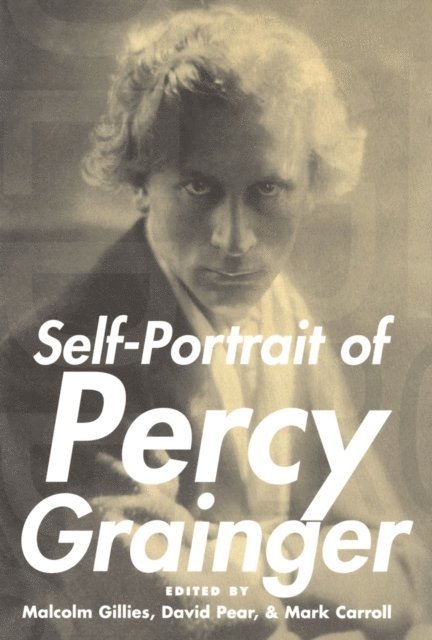
Shortly before his death, Percy Grainger (1882-1961) lodged over twenty unpublished sketches in his Australian Museum. Self-Portrait of Percy Grainger draws exclusively from these sketches, revealing for the first time an illuminating portrait of the composer's life. With such titles as "The Aldridge-Grainger-Strom Saga," "Thunks," "Ere-I-Forget," "The Love-Life of Helen and Paris," and "Anecdotes," these manuscripts were intended as precursors to Grainger's autobiography, My Wretched Tone-Life, which he only commenced in his final years. Expertly shaping these sketches, the editors have created a "self-portrait" along the lines that Grainger himself had intended. The volume first introduces Grainger's forebears, parents, friends, wife, and himself before moving on to his views on composition, performance, and the musical world. In these sketches, Grainger addresses such topics as racial and national identity, the meaning of work, physical culture, language reform, sexual practice, and artistic patronage. Grainger also probes the nature of musical genius, discussing a broad range of composers including Igor Stravinsky, Thomas Beecham, Frederick Delius, Edvard Grieg, Charles Stanford, Cyril Scott, Fritz Kreisler, Donald Tovey, Ferruccio Busoni, and Balfour Gardiner. Among the works of his own that Grainger most featured are his The Warriors --Music for an Imaginary Ballet, Colonial Song, the Lincolnshire Posy series of band pieces, his greatest "hit" Country Gardens, and his many settings of English folk-music. Written in Grainger's own self-created "Nordic English" as well as translated from Danish, the language of his most intimate confessions, Self-Portrait of Percy Grainger sheds light on some of the most revealing details of the composer's life. The sketches trace Grainger's changing self-perception, from the romantically tinged, even lustful, views of his forties and fifties, through a period of wistfulness in his sixties, to the bitterness and self-loathing of his old age. The volume also includes several of Grainger's own drawings as well as both public and private photographs. A fascinating and revealing collection of vignettes, this extraordinary book will appeal to instructors, students, and enthusiasts in musicology, music history, cultural studies, and Australian, British, and American history.
959 kr
Skickas inom 5-8 vardagar
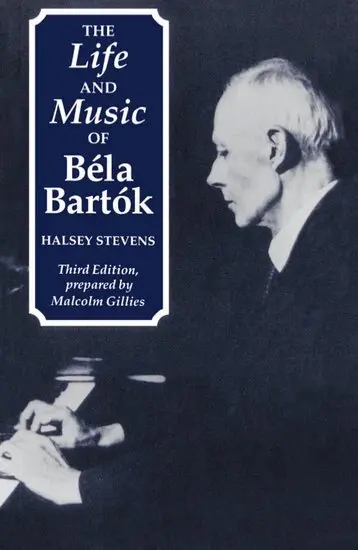
First published in 1953, Halsey Stevens's The Life and Music of Béla Bartók was hailed as a triumph of musicology and quickly established itself as the classic text. Stevens combined an authoritiative, balanced account of the Hungarian composer's life with candid insightful analyses of his numerous works. To Stevens, the high point of Bartók's genius was the chamber music, which he assessed was of a quality unrivalled by any other composer of the early twentieth century. But he evaluated Bartók's entire output with mastery, picking out the composer's strengths and weaknesses and conveying the essence of his compositional techniques. Stevens's views have greatly influenced the study of Bartók and Hungarian music over the last four decades.Issued in a revised edition in 1964, Stevens's work now appears in a third edition, prepared by the Bartók scholar, Malcolm Gillies. A comprehensive chronological list of works is added, together with a select bibliography and discography. Minor revisions to the text are suggested in a new Introduction, and the text is enhanced by eight pages of photgraphs, some of them little known.
1 707 kr
Skickas inom 3-6 vardagar
Percy Grainger was one of the most colourful of this century's cultural figures. As a pianist and largely self-taught composer he was feted in the 1910s and 1920s, and is probably still best known for the work he `dished up' in many different guises, Country Gardens. But Grainger aspired to the role of `the all-round man' and nourished ideas, some brilliant, others ludicrous, across the full range of human endeavour: race, nationality, sex, language, life-style, food, clothes, technology, ecology. The All-Round Man depicts that scrambling diversity through seventy-six uninhibited letters from Grainger's `American' years, 1914-61. These letters are fascinating to read: they are cultivated `rambles' (as Grainger actually called several of his compositions), not dissimilar to today's telephone conversations. Often written in Grainger's crunchy `Blue-eyed English', they explore uninhibitedly every corner of his public and private life. They reflect the magnificent attempts of a great but flawed mind to encompass the world. From the letters: `Personally I do not feel like a modern person at all. I feel quite at home in South Sea Island music, in Maori legends, in the Icelandic Sagas, in the Anglo-Saxon `Battle of Brunnanburh', feel very close to Negroes in various countries, but hardly understand modern folk at all.' `Music seems almost to have a "surface", a smooth surface, a grained surface, a prickly surface to the ear. All these distinguishing characteristics (roughly hinted at in the above silly similes) are to me the "body of music" are to music what "looks", skin, hair are in a person, the actual stuff and manifestation whereby we know it and recognize it' `You said that too much such treatment annoyed, nerveteased you. Then let me thus tease you while you punish me for the annoyance I give you: Let me lay my weight upon, momi-ing at yr heavenbringing uma, while you thrash my bottom, back & legs in rising annoyance'
1 961 kr
Skickas inom 5-8 vardagar
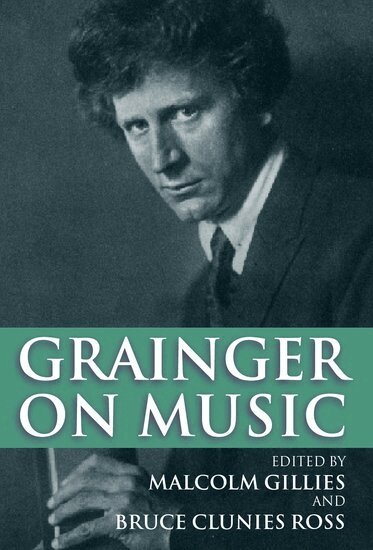
Cyril Scott once described Percy Grainger as a `lovable eccentric'. The Australian-American pianist, composer, ethnologist, and aspiring `all-round man' was, however, more eccentric to his own age than to ours. His views on the environment, food, the body, participatory democracy, and sex all anticipated by several decades views more typical of the mid-late twentieth century. Prolific as a composer, performer, and recording artist, Grainger was an indefatigable writer. This selection of forty-six essays about the production, promotion, and propagation of music is drawn from his over 150 public writings. Written between the turn of the century and the early 1950s, these essays reveal Grainger's youthful compositional plans, his ideas about piano technique, and his enduring high regard for the music of Edvard Grieg, Frederick Delius, and `Frankfurt Group' colleagues Cyril Scott, Roger Quilter, and Henry Balfour Gardiner. Grainger on Music also pursues his evolving thoughts about Nordic music, `Free Music', instrumental usage, and his occasional suggestions for musical development in Australia and the United States.
294 kr
Skickas inom 5-8 vardagar
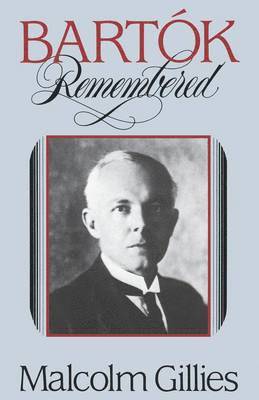
In Bartok Remembered, Malcolm Gillies has brought us closer to this man through a collection of memoirs written by those who knew him best. The volume contains nearly one hundred recollections of Bartok, from his mother's memories of his early years in provincial Hungary, to assorted reminiscences of his last years in New York.
1 119 kr
Skickas inom 10-15 vardagar
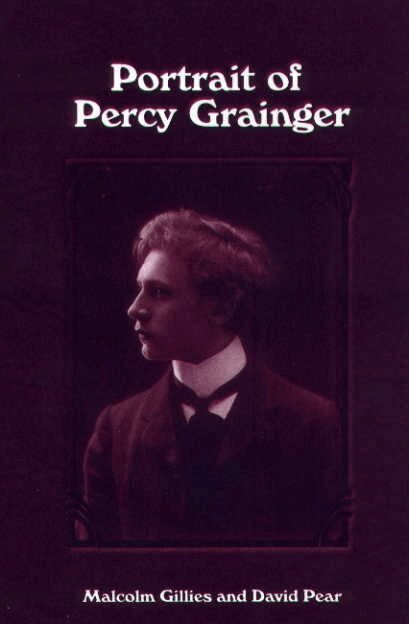
A unique treatment of the key influences on the life of this important Australian composer, consisting of oral histories by people who knew Grainger, as well as reflections from his own writings.Percy Grainger [1882-1961] was a pianist, composer, ethnographer, essayist, and much more. The Australian-American musician aspired to the condition of a polymath, with strong interests in language, culture, ecology and technology. In an age of increasing specialisation Grainger held to a breathless all-roundedness.This book looks at the scrabbling diversity of Grainger's life through the eyes of others. Family and friends, pupils, musical associatesand chance acquaintances recall their experiences of Percy Grainger from his boyhood in colonial Australia, through his conservatorium years in Germany, on to his early professional years in London, and further to the zenith of his career and then years of decline in the United States. In the final chapter, Grainger himself explains the driving passions of his life. Fifty illustrations, including architectural drawings, scores and machine plans, vividly depict the enthusiasms described in over ninety recollections of Grainger.A composer of over four hundred compositions and virtuoso performer in some three thousand concerts, Grainger left a large legacy. He was an importantinfluence upon the folk-song movement in Britain, and, through such masterworks as Lincolnshire Posy, he was enduringly popular with the band movement in America. On a personal level, his development of the language of "blue-eyed English" was stillborn, and his muscular style of pianism found few adherents among the next generation of performers. His frankly expressed views on sexual licence were also many decades ahead of their time. Today, however, Grainger the musician is again in the ascendant. His more innovative works are gaining a belated hearing, while his standards, such as Country Gardens, remain firm favorites.Malcolm Gillies and David Pear areco-editors of Grainger on Music and 'The All-Round Man': Selected Letters of Percy Grainger, 1914-1961