Marc Benitah – författare
2 662 kr
Läs direkt efter köp
This work on the law of subsidies has long been awaited by many actors in international trade. With its introduction of the concept of ''attenuation'' of entitlement, Marc Benitah''s completely new analysis alters our understanding of the international economic law of subsidies - and its future invocation and jurisprudence - forever.
The issue of subsidies is arguably the predominant theme, at this moment, in international economic law, and a consistent approach to the legal treatment of subsidies is urgently needed. In Professor Benitah''s view, the answer lies in the recognition that entitlements granted to a party seeking to defend itself against the ''adverse effects'' of subsidies must be ''attenuated'' in order to avoid undesirable economic and social consequences. In the various techniques of attenuation - thoroughly described and analyzed in this book - may be found the unifying thread on which a logical, coherent law of subsidies may be strung:
• Why techniques of attenuation are intimately linked to the birth of past and future legal disputes relating to subsidies;• Why significant techniques of attenuation (e.g. taking into account the positive impact of a subsidy on consumers) have not arisen in the GATT/WTO context;• Why much recent theoretical debate on the concept of ''distortion'' has not led to a breakthrough in the law of subsidies;• Why attenuations favouring developing countries are surprisingly legally vulnerable in practice;• Why deliberate recourse to techniques of attenuation necessitates their continuing clarification through a case law process.By referring to the legal materials of both the GATT 1947 and the WTO systems at each point in his demonstration, Professor Benitah lays a substantial groundwork for determining innovative WTO norms. This fresh and challenging book examines even the most complex aspects of the law of subsidies. Rooted in case law, it takes a highly pragmatic approach which will amply satisfy the needs of legal practitioners, government officials, and academics concerned with international economic law.
Marc Benitah is Professor of International Law at the University of Quebec. Last year he was Visiting Professor at McGill University in Montreal. Professor Benitah is Docteur en Droit from the Université Panthéon-Sorbonne in Paris.
''Professor Benitah''s book deeply renews the analysis of the law of subsidies in the multilateral commercial system.''
Professor T. Flory, European Chair Jean Monnet, University of Paris XII
''This book invites us to a renewed analysis of the role of the "judge" in this painful period of globalization.''
Revue Internationale de Droit Economique (1999/I)
''One cannot deny the importance ... of this book.''
Canadian Yearbook of International Law (1998)
''The innovative approach of this book offers to the reader a thorough analysis of the legal treatment of subsidies under the GATT/WTO system.''
Revue Générale de Droit International Public (1999/I)
''A stimulating analysis, very surprising sometimes, which should prove to be fruitful.''
J.-F. Abgrall, Ministry of International Affairs, Quebec; Director-General of Commercial Policy during the Uruguay Round
2 376 kr
Läs direkt efter köp
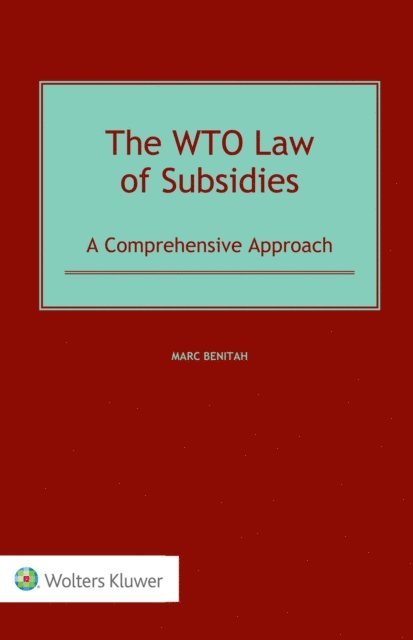
Subsidies are arguably the dominant theme in International Economic Law. A prolific case law has been elaborated by WTO Panels and Appellate Body in response to the multitude of complaints lodged in the past two decades (Softwood Lumber, Airbus, Boeing, etc.)
Unfortunately, it is possible to be overwhelmed by the complexity of this case law. This book provides a comprehensive approach in response to this complexity. First, it avoids unnecessary legal jargon, making it accessible to a large public. Second, it adopts a comprehensive and progressive approach where legal subtleties are not avoided but presented at the right moment and the right place. The reader is therefore not overwhelmed from the outset by a multitude of details.
The first Part of the book adopts the perspective of a WTO Member seeking to counter an alleged subsidy granted by another Member. To this end, this first Part scans and analyzes in detail all WTO Agreements, containing cumulative disciplines and remedies relating to subsidies. Therefore, it is not only the SCM Agreement that is scanned and analyzed but also the Agreement on Agriculture (AoA), GATT 1994, and even the 1980 Agreement on Trade in Civil Aircraft (ATCA).
The second Part of the book adopts the perspective of a WTO Member accused of granting subsidies violating subsidies disciplines.To this end, an original classification is offered of the various strategies that can be used by this Member. For this purpose, a distinction is made between the “threshold strategy” where the existence of a challengeable subsidy is recused from the outset, the “denying violation of disciplines strategy,”the “exemption or exception strategy,” the “procedural and evidentiary strategy,” and finally the “implementing strategy.”
The last Part of this book, which could turn out to be the most useful for the community of agents concerned by subsidies, offers an original examination of pending legal issues. To this end, a relevant distinction is established between pending legal issues partially answered by present case law and pending legal issues not still answered by present case law.
This case law and the norms disciplining subsidies in WTO Agreements are of utmost importance first for International Trade Ministries, Parliaments, and International Institutions (OECD, CNUCED, FAO, etc.). However, Non-Governmental Organizations (World Wide Fund, etc.) are also directly concerned by this topic regarding, for example, fisheries subsidies and their impact on overexploitation of marine resources. The private sector (fishing fleets, fishermen, extractive industries, etc.) is also affected by this topic particularly regarding future investments.Law firms involved in subsidies cases are naturally at the forefront of the community of agents concerned by this topic.
2 382 kr
Läs direkt efter köp
Subsidies are arguably the dominant theme in International Economic Law. A prolific case law has been elaborated by WTO Panels and Appellate Body in response to the multitude of complaints lodged in the past two decades (Softwood Lumber, Airbus, Boeing, etc.)
Unfortunately, it is possible to be overwhelmed by the complexity of this case law. This book provides a comprehensive approach in response to this complexity. First, it avoids unnecessary legal jargon, making it accessible to a large public. Second, it adopts a comprehensive and progressive approach where legal subtleties are not avoided but presented at the right moment and the right place. The reader is therefore not overwhelmed from the outset by a multitude of details.
The first Part of the book adopts the perspective of a WTO Member seeking to counter an alleged subsidy granted by another Member. To this end, this first Part scans and analyzes in detail all WTO Agreements, containing cumulative disciplines and remedies relating to subsidies. Therefore, it is not only the SCM Agreement that is scanned and analyzed but also the Agreement on Agriculture (AoA), GATT 1994, and even the 1980 Agreement on Trade in Civil Aircraft (ATCA).
The second Part of the book adopts the perspective of a WTO Member accused of granting subsidies violating subsidies disciplines.To this end, an original classification is offered of the various strategies that can be used by this Member. For this purpose, a distinction is made between the “threshold strategy” where the existence of a challengeable subsidy is recused from the outset, the “denying violation of disciplines strategy,”the “exemption or exception strategy,” the “procedural and evidentiary strategy,” and finally the “implementing strategy.”
The last Part of this book, which could turn out to be the most useful for the community of agents concerned by subsidies, offers an original examination of pending legal issues. To this end, a relevant distinction is established between pending legal issues partially answered by present case law and pending legal issues not still answered by present case law.
This case law and the norms disciplining subsidies in WTO Agreements are of utmost importance first for International Trade Ministries, Parliaments, and International Institutions (OECD, CNUCED, FAO, etc.). However, Non-Governmental Organizations (World Wide Fund, etc.) are also directly concerned by this topic regarding, for example, fisheries subsidies and their impact on overexploitation of marine resources. The private sector (fishing fleets, fishermen, extractive industries, etc.) is also affected by this topic particularly regarding future investments.Law firms involved in subsidies cases are naturally at the forefront of the community of agents concerned by this topic.
2 790 kr
Skickas inom 5-8 vardagar
2 978 kr
Tillfälligt slut