Marcello Delitala – författare
Visar alla böcker från författaren . Handla med fri frakt och snabb leverans.
5 produkter
5 produkter
Inbunden, Engelska, 2006
1 081 kr
Skickas inom 10-15 vardagar
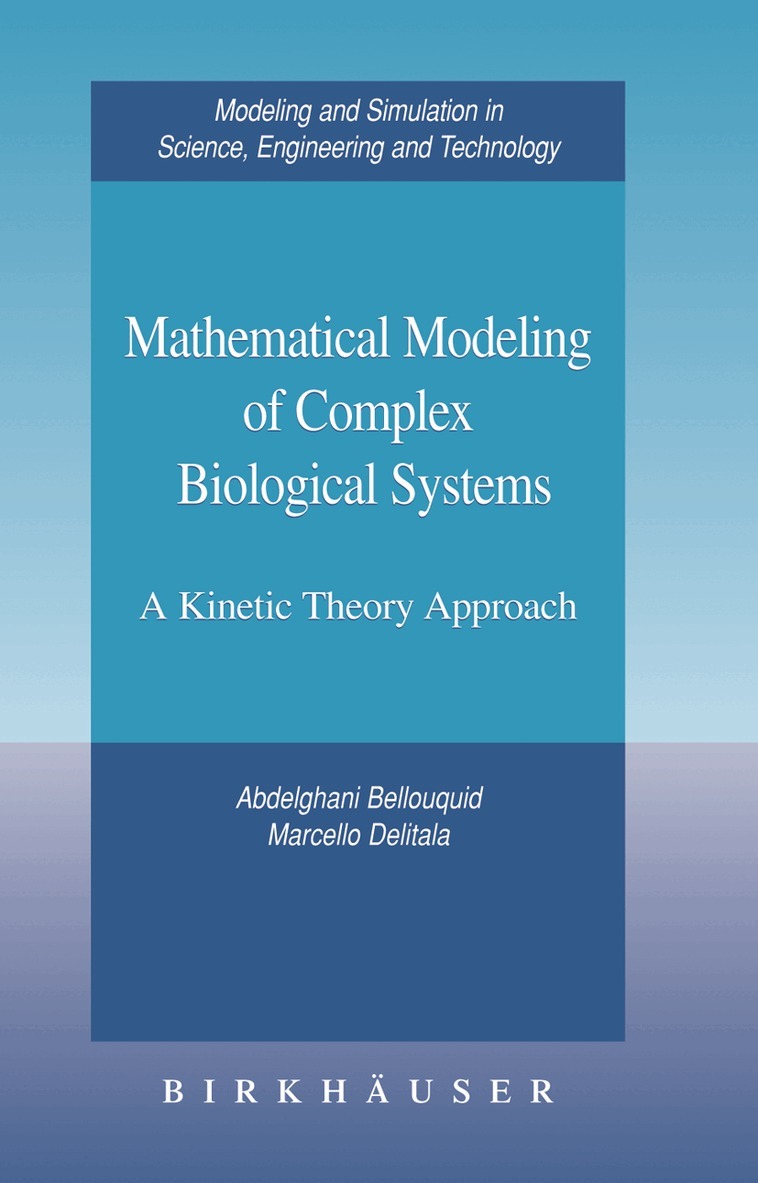
ContentsandScienti?cAims The scienti?c community is aware that the great scienti?c revolution of this century will be the mathematical formalization, by methods of applied mathematics, of complex biological systems. A fascinating prospect is that biological sciences will ?nally be supported by rigorous investigation me- ods and tools, similar to what happened in the past two centuries in the case of mechanical and physical sciences. It is not an easy task, considering that new mathematical methods maybeneededtodealwiththeinnercomplexityofbiologicalsystemswhich exhibit features and behaviors very di?erent from those of inert matter. Microscopic entities in biology, say cells in a multicellular system, are characterized by biological functions and the ability to organize their dynamics and interactions with other cells. Indeed, cells organize their dynamics according to the above functions, while classical particles follow deterministic laws of Newtonian mechanics. Cells have a life according to a cell cycle which ends up with a programmed death. The dialogue among cells can modify their behavior. The activity of cells includes proliferation and/or destructive events which may, in some cases, result in dangerously reproductive events. Finally, a cellular system may move far from eq- librium in physical situations where classical particles generally show a tendency toward equilibrium. An additional source of complexity is that biological systems always need a multiscale approach. Speci?cally, the dynamics of a cell, including its life, are ruled by sub-cellular entities, while most of the phenomena can be e?ectively observed only at the macroscopic scale.
E-bok
PDF, Engelska, 20071 416 kr
Läs direkt efter köp
ContentsandScienti?cAims The scienti?c community is aware that the great scienti?c revolution of this century will be the mathematical formalization, by methods of applied mathematics, of complex biological systems. A fascinating prospect is that biological sciences will ?nally be supported by rigorous investigation me- ods and tools, similar to what happened in the past two centuries in the case of mechanical and physical sciences. It is not an easy task, considering that new mathematical methods maybeneededtodealwiththeinnercomplexityofbiologicalsystemswhich exhibit features and behaviors very di?erent from those of inert matter. Microscopic entities in biology, say cells in a multicellular system, are characterized by biological functions and the ability to organize their dynamics and interactions with other cells. Indeed, cells organize their dynamics according to the above functions, while classical particles follow deterministic laws of Newtonian mechanics. Cells have a life according to a cell cycle which ends up with a programmed death. The dialogue among cells can modify their behavior. The activity of cells includes proliferation and/or destructive events which may, in some cases, result in dangerously reproductive events. Finally, a cellular system may move far from eq- librium in physical situations where classical particles generally show a tendency toward equilibrium. An additional source of complexity is that biological systems always need a multiscale approach. Speci?cally, the dynamics of a cell, including its life, are ruled by sub-cellular entities, while most of the phenomena can be e?ectively observed only at the macroscopic scale.
Del 67 - Springer Proceedings in Mathematics & Statistics
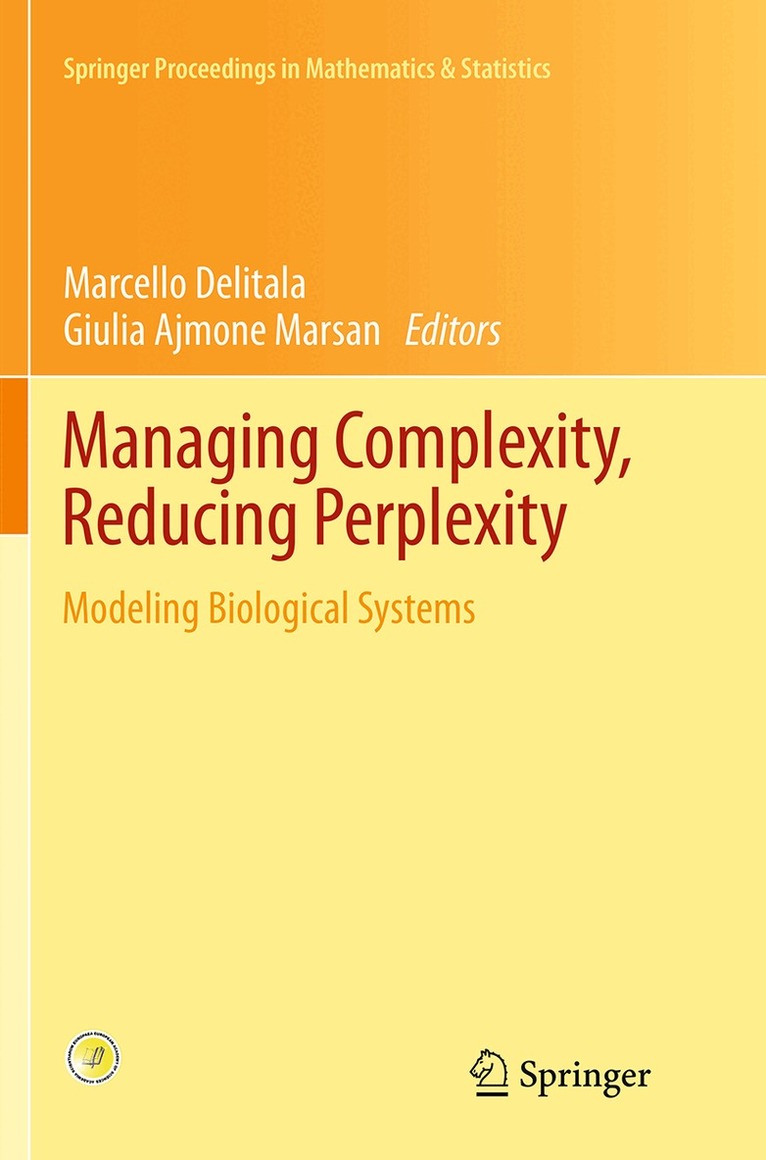
Managing Complexity, Reducing Perplexity
Modeling Biological Systems
Inbunden, Engelska, 2014
1 081 kr
Skickas inom 10-15 vardagar
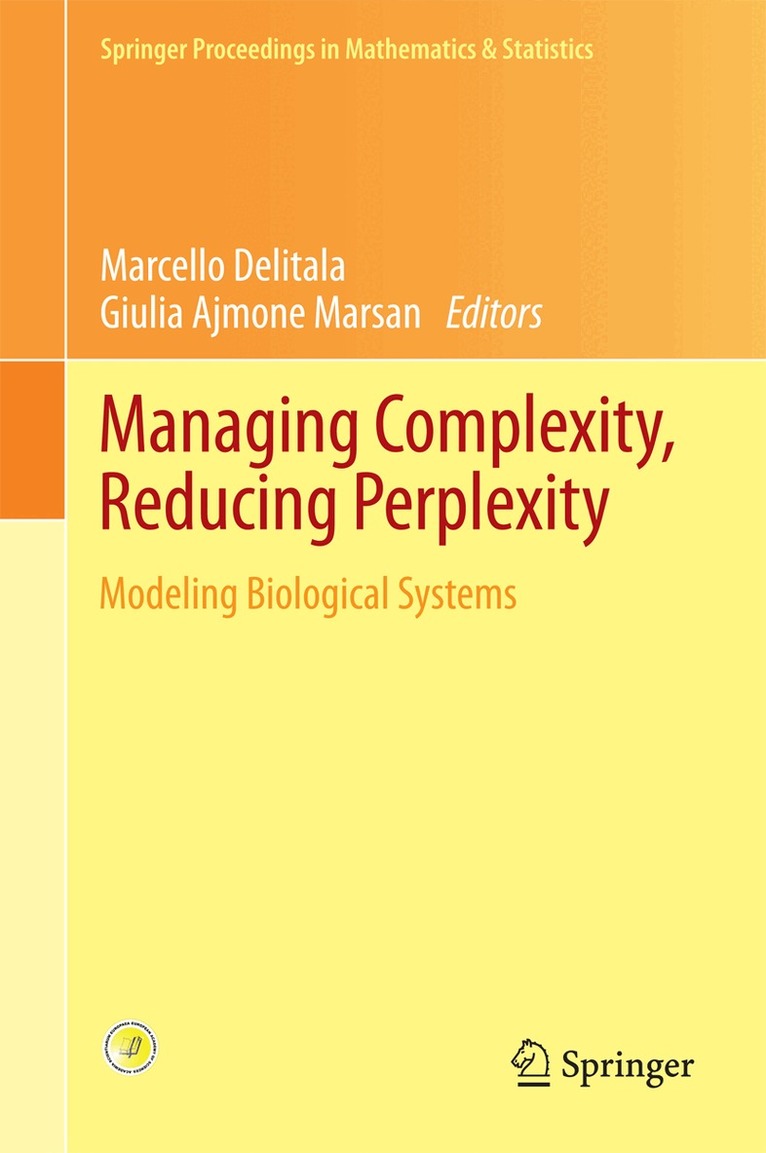
”Managing Complexity, Reducing Perplexity” is devoted to an overview of the status of the art in the study of complex systems, with particular focus on the analysis of systems pertaining to living matter. Both senior scientists and young researchers from diverse and prestigious institutions with a deliberately interdisciplinary cut were invited, in order to compare approaches and problems from different disciplines. The common aim of the contributions was to analyze the complexity of living systems by means of new mathematical paradigms that are more adherent to reality and which are able to generate both exploratory and predictive models that are capable of achieving a deeper insight into life science phenomena.
E-bok
PDF, Engelska, 20141 416 kr
Läs direkt efter köp
”Managing Complexity, Reducing Perplexity” is devoted to an overview of the status of the art in the study of complex systems, with particular focus on the analysis of systems pertaining to living matter. Both senior scientists and young researchers from diverse and prestigious institutions with a deliberately interdisciplinary cut were invited, in order to compare approaches and problems from different disciplines. The common aim of the contributions was to analyze the complexity of living systems by means of new mathematical paradigms that are more adherent to reality and which are able to generate both exploratory and predictive models that are capable of achieving a deeper insight into life science phenomena.
Häftad, Engelska, 2016
1 439 kr
Skickas inom 5-8 vardagar
”Managing Complexity, Reducing Perplexity” is devoted to an overview of the status of the art in the study of complex systems, with particular focus on the analysis of systems pertaining to living matter. Both senior scientists and young researchers from diverse and prestigious institutions with a deliberately interdisciplinary cut were invited, in order to compare approaches and problems from different disciplines. The common aim of the contributions was to analyze the complexity of living systems by means of new mathematical paradigms that are more adherent to reality and which are able to generate both exploratory and predictive models that are capable of achieving a deeper insight into life science phenomena.