Margaret Prugovecki - Böcker
Visar alla böcker från författaren Margaret Prugovecki. Handla med fri frakt och snabb leverans.
3 produkter
3 produkter
Del 48 - Fundamental Theories of Physics
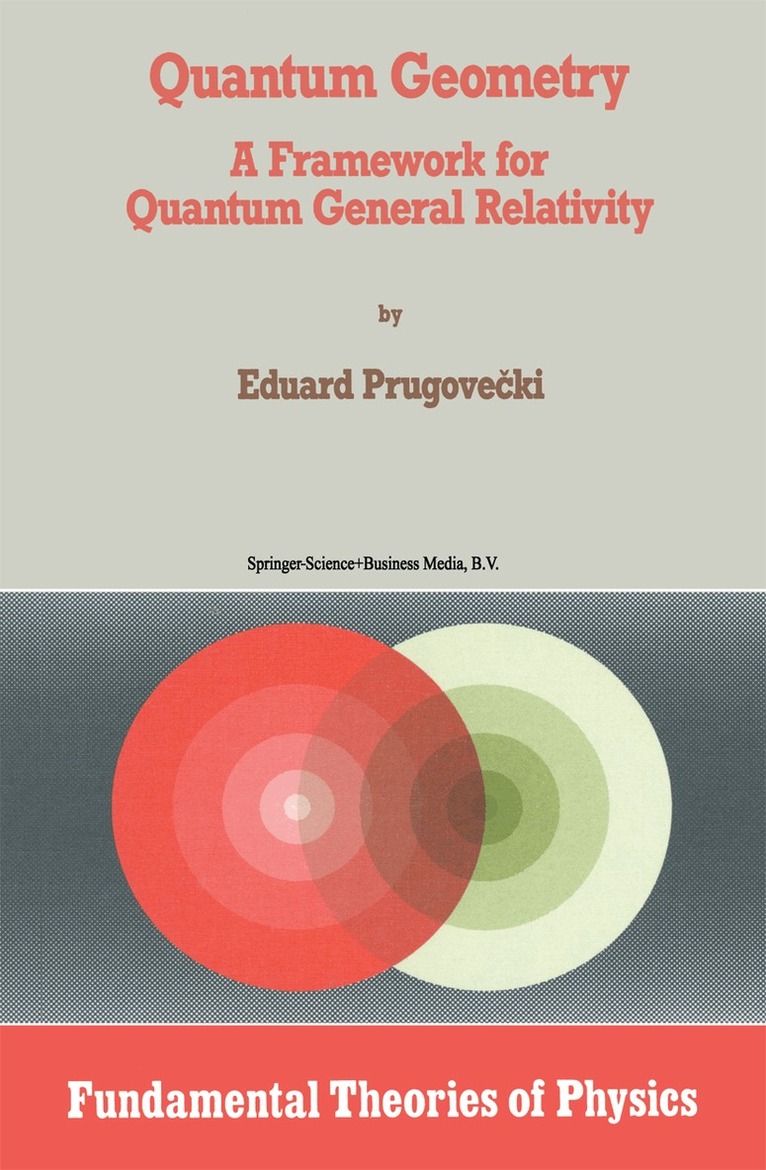
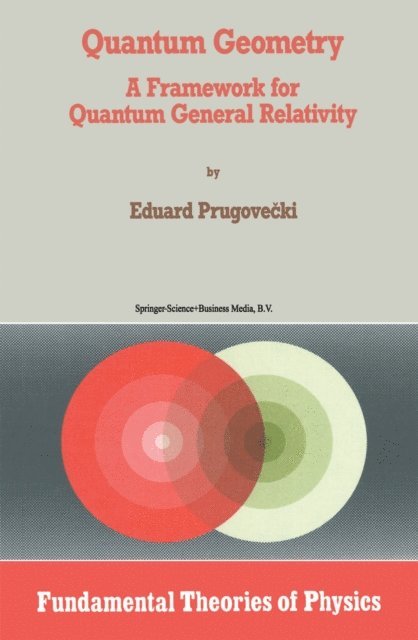
Quantum Geometry
A Framework for Quantum General Relativity
Inbunden, Engelska, 1992
2 117 kr
Skickas inom 10-15 vardagar
The present monograph provides a systematic and basicaIly self-eontained introduetion to a mathematieal framework eapable of ineOIporating those fundamental physical premises of general relativity and quantum meehanics which are not mutually ineonsistent, and which ean be therefore retained in the unifieation of these two fundamental areas of twentieth- eentury physics. Thus, its underlying thesis is that the equivalenee principle of classical general relativity remains true at the quantum level, where it has to be reeonciled, however, with the uneertainty principle. As will be discussed in the first as weIl as in the last chapter, eonventional methods based on classical geometries and on single Hilbert space frame- works for quantum meehanics have failed to aehieve such a reconciliation. On the other hand, foundational arguments suggest that new types of geometries should be introdueed. The geometries proposed and studied in this monograph are referred to as quantum geometries, sinee basic quantum principles are ineorporated into their strueture from the outset.The mathematical tools used in constructing these quantum geometries are drawn from functional analysis and fibre bundle theory, and in particular from Hilbert space the- ory, group representation theory, and modern formulations of differential geometry. The developed physical eoncepts have their roots in nonrelativistic and relativistic quantum me- chanics in Hilbert spaee, in classical general relativity and in quantum field theory for mas- sive and gauge fields.
Del 48 - Fundamental Theories of Physics
Quantum Geometry
A Framework for Quantum General Relativity
Häftad, Engelska, 2010
2 117 kr
Skickas inom 10-15 vardagar
The present monograph provides a systematic and basicaIly self-eontained introduetion to a mathematieal framework eapable of ineOIporating those fundamental physical premises of general relativity and quantum meehanics which are not mutually ineonsistent, and which ean be therefore retained in the unifieation of these two fundamental areas of twentieth- eentury physics. Thus, its underlying thesis is that the equivalenee principle of classical general relativity remains true at the quantum level, where it has to be reeonciled, however, with the uneertainty principle. As will be discussed in the first as weIl as in the last chapter, eonventional methods based on classical geometries and on single Hilbert space frame- works for quantum meehanics have failed to aehieve such a reconciliation. On the other hand, foundational arguments suggest that new types of geometries should be introdueed. The geometries proposed and studied in this monograph are referred to as quantum geometries, sinee basic quantum principles are ineorporated into their strueture from the outset.The mathematical tools used in constructing these quantum geometries are drawn from functional analysis and fibre bundle theory, and in particular from Hilbert space the- ory, group representation theory, and modern formulations of differential geometry. The developed physical eoncepts have their roots in nonrelativistic and relativistic quantum me- chanics in Hilbert spaee, in classical general relativity and in quantum field theory for mas- sive and gauge fields.
Del 4 - Fundamental Theories of Physics
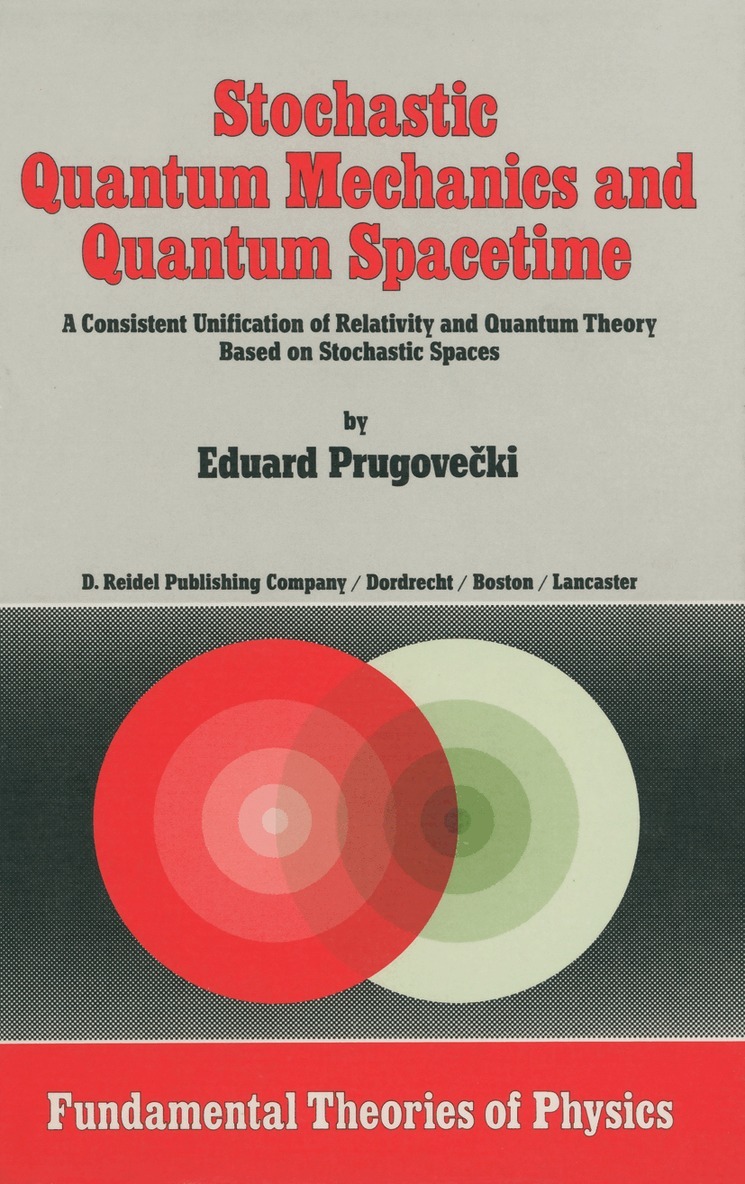
Stochastic Quantum Mechanics and Quantum Spacetime
A Consistent Unification of Relativity and Quantum Theory Based on Stochastic Spaces
Häftad, Engelska, 2011
1 167 kr
Skickas inom 10-15 vardagar
The principal intent of this monograph is to present in a systematic and self-con tained fashion the basic tenets, ideas and results of a framework for the consistent unification of relativity and quantum theory based on a quantum concept of spacetime, and incorporating the basic principles of the theory of stochastic spaces in combination with those of Born's reciprocity theory. In this context, by the physicial consistency of the present framework we mean that the advocated approach to relativistic quantum theory relies on a consistent probabilistic interpretation, which is proven to be a direct extrapolation of the conventional interpretation of nonrelativistic quantum mechanics. The central issue here is that we can derive conserved and relativistically convariant probability currents, which are shown to merge into their nonrelativistic counterparts in the nonrelativistic limit, and which at the same time explain the physical and mathe matical reasons behind the basic fact that no probability currents that consistently describe pointlike particle localizability exist in conventional relativistic quantum mechanics. Thus, it is not that we dispense with the concept oflocality, but rather the advanced central thesis is that the classical concept of locality based on point like localizability is inconsistent in the realm of relativistic quantum theory, and should be replaced by a concept of quantum locality based on stochastically formulated systems of covariance and related to the aforementioned currents.