Marinus J.A. Werger - Böcker
Visar alla böcker från författaren Marinus J.A. Werger. Handla med fri frakt och snabb leverans.
7 produkter
7 produkter
6 123 kr
Skickas inom 10-15 vardagar
Southern Africa is certainly not a naturally bounded area so that there are several possibilities for delineating it and concepts about its extent. Wellington* discussed the various possibilities for delineation and suggested that one line stands out more clearly and definitely as a physical boundary than any other, namely the South Equatorial Divide, the watershed between the ZaIre, Cuanza and Rufiji Rivers on the one hand and the Z ambezi, Cunene and Rovuma Rivers on the other. This South Equatorial Divide is indeed a major line of separation for some organisms and is also applicable in a certain geographical sense, though it does not possess the slightest significance for many other groups of organisms, ecosystems or geographical and physical features of Africa. The placing of the northern boundary of southern Africa differs in fact strongly per scientific dis cipline and is also influenced by practical considerations regarding the possibilities of scientific work as subordinate to certain political realities and historically grown traditions. This is illustrated, for example, in such works as the Flora of Southern Africa, where the northern boundary of the area is conceived as the northern and eastern political boundaries of South West Africa, South Africa and Swaziland. Botswana, traditionally included in the area covered by the Flora Zambesiaca, thus forms a large wedge in 'Southern Africa'.
536 kr
Skickas inom 10-15 vardagar
biological attributes of the three species according to the sequence in which they invade successively as a conse Studies on sample plots in Halimione portulacoides com munities show that environmental disturbances, either quence of environmental disturbance. It can therefore be concluded that for understanding this mechanism in the natural or induced by man, start a sequence of partly salt-marsh ecosystem a thorough study on the functioning overlapping density maxima in Suaeda maritima, Aster of these and other relevant biological attributes in the local tripolium and Puccinellia maritima successively, before the populations is essential. original Halimione community totally recovers. When Returning to the basic questions put in the introduction succession time before recovering is long enough, there are it is concluded that: tendencies in redundancy of this sequence stressing the unilinear character of the succession. Minor environmental a) There exist orderly and predictable succession patterns in the investigated salt-marsh vegetation. impacts induce a longer time-lag period of the Suaeda b) Following occasional disturbances, whatever these may density maximum, suggesting threshold values of these impacts for the species to maintain minimal population be, the vegetation recovers via a sequence of overlapping interim species populations showing a unilinear or obliga densities or to become locally extinct. This sequence of tory (Hom 1976) succession pattern.
2 101 kr
Skickas inom 10-15 vardagar
A review of the developments in the various branches of vegetation science with special attention to the Dutch contributions compiled to celebrate the one-hundredth meeting of the Commission for the Study of Vegetation of the Royal Botanical Society of the Netherlands
2 101 kr
Skickas inom 10-15 vardagar
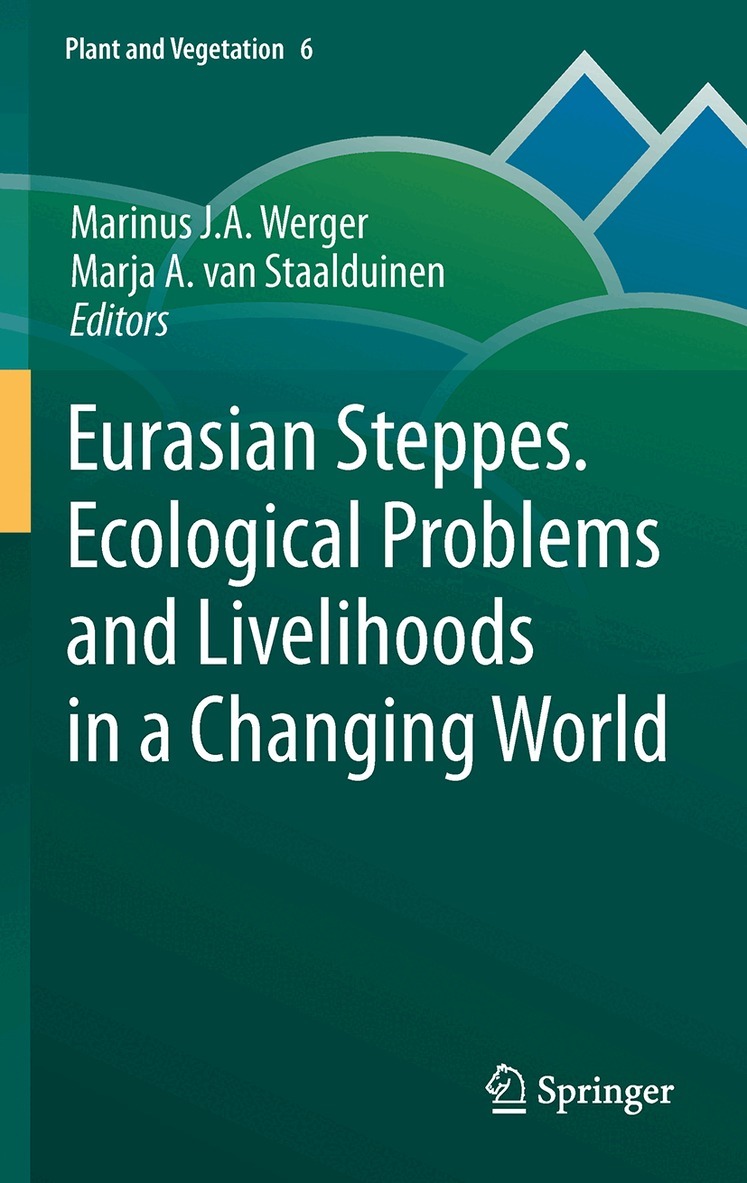
Steppes form one of the largest biomes. Drastic changes in steppe ecology, land use and livelihoods came with the emergence, and again with the collapse, of communist states. Excessive ploughing and vast influx of people into the steppe zone led to a strong decline in nomadic pastoralism in the Soviet Union and China and in severely degraded steppe ecosystems. In Mongolia nomadic pastoralism persisted, but steppes degraded because of strongly increased livestock loads. After the Soviet collapse steppes regenerated on huge tracts of fallow land. Presently, new, restorative steppe land management schemes are applied. On top of all these changes come strong effects of climate change in the northern part of the steppe zone. This book gives an up-to-date overview of changes in ecology, climate and use of the entire Eurasian steppe area and their effects on livelihoods of steppe people. It integrates knowledge that so far was available only in a spectrum of locally used languages.
2 101 kr
Skickas inom 10-15 vardagar
Excessive ploughing and vast influx of people into the steppe zone led to a strong decline in nomadic pastoralism in the Soviet Union and China and in severely degraded steppe ecosystems.
536 kr
Skickas inom 10-15 vardagar
We have edited this book in honour ofMakoto Numata, the nestor of Japanese plant ecology, who will celebrate his 65th birthday in November 1982 and will be retiring from office in March 1983. As the main concern of his work during the last years was to educate people in ecological understanding - probably the only possibility for mankind to master the 'environmental problems' - the topic chosen for this book seemed the most suitable one to honour the retiree. We hope that this volume will prove to be useful for many in carrying through this important task of modern ecology. We are grateful to the authors and particularly to Mr. Peters and the staff of Dr. W. Junk publishers for their patient cooperation. We are also indebted to Jan Knaapen for making the index. Wien, Utrecht and Chiba, June 1982 The Editors VII Contents Preface.................................................................................................... VII List of contributors....................................................................................... XI A biography of Makoto Numata by I. Ikusima ........................................................ .
6 123 kr
Skickas inom 10-15 vardagar
This is illustrated, for example, in such works as the Flora of Southern Africa, where the northern boundary of the area is conceived as the northern and eastern political boundaries of South West Africa, South Africa and Swaziland.