Martin Langenkamp – författare
Visar alla böcker från författaren Martin Langenkamp. Handla med fri frakt och snabb leverans.
3 produkter
3 produkter
Inbunden, Engelska, 2010
1 439 kr
Skickas inom 5-8 vardagar
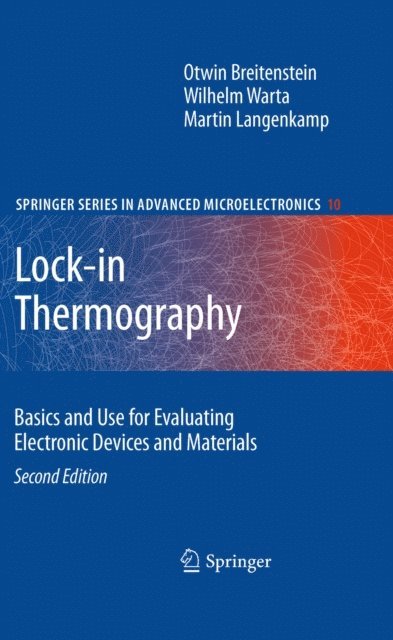
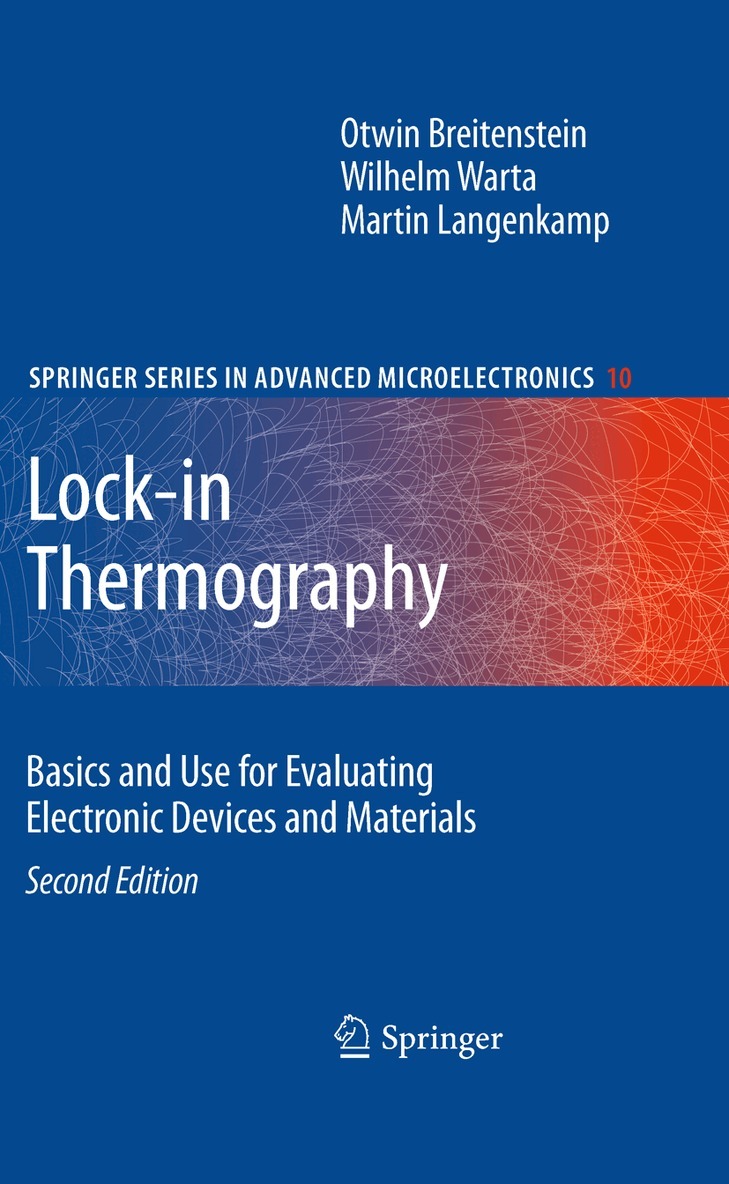
In the last 7 years, the ?rst edition of “Lock-in Thermography” has established as a reference book for all users of this technique for investigating electronic devices, especially solar cells. At this time, a vital further development of lock-in therm- raphy could be observed. Not only the experimental technique was improved by applying new and better infrared cameras, solid immersion lenses, and novel t- ing strategies, but also completely new application ?elds of lock-in thermography were established by implying irradiation of light during the measurements. The two groups of new techniques are different kinds of Illuminated Lock-In Thermography (ILIT) and Carrier Density Imaging, resp. Infrared Lifetime Imaging (CDI/ILM). While ILIT is performed on solar cells, CDI/ILM is performed on bare wafers for imaging the local minority carrier lifetime and the local concentration of trapping centers. The new edition of this book implements these new developments. One new section entitled “Timing strategies” is added. In this, new ways are introduced to overcome previous limitations of the choice of the lock-in frequency in comparison with the frame rate of the camera. The previous diffraction limit of the spatial resolution can be overcome by a factor of up to 4 by applying so-called solid immersion lenses. This technique is introduced and its application for failure analysis of ICs, where highest possible spatial resolution is desired, is shown in another new section.
E-bok
PDF, Engelska, 20101 416 kr
Läs direkt efter köp
In the last 7 years, the ?rst edition of “Lock-in Thermography” has established as a reference book for all users of this technique for investigating electronic devices, especially solar cells. At this time, a vital further development of lock-in therm- raphy could be observed. Not only the experimental technique was improved by applying new and better infrared cameras, solid immersion lenses, and novel t- ing strategies, but also completely new application ?elds of lock-in thermography were established by implying irradiation of light during the measurements. The two groups of new techniques are different kinds of Illuminated Lock-In Thermography (ILIT) and Carrier Density Imaging, resp. Infrared Lifetime Imaging (CDI/ILM). While ILIT is performed on solar cells, CDI/ILM is performed on bare wafers for imaging the local minority carrier lifetime and the local concentration of trapping centers. The new edition of this book implements these new developments. One new section entitled “Timing strategies” is added. In this, new ways are introduced to overcome previous limitations of the choice of the lock-in frequency in comparison with the frame rate of the camera. The previous diffraction limit of the spatial resolution can be overcome by a factor of up to 4 by applying so-called solid immersion lenses. This technique is introduced and its application for failure analysis of ICs, where highest possible spatial resolution is desired, is shown in another new section.
E-bok
PDF, Engelska, 20131 100 kr
Läs direkt efter köp
Although the first publication on lock-in thermography appeared in 1988 con cerning electronic device testing, this technique only became popular in the 1990s in connection with the nondestructive testing of materials (NDT, espe cially photothermal and thermoelastic investigations). In the early 1990s our group at the Max Planck Institute of Microstructure Physics in Halle had the task to image small leakage currents in silicon solar cells. We soon realized that neither conventional (steady-state) thermography nor the only avail able lock-in thermography system of that time was sensitive enough to image the tiny temperature differences caused by these leakage currents. Therefore we developed the "Dynamic Precision Contact Thermography" technique (DPCT), which was the first lock-in thermography system having a detection limit below 100 J. . LK. However, this system turned out to be too impractica ble for general use, since it worked in a mechanical contacting mode, and its measurement time was necessarily many hours. With the availability of highly sensitive focal plane array thermocameras at the end of the 1990s, the way was opened to construct highly sensitive IR-based lock-in thermogra phy systems. This was done independently by groups working in NDT and by us working in electronic device testing, whereby the different demands in the different fields lead to partly different approaches in the realization. For photothermal investigations a low lock-in frequency is usually used in order to see sub-surface details, and for thermoelastic investigations the thermo camera cannot usually be synchronized to the temperature modulation.