Masamichi Takesaki – författare
Visar alla böcker från författaren Masamichi Takesaki. Handla med fri frakt och snabb leverans.
10 produkter
10 produkter
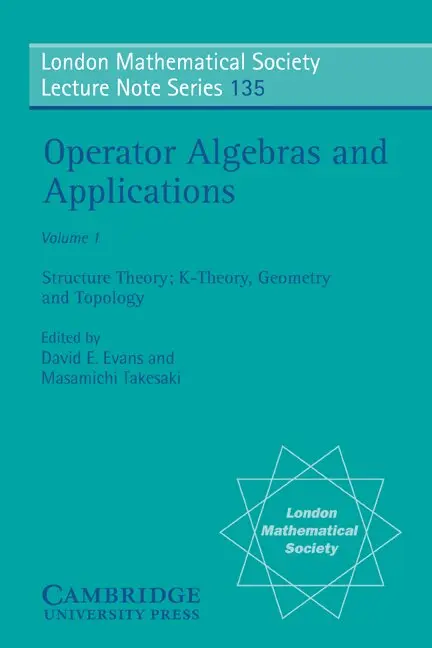
Del 135 - London Mathematical Society Lecture Note Series
Operator Algebras and Applications: Volume 1, Structure Theory; K-theory, Geometry and Topology
Häftad, Engelska, 1989
949 kr
Skickas inom 7-10 vardagar
These volumes form an authoritative statement of the current state of research in Operator Algebras. They consist of papers arising from a year-long symposium held at the University of Warwick. Contributors include many very well-known figures in the field.
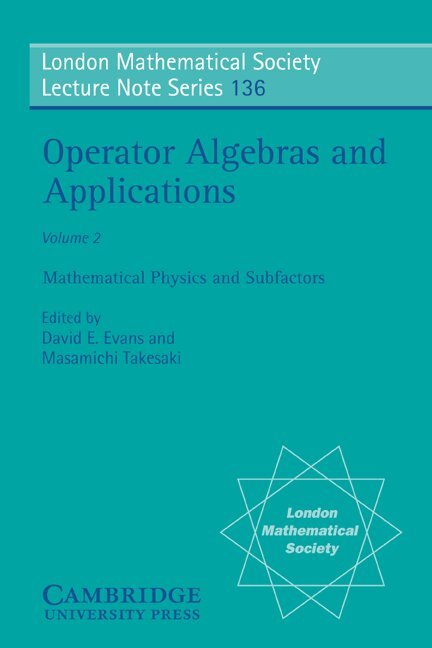
Del 136 - London Mathematical Society Lecture Note Series
Operator Algebras and Applications: Volume 2
Häftad, Engelska, 1989
935 kr
Skickas inom 7-10 vardagar
These volumes form an authoritative statement of the current state of research in Operator Algebras. They consist of papers arising from a year-long symposium held at the University of Warwick. Contributors include many very well-known figures in the field.
E-bok
PDF, Engelska, 20121 069 kr
Läs direkt efter köp
Mathematics for infinite dimensional objects is becoming more and more important today both in theory and application. Rings of operators, renamed von Neumann algebras by J. Dixmier, were first introduced by J. von Neumann fifty years ago, 1929, in [254] with his grand aim of giving a sound founda tion to mathematical sciences of infinite nature. J. von Neumann and his collaborator F. J. Murray laid down the foundation for this new field of mathematics, operator algebras, in a series of papers, [240], [241], [242], [257] and [259], during the period of the 1930s and early in the 1940s. In the introduction to this series of investigations, they stated Their solution 1 {to the problems of understanding rings of operators) seems to be essential for the further advance of abstract operator theory in Hilbert space under several aspects. First, the formal calculus with operator-rings leads to them. Second, our attempts to generalize the theory of unitary group-representations essentially beyond their classical frame have always been blocked by the unsolved questions connected with these problems. Third, various aspects of the quantum mechanical formalism suggest strongly the elucidation of this subject. Fourth, the knowledge obtained in these investigations gives an approach to a class of abstract algebras without a finite basis, which seems to differ essentially from all types hitherto investigated. Since then there has appeared a large volume of literature, and a great deal of progress has been achieved by many mathematicians.
Häftad, Engelska, 2011
922 kr
Skickas inom 10-15 vardagar
Mathematics for infinite dimensional objects is becoming more and more important today both in theory and application. Rings of operators, renamed von Neumann algebras by J. Dixmier, were first introduced by J. von Neumann fifty years ago, 1929, in [254] with his grand aim of giving a sound founda tion to mathematical sciences of infinite nature. J. von Neumann and his collaborator F. J. Murray laid down the foundation for this new field of mathematics, operator algebras, in a series of papers, [240], [241], [242], [257] and [259], during the period of the 1930s and early in the 1940s. In the introduction to this series of investigations, they stated Their solution 1 {to the problems of understanding rings of operators) seems to be essential for the further advance of abstract operator theory in Hilbert space under several aspects. First, the formal calculus with operator-rings leads to them. Second, our attempts to generalize the theory of unitary group-representations essentially beyond their classical frame have always been blocked by the unsolved questions connected with these problems. Third, various aspects of the quantum mechanical formalism suggest strongly the elucidation of this subject. Fourth, the knowledge obtained in these investigations gives an approach to a class of abstract algebras without a finite basis, which seems to differ essentially from all types hitherto investigated. Since then there has appeared a large volume of literature, and a great deal of progress has been achieved by many mathematicians.
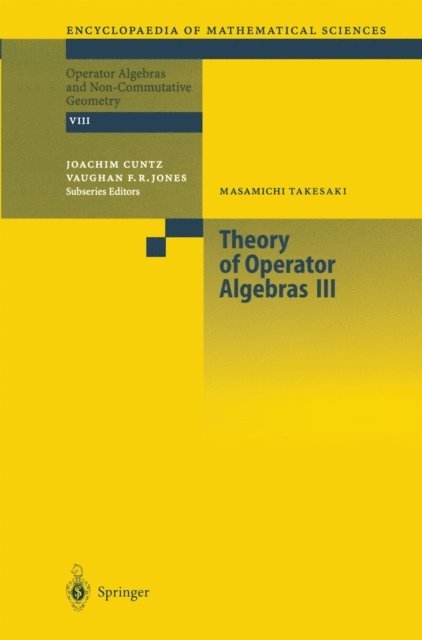
Del 127 - Encyclopaedia of Mathematical Sciences
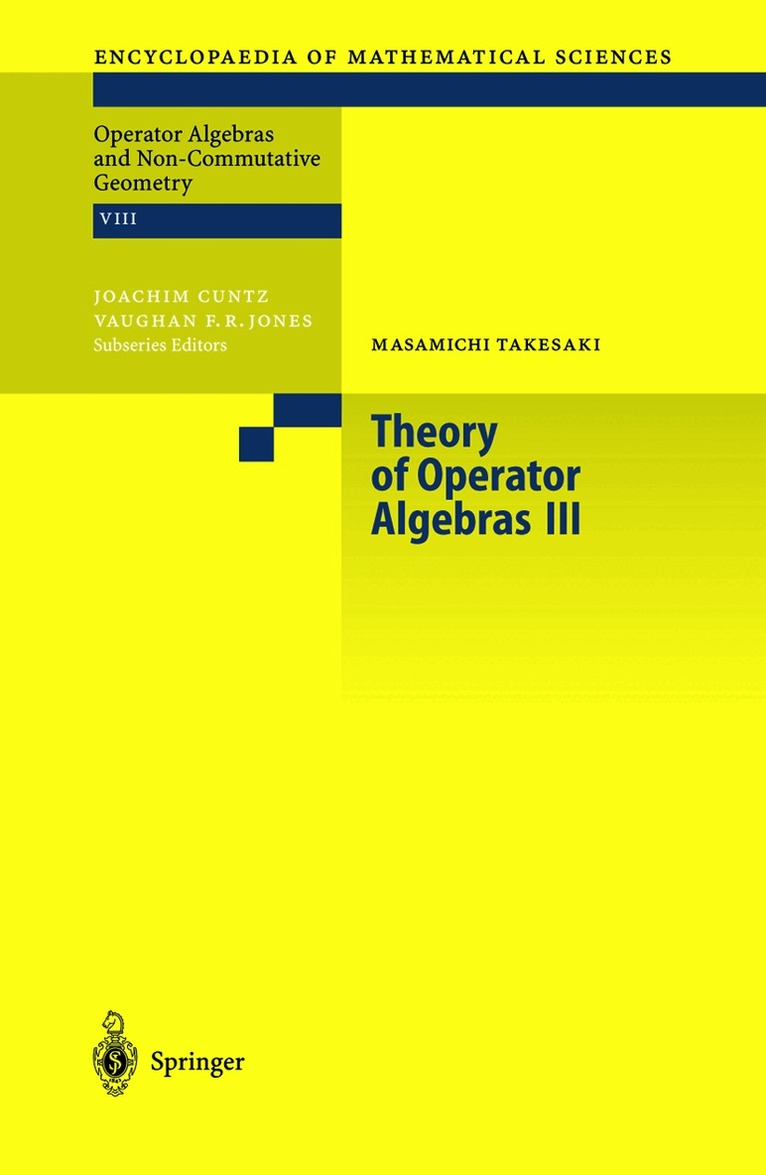
Theory of Operator Algebras III
Inbunden, Engelska, 2002
1 946 kr
Skickas inom 10-15 vardagar
to the Encyclopaedia Subseries on Operator Algebras and Non-Commutative Geometry The theory of von Neumann algebras was initiated in a series of papers by Murray and von Neumann in the 1930's and 1940's. A von Neumann algebra is a self-adjoint unital subalgebra M of the algebra of bounded operators of a Hilbert space which is closed in the weak operator topology. According to von Neumann's bicommutant theorem, M is closed in the weak operator topology if and only if it is equal to the commutant of its commutant. A factor is a von Neumann algebra with trivial centre and the work of Murray and von Neumann contained a reduction of all von Neumann algebras to factors and a classification of factors into types I, II and III. C* -algebras are self-adjoint operator algebras on Hilbert space which are closed in the norm topology. Their study was begun in the work of Gelfand and Naimark who showed that such algebras can be characterized abstractly as involutive Banach algebras, satisfying an algebraic relation connecting the norm and the involution. They also obtained the fundamental result that a commutative unital C* -algebra is isomorphic to the algebra of complex valued continuous functions on a compact space - its spectrum. Since then the subject of operator algebras has evolved into a huge mathematical endeavour interacting with almost every branch of mathematics and several areas of theoretical physics.
Inbunden, Engelska, 2002
1 946 kr
Skickas inom 10-15 vardagar
to the Encyclopaedia Subseries on Operator Algebras and Non-Commutative Geometry The theory of von Neumann algebras was initiated in a series of papers by Murray and von Neumann in the 1930's and 1940's. A von Neumann algebra is a self-adjoint unital subalgebra M of the algebra of bounded operators of a Hilbert space which is closed in the weak operator topology. According to von Neumann's bicommutant theorem, M is closed in the weak operator topology if and only if it is equal to the commutant of its commutant. A factor is a von Neumann algebra with trivial centre and the work of Murray and von Neumann contained a reduction of all von Neumann algebras to factors and a classification of factors into types I, IT and III. C* -algebras are self-adjoint operator algebras on Hilbert space which are closed in the norm topology. Their study was begun in the work of Gelfand and Naimark who showed that such algebras can be characterized abstractly as involutive Banach algebras, satisfying an algebraic relation connecting the norm and the involution. They also obtained the fundamental result that a commutative unital C* -algebra is isomorphic to the algebra of complex valued continuous functions on a compact space - its spectrum. Since then the subject of operator algebras has evolved into a huge mathematical endeavour interacting with almost every branch of mathematics and several areas of theoretical physics.
Del 127 - Encyclopaedia of Mathematical Sciences
Theory of Operator Algebras III
Häftad, Engelska, 2010
1 946 kr
Skickas inom 10-15 vardagar
to the Encyclopaedia Subseries on Operator Algebras and Non-Commutative Geometry The theory of von Neumann algebras was initiated in a series of papers by Murray and von Neumann in the 1930's and 1940's. A von Neumann algebra is a self-adjoint unital subalgebra M of the algebra of bounded operators of a Hilbert space which is closed in the weak operator topology. According to von Neumann's bicommutant theorem, M is closed in the weak operator topology if and only if it is equal to the commutant of its commutant. A factor is a von Neumann algebra with trivial centre and the work of Murray and von Neumann contained a reduction of all von Neumann algebras to factors and a classification of factors into types I, II and III. C* -algebras are self-adjoint operator algebras on Hilbert space which are closed in the norm topology. Their study was begun in the work of Gelfand and Naimark who showed that such algebras can be characterized abstractly as involutive Banach algebras, satisfying an algebraic relation connecting the norm and the involution. They also obtained the fundamental result that a commutative unital C* -algebra is isomorphic to the algebra of complex valued continuous functions on a compact space - its spectrum. Since then the subject of operator algebras has evolved into a huge mathematical endeavour interacting with almost every branch of mathematics and several areas of theoretical physics.
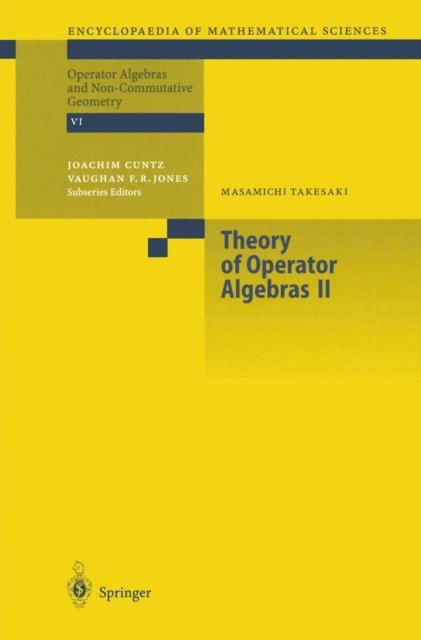
Del 125 - Encyclopaedia of Mathematical Sciences
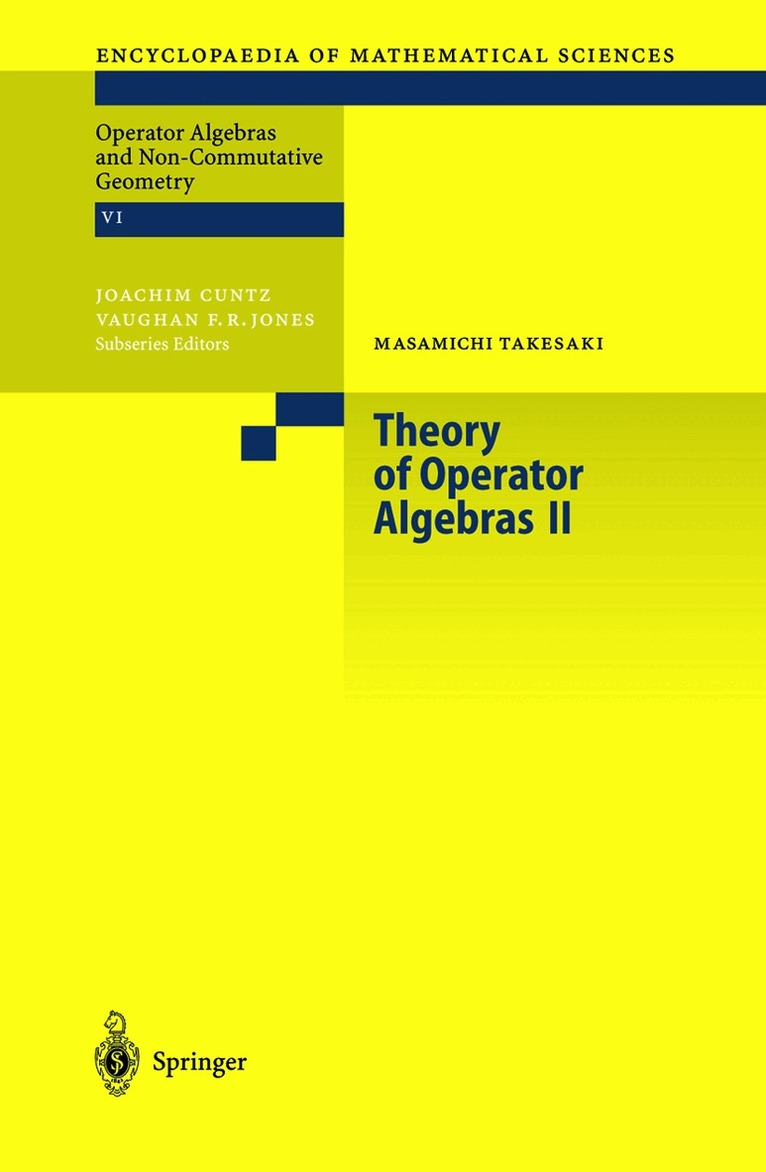
Theory of Operator Algebras II
Häftad, Engelska, 2010
1 946 kr
Skickas inom 10-15 vardagar
to the Encyclopaedia Subseries on Operator Algebras and Non-Commutative Geometry The theory of von Neumann algebras was initiated in a series of papers by Murray and von Neumann in the 1930's and 1940's. A von Neumann algebra is a self-adjoint unital subalgebra M of the algebra of bounded operators of a Hilbert space which is closed in the weak operator topology. According to von Neumann's bicommutant theorem, M is closed in the weak operator topology if and only if it is equal to the commutant of its commutant. A factor is a von Neumann algebra with trivial centre and the work of Murray and von Neumann contained a reduction of all von Neumann algebras to factors and a classification of factors into types I, IT and III. C* -algebras are self-adjoint operator algebras on Hilbert space which are closed in the norm topology. Their study was begun in the work of Gelfand and Naimark who showed that such algebras can be characterized abstractly as involutive Banach algebras, satisfying an algebraic relation connecting the norm and the involution. They also obtained the fundamental result that a commutative unital C* -algebra is isomorphic to the algebra of complex valued continuous functions on a compact space - its spectrum. Since then the subject of operator algebras has evolved into a huge mathematical endeavour interacting with almost every branch of mathematics and several areas of theoretical physics.
E-bok
PDF, Engelska, 20132 524 kr
Läs direkt efter köp
to the Encyclopaedia Subseries on Operator Algebras and Non-Commutative Geometry The theory of von Neumann algebras was initiated in a series of papers by Murray and von Neumann in the 1930''s and 1940''s. A von Neumann algebra is a self-adjoint unital subalgebra M of the algebra of bounded operators of a Hilbert space which is closed in the weak operator topology. According to von Neumann''s bicommutant theorem, M is closed in the weak operator topology if and only if it is equal to the commutant of its commutant. A factor is a von Neumann algebra with trivial centre and the work of Murray and von Neumann contained a reduction of all von Neumann algebras to factors and a classification of factors into types I, IT and III. C* -algebras are self-adjoint operator algebras on Hilbert space which are closed in the norm topology. Their study was begun in the work of Gelfand and Naimark who showed that such algebras can be characterized abstractly as involutive Banach algebras, satisfying an algebraic relation connecting the norm and the involution. They also obtained the fundamental result that a commutative unital C* -algebra is isomorphic to the algebra of complex valued continuous functions on a compact space - its spectrum. Since then the subject of operator algebras has evolved into a huge mathematical endeavour interacting with almost every branch of mathematics and several areas of theoretical physics.
E-bok
PDF, Engelska, 20132 524 kr
Läs direkt efter köp
to the Encyclopaedia Subseries on Operator Algebras and Non-Commutative Geometry The theory of von Neumann algebras was initiated in a series of papers by Murray and von Neumann in the 1930''s and 1940''s. A von Neumann algebra is a self-adjoint unital subalgebra M of the algebra of bounded operators of a Hilbert space which is closed in the weak operator topology. According to von Neumann''s bicommutant theorem, M is closed in the weak operator topology if and only if it is equal to the commutant of its commutant. A factor is a von Neumann algebra with trivial centre and the work of Murray and von Neumann contained a reduction of all von Neumann algebras to factors and a classification of factors into types I, II and III. C* -algebras are self-adjoint operator algebras on Hilbert space which are closed in the norm topology. Their study was begun in the work of Gelfand and Naimark who showed that such algebras can be characterized abstractly as involutive Banach algebras, satisfying an algebraic relation connecting the norm and the involution. They also obtained the fundamental result that a commutative unital C* -algebra is isomorphic to the algebra of complex valued continuous functions on a compact space - its spectrum. Since then the subject of operator algebras has evolved into a huge mathematical endeavour interacting with almost every branch of mathematics and several areas of theoretical physics.