Matthew Tapie – författare
Visar alla böcker från författaren Matthew Tapie. Handla med fri frakt och snabb leverans.
8 produkter
8 produkter
Häftad, Engelska, 2025
483 kr
Skickas inom 5-8 vardagar
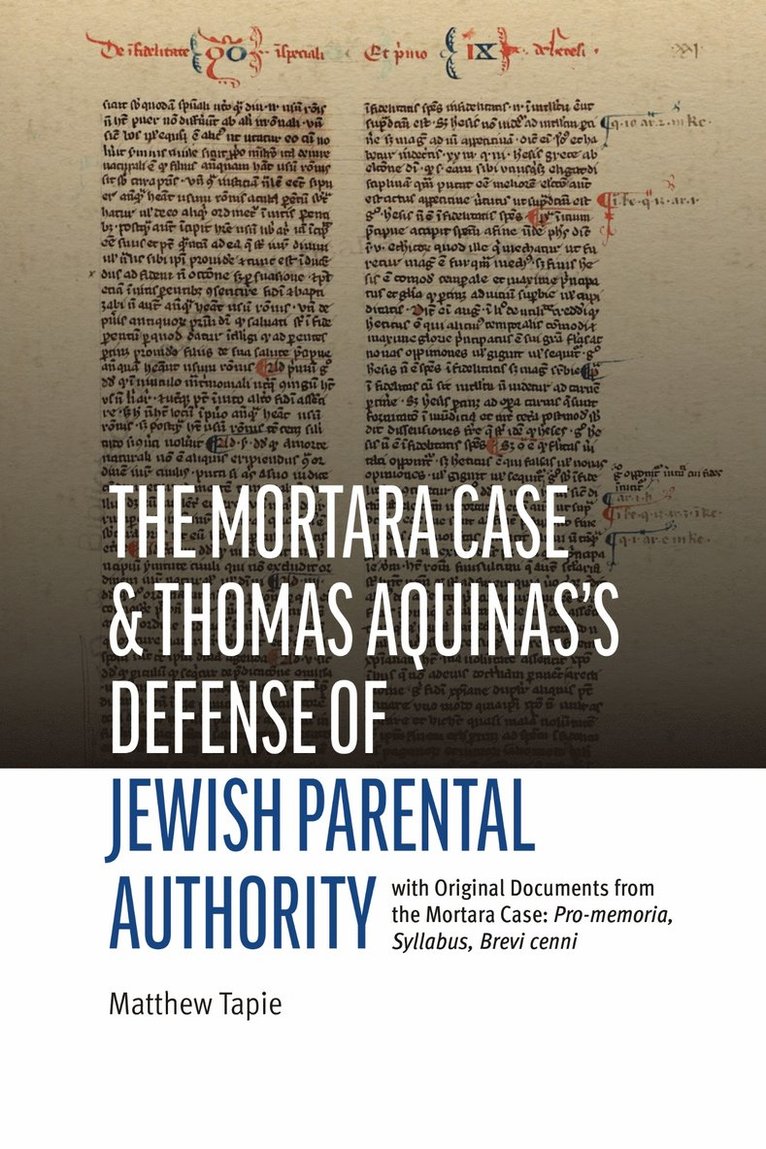
The Mortara case refers to Pope Pius IX's 1858 removal of a six-year-old Jewish boy, Edgardo Mortara, from his parents in Bologna, Italy. Six years after Edgardo was born, it was reported that the family's Christian housekeeper had baptized the boy after he had fallen ill as an infant and was allegedly in danger of death. Since canon law and civil law stipulated that a baptized child must be raised Catholic, Pius IX used his power as head of the papal states to remove the boy.In advocating for the return of the child, the Mortara's submitted to the Vatican a two-part document, which appealed to the teachings of Thomas Aquinas against baptism of Jewish children invitis parentibus (against the will of the parents). The papal counsel's reply denied the request, citing Aquinas's teaching to argue that Edgardo's baptism was valid, and that he belonged to the Church. Today, some Catholic theologians defend or at least excuse the Pope's decision with appeal to the works of Aquinas. Which side had the correct interpretation of Aquinas's teaching? And how does this answer impact Catholic theology and Catholic Jewish-relations today?The Mortara Case and St. Thomas Aquinas's Defense of Jewish Parental Authority adjudicates the claims of both sides of the debate through an analysis of Aquinas's teaching as it is interpreted in the Italian and Latin original documents from the 1858 case, which are housed in the Vatican Apostolic Archives, and reproduced here, with facing English translations, for the first time. Tapie demonstrates that, for Aquinas, Jewish parental rights are an order of the natural law, which Aquinas likened to a spiritualis uterus (spiritual womb). Through the metaphor of the spiritual womb, Aquinas merged the Roman institution of parental rights with the theological concept of the natural law. Tapie concludes by examining baptism invitis parentibus in the current Code of Canon Law with attention to the Second Vatican Council's teaching on religious freedom and the Jewish people.
Inbunden, Engelska, 2025
823 kr
Skickas inom 5-8 vardagar
The aim of this groundbreaking volume is to "enrich and intensify the theological dimension of the Jewish-Catholic dialogue" called for by the 2015 Vatican document, The Gifts and the Calling of God are Irrevocable by building a bridge between Catholic systematic theology and Catholic- Jewish dialogue. The collection includes 19 essays that facilitate a rigorous exchange between Jewish scholars and Catholic theologians on some of the most difficult questions in Jewish-Christian dialogue. The scholars discuss the relation of the election of Israel to the universality of salvation in Christ, the nature and extent of the Church's mission, the affirmation that God's covenant with the Jewish people has never been revoked, and whether the land of Israel is an aspect of that covenant. The Catholic thinkers included in this volume address these topics with attention to the sources and foundational voices of Catholic theology including St. Augustine and St. Thomas Aquinas. Indeed, this important new work is the first volume to address Aquinas on the law in the context of the Jewish-Christian encounter. The Catholic authors follow what might be called the Ratzingerian line of post-conciliar Catholic theological reflection on Jews and Judaism. With some important exceptions, this line has generally lacked exponents in English-speaking theology. The essays raise the question of what theological dialogue is, and how it relates to interreligious dialogue and Catholic systematic theological reflection. Yet difficulties emerge immediately. What is the relationship between internal Catholic theological reflection on Israel and Church and the external interreligious dialogue with rabbinic Judaism and the Jewish people? The volume demonstrates how, in theological dialogue, it becomes clear just how much separates the two traditions despite sharing concepts and the language of Scripture. The essays demonstrate how the challenge of Catholic-Jewish theological dialogue is, in part, keeping open the space for dialogue without minimizing or playing down differences. As Pope Benedict XVI observed, "to be sincere, the existing differences must not be kept silent or minimized: even in things that, due to our intimate conviction of faith, make us different from one another; in fact, precisely in these things, we must respect each other." This volume is needed for any Catholic theological library, and especially those interested in the contemporary Jewish-Christian encounter.
Inbunden, Engelska, 2014
430 kr
Skickas inom 5-8 vardagar
Häftad, Engelska, 2020
319 kr
Skickas inom 5-8 vardagar
Inbunden, Engelska, 2020
493 kr
Skickas inom 5-8 vardagar
E-bok
Engelska, 2020568 kr
Läs direkt efter köp
The Business of War incisively interrogates the development and contemporary implications of the military-industrial complex. It exposes the moral dangers of life in neoliberal economies dependent upon war-making for their growth and brings the Christian tradition''s abundance of resources into conversation with this phenomenon. In doing so, the authors invite us to rethink the moral possibilities of Christian life in the present day with an eye toward faithful resistance to "the business of war" and its influence in every aspect of our lives. In combining biblical, historical, theological, and ethical analyses of "the business of war," the authors invite us to better understand it as a new moral problem that demands a new, faithful response. With contributions from: Pamela BrubakerStan GoffChristina McRorie Logan Mehl-LaituriKara SladeWon Chul ShinDavid Swartz Jonathan TranMyles WerntzMatthew WhelanTobia Winright
Häftad, Engelska, 2014
276 kr
Skickas inom 5-8 vardagar
E-bok
Engelska, 2014422 kr
Läs direkt efter köp
The question of whether or not Thomas Aquinas''s theology is supersessionist has elicited deep disagreement among scholars. Some maintain that Aquinas is the standard-bearer of a supersessionist church that undermines Judaism, while others hold that Aquinas avoids supersessionism altogether. Yet the discussion over whether Aquinas''s theology is supersessionist has not always carefully interrogated the term "supersessionism," nor has it taken into account some of Aquinas''s most relevant texts on the subject of Israel and the Church: his commentaries on Paul''s letters. Drawing upon the Pauline commentaries, Aquinas on Israel and the Church argues that while Aquinas''s most commonly articulated view is that Jewish worship is discontinued after the passion of Christ, Aquinas also advanced views that set this into question, and in ways that support contemporary Christian teachings that affirm the value of postbiblical Judaism.