M.D. Cooper – författare
Visar alla böcker från författaren M.D. Cooper. Handla med fri frakt och snabb leverans.
5 produkter
5 produkter
Häftad, Engelska, 1979
1 122 kr
Skickas inom 10-15 vardagar
The subject of immune deficiency has become of special importance for two reasons. First, conditions with well defined defects in the immune system could be analyzed as "experiments of nature" in terms of finding out the accurate biological relevance of the defective link in the immune system. Secondly, the recognition of immune deficiency states has become important in order to provide the patients with the treatment necessary to remedy these defects. With regard to immune deficiency states in patients, these have been instrumental as "experiments of nature" in the revelation by Drs. Good and Cooper and their associates of the two-component structure of the immune system, a discovery which can be consi dered as a major breakthrough in the history of immunopathology. Today's research allows us to go far beyond this basic two component structure with the assessment of disorders affecting either cell to cell interactions or regarding subsets of lymphocyte populations. Furthermore, the association of immune deficiency with distinct enzymatic defects of purine metabolism is opening the door to the molecular level of immune deficiency. Dr. Cooper and Dr. Lawton have succeeded in obtaining the collaboration of the leaders in the field of immune deficiency. In view of the importance of their contributions in scientific and clinical terms, we decided to prepare a book version of the two issues of Seminars in Immunopathology devoted to this subject.
Inbunden, Engelska, 2002
1 680 kr
Skickas inom 10-15 vardagar
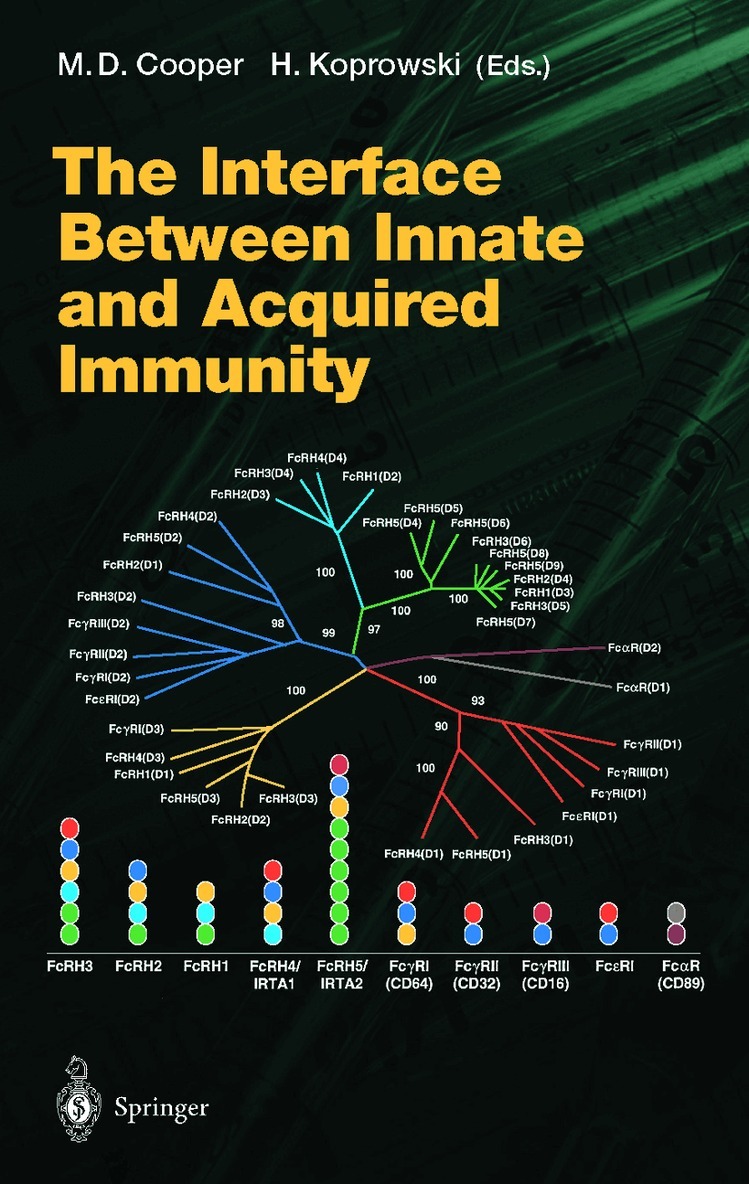
The topics of this volume include regulation of the helper T cell subset involved in inflammatory responses versus the subset of helper T cells involved in promoting B cells responses in humoral immunity, the regulation of T cell activity in inflammatory and autoimmune disease by the tumor necrosis factor superfamily of receptors and their ligands, the wide array of inhibitory and activating receptor that regulate natural killer cell function, phylogeny of Ig gene superfamily members linked to the major histocompatibility gene complex, the IgFc receptor family and a newly discovered family of Fc receptor homologs, the role of complement in linking innate and adaptive immunity, and manipulation of the potential for plants to protect themselves by innate and adaptive responses to viruses.
Del 266 - Current Topics in Microbiology and Immunology
Interface Between Innate and Acquired Immunity
Häftad, Engelska, 2010
1 680 kr
Skickas inom 10-15 vardagar
All multicellular organisms may possess innate immunity mediated by defense mechanisms with which the organism is born. In recent years much has been learned about the diversity of innate immune mechanisms. A large array of naturally produced antimicrobial peptides has been de fined. A variety of cell surface receptors that recognize common patterns displayed by infectious organisms have been identified along with the intracellular pathways that these receptors use to activate cellular defense functions. Cell surface receptors on natural killer (NK) cells have been shown to sense microbial invasion in neighboring cells, thereby setting into motion their elimination by cy totoxic mechanisms. Other receptors have been found to facilitate phagocytosis and intracellular killing of microbes by phagocytic cells. These and other natural defense mechanisms have traditionally been viewed as the first line of body defense in vertebrate species that also possess the capacity for acquired or adaptive immunity. Sharks and all of the other jawed vertebrates generate large repertoires of T and B lymphocyte clones that display different antigen specific receptors in the form ofT cell receptors (TCR) and immunoglobulins (Ig) that allow them to recognize and respond to antigens in collaboration with antigen-present ing cells. Memory T and B cells are then generated to allow faster and heightened cellular and humoral immune re sponses on secondary antigen encounter. In recent years it has also become obvious that innate immune responses can directly influence adaptive immune responses in ways that will enhance body defense.
E-bok
PDF, Engelska, 20121 408 kr
Läs direkt efter köp
The subject of immune deficiency has become of special importance for two reasons. First, conditions with well defined defects in the immune system could be analyzed as "experiments of nature" in terms of finding out the accurate biological relevance of the defective link in the immune system. Secondly, the recognition of immune deficiency states has become important in order to provide the patients with the treatment necessary to remedy these defects. With regard to immune deficiency states in patients, these have been instrumental as "experiments of nature" in the revelation by Drs. Good and Cooper and their associates of the two-component structure of the immune system, a discovery which can be consi dered as a major breakthrough in the history of immunopathology. Today''s research allows us to go far beyond this basic two component structure with the assessment of disorders affecting either cell to cell interactions or regarding subsets of lymphocyte populations. Furthermore, the association of immune deficiency with distinct enzymatic defects of purine metabolism is opening the door to the molecular level of immune deficiency. Dr. Cooper and Dr. Lawton have succeeded in obtaining the collaboration of the leaders in the field of immune deficiency. In view of the importance of their contributions in scientific and clinical terms, we decided to prepare a book version of the two issues of Seminars in Immunopathology devoted to this subject.
E-bok
PDF, Engelska, 20132 044 kr
Läs direkt efter köp
All multicellular organisms may possess innate immunity mediated by defense mechanisms with which the organism is born. In recent years much has been learned about the diversity of innate immune mechanisms. A large array of naturally produced antimicrobial peptides has been de fined. A variety of cell surface receptors that recognize common patterns displayed by infectious organisms have been identified along with the intracellular pathways that these receptors use to activate cellular defense functions. Cell surface receptors on natural killer (NK) cells have been shown to sense microbial invasion in neighboring cells, thereby setting into motion their elimination by cy totoxic mechanisms. Other receptors have been found to facilitate phagocytosis and intracellular killing of microbes by phagocytic cells. These and other natural defense mechanisms have traditionally been viewed as the first line of body defense in vertebrate species that also possess the capacity for acquired or adaptive immunity. Sharks and all of the other jawed vertebrates generate large repertoires of T and B lymphocyte clones that display different antigen specific receptors in the form ofT cell receptors (TCR) and immunoglobulins (Ig) that allow them to recognize and respond to antigens in collaboration with antigen-present ing cells. Memory T and B cells are then generated to allow faster and heightened cellular and humoral immune re sponses on secondary antigen encounter. In recent years it has also become obvious that innate immune responses can directly influence adaptive immune responses in ways that will enhance body defense.