MD Uzzal Molla – författare
Visar alla böcker från författaren MD Uzzal Molla. Handla med fri frakt och snabb leverans.
25 produkter
25 produkter
Häftad, Engelska, 2026
266 kr
Skickas inom 5-8 vardagar
E-bok
Engelska, 202624 kr
Läs direkt efter köp
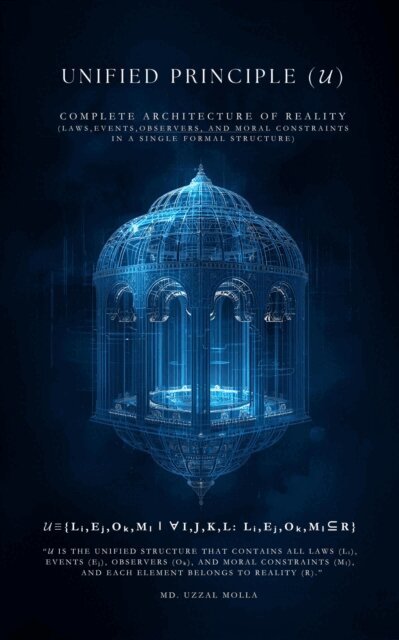
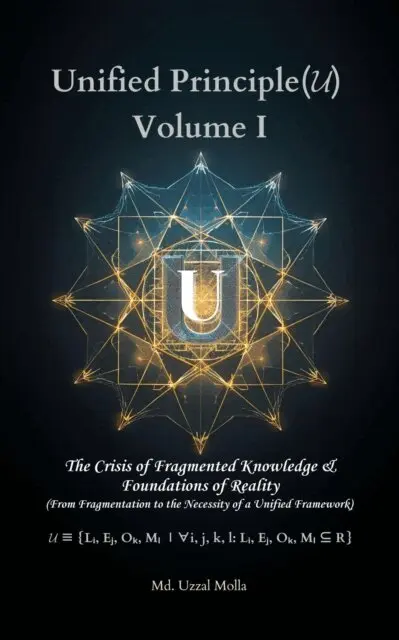
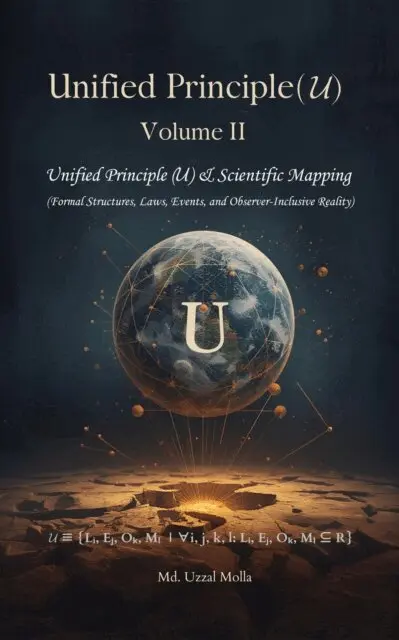
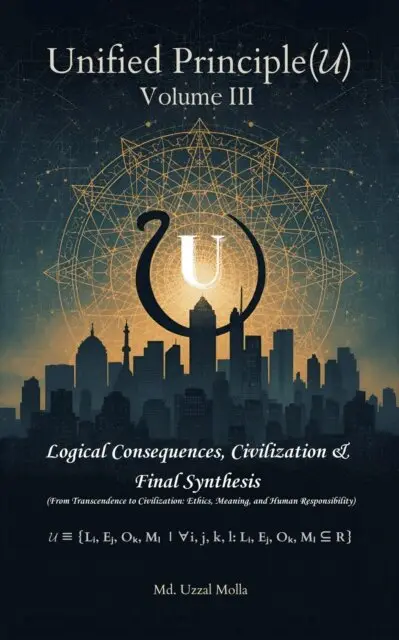
Unified Principle (𝓤): Complete Architecture of RealityThis thesis proposes an integrated and mathematically rigorous framework for understanding reality, in which laws, events, observers, and moral constraints are unified within a single coherent structure, denoted by 𝓤. Although conventional science has been highly successful in predicting phenomena, it suffers from a fragmented structure of knowledge-physical laws, quantum indeterminacy, consciousness, and morality are often treated separately. This separation creates conceptual incompleteness and hinders the formation of a logically consistent, observer-integrated model of reality.𝓤 is formally defined as follows:𝓤 ≡ {Lᵢ,Eⱼ,Oₖ,Mₗ∣∀i,j,k,l: Lᵢ,Eⱼ,Oₖ,Mₗ ⊆R}"e;𝓤 is the unified structure that contains all laws (Lᵢ), events (Eⱼ), observers (Oₖ), and moral constraints (Mₗ), and each element belongs to reality (R)."e;The Unified Principle (𝓤) constitutes the first fully integrated, mathematically and philosophically complete framework for reality. It unifies science, morality, consciousness, and civilization within a single coherent model, ensuring that human knowledge, action, and social development remain fully aligned with the fundamental architecture of reality. This work redefines the boundaries of science, philosophy, and ethics, and provides a unified foundation for future human inquiry and civilization.Moral Layer: Moral Function as Meta-ConstraintMorality here is not a separate emotion or social contract;it is a meta-rule imposed upon function-space:Mₗ(f(Oₖ,Lᵢ))⇒Eⱼ∗∈Eⱼ• f(Oₖ,Lᵢ) → possible event• Mₗ → structural filter• Result → Eⱼ∗• Eⱼ∗ := the structurally admissible realization of EⱼWhere Eⱼ∗ ∈ Eⱼ is the structurally admissible outcome.A valid, structurally permitted eventthat is consistent with both laws (Lᵢ) and moral constraints (Mₗ)Philosophical ImplicationsReality as Totality: Everything is within 𝓤; nothing exists outside it.Non-reducibility: L,E,O,M are ontologically fundamental; removing or reducing them generates paradox.Observer Responsibility:Every observational act is embedded within reality; no act is morally or physically neutral.Moral Realism: Morality emerges from structural necessity rather than theological doctrine or personal preference.Completeness: 𝓤 is capable of generating all events, scientific laws, moral principles, and civilizational constraints.Essence: 𝓤 unifies science, morality, and consciousness into a single mathematical-philosophical architecture, providing a logically necessary structure for understanding reality.Mathematical Formalism of Reality-Observer InteractionEvent FunctionalNo event in reality is spontaneous; it is the joint result of laws, observers, and moral structure.Eⱼ = f(Lᵢ,Oₖ,Mₗ)Explanation:Lᵢ – the legal structure permitting the eventOₖ – the observer activating and registering the eventMₗ – the structural moral boundary of the eventInformation-Theoretic MappingEach event is registered in reality as information, but not randomly.I(Eⱼ) = entropy-consistent, observer-registered, law-aligned dataMeaning:Information must be entropy-consistentRegistered by an observerAnd consistent with the applicable laws LᵢThus information, time, and reality are unified within the same structure.Necessity of Transcendence: The logical inference of a Creator / Ground of Reality resolves infinite regress and the problem of the origin of laws.∴ ∃G : G = Ground of RealityPhilosophical Meaning:This G – Creator / Ultimate Ground – is not a religious assumption, but a mathematical and logical necessity.
Del 3 - Volume
Unified Principle (
Häftad, Engelska, 2026
162 kr
Skickas inom 5-8 vardagar
E-bok
Engelska, 202620 kr
Läs direkt efter köp
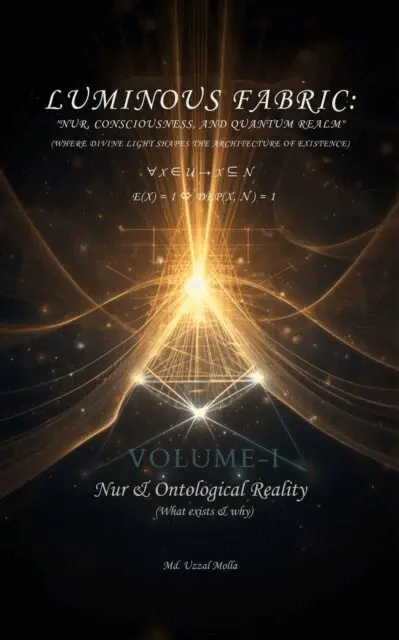
Luminous Fabric: Nur, Consciousness, and Quantum RealmVolume I - Nur & Ontological Reality (What exists & why)What does it mean to exist? Why is there something rather than nothing? And what is the ultimate ground upon which all reality stands?In this ground-breaking volume, a unified ontological framework is introduced-one that bridges metaphysics, logic, and the deepest structures of reality through a single formal principle. At its core lies the concept of Necessary Existence (N), identified as Nur-the luminous ground from which all existence emerges, within which all reality is contained, and upon which every entity depends.Through precise formal expressions such as∀x ∈ U → x ⊆ NandE(x) = 1 ⇔ Dep(x, N) = 1,the book establishes a rigorous model where existence is not arbitrary but structurally grounded. Reality (U) is presented not as a closed, self-explaining system, but as an ontologically dependent totality-pointing beyond itself to an uncaused, necessary foundation.Luminous Fabric is not merely a philosophical inquiry-it is a structural redefinition of existence itself. It offers a pathway from fragmented knowledge toward a coherent, unified vision of reality, where logic, existence, and meaning converge in the light of Nur.Md. Uzzal Molla is a Bangladeshi writer, independent researcher, and banker. His work primarily focuses on the intersection of spirituality, Islamic philosophy, and theoretical research into the nature of reality. Key Published Works: 1. Unified Principle, 2. Structure Shows the Meaning, 3. Spirituality and Humanity in Al-Qur'an, 4. The Secret and Significance of the 99 Names of Allah (Asma-ul-Husna)
Del 2 - Volume
Unified Principle (
Häftad, Engelska, 2026
148 kr
Skickas inom 5-8 vardagar
Häftad, Engelska, 2026
162 kr
Skickas inom 5-8 vardagar
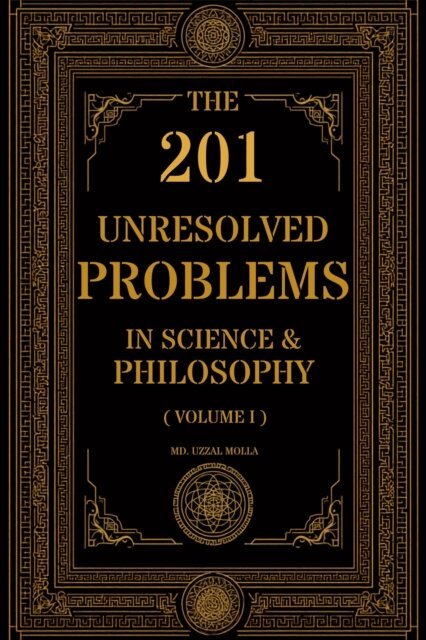
Del 1 - Volume I
Unified Principle (
Häftad, Engelska, 2026
162 kr
Skickas inom 5-8 vardagar
E-bok
Engelska, 202623 kr
Läs direkt efter köp
Be and It Is: Beyond the Big Bang explores the nature of existence beyond the idea of the universe as a mere beginning event. Moving past purely material explanations of creation, this philosophical work argues that reality is not the product of an isolated cosmic explosion, but the continuous manifestation of a necessary, conscious, and intelligent Being.Through reflections on cosmology, time, causality, spacetime, consciousness, and ontology, the book examines the limits of the Big Bang Theory as an ultimate explanation of existence. It proposes that time and causality belong to the structure of the universe itself and therefore cannot fully explain the ground from which reality arises.Drawing philosophical inspiration from the Qur'anic expression "e;Be, and it is"e; (Kun fa-yakūn), the book reinterprets creation not as a one-time event in the distant past, but as continuous presence and manifestation within Being itself.Blending metaphysics, cosmology, and philosophical theology, this work presents a unified framework in which:existence is continuous rather than absent,the universe is manifestation rather than independent origin,and Being is understood as necessary, conscious, intelligent, and foundational to all reality.A profound exploration of the ultimate question:What does it truly mean for existence to be?
E-bok
Engelska, 202624 kr
Läs direkt efter köp
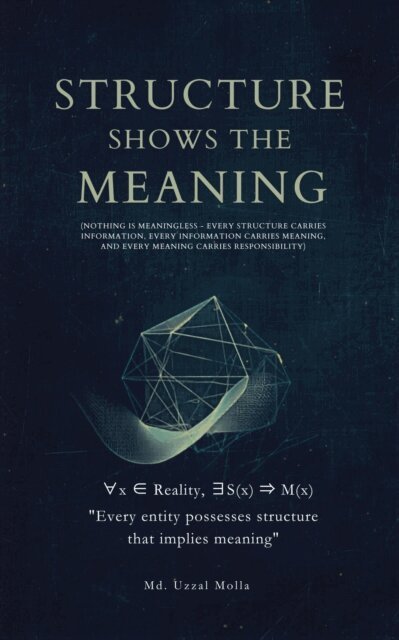
Mathematical Description of "e;Structure Shows the Meaning"e;This framework presents a formal and unified mathematical articulation of the principle "e;Structure Shows the Meaning."e; It establishes that meaning is not arbitrary, but systematically derived from structure through definable functional relationships within reality.At the most fundamental level, the principle is expressed as a direct mapping:S → M,where Structure (S) gives rise to Meaning (M).This relationship is further formalized through a functional representation:M = f(S),where f denotes an interpretation function that maps structure to meaning.However, meaning does not emerge in isolation. It is shaped through the interaction between structure and conscious agents. Thus, the model is extended to include observers:M = f(S, Ok),where Ok represents observers. Meaning emerges when structure is interpreted within an observational context.To achieve a complete representation of reality, the framework is expanded through the Unified Principle (𝓤):𝓤 = {Li, Ej, Ok, Ml},where Li (Laws) define governing principles, Ej (Events) represent dynamic occurrences, Ok (Observers) enable interpretation, and Ml (Moral constraints) introduce ethical structure. Accordingly, meaning is defined as:M = f(Li, Ej, Ok, Ml).Causality within this system is modeled through temporal evolution:Ejₜ₊₁ = g(Ejₜ, Li, Ok, Ml),where g represents the causal transformation function, describing how present structures and conditions generate future events.The framework further establishes that meaning gives rise to value:V = h(M),where h is the valuation function determining significance, importance, or ethical weight. This leads to the structural progression:Structure → Meaning → Value.At the highest level, these components integrate to form civilization:C = k(Li, Ej, Ok, Ml),where k represents systemic integration, modeling how structural elements collectively shape societal and civilizational outcomes.This progression can be summarized as a complete chain:S → M → V → A → C,where Action (A) emerges from value and contributes to the formation of civilization.In its most compact form, the entire framework is expressed as:C = k(h(f(S, Ok))),indicating that civilization is the result of successive transformations from structure to meaning, meaning to value, and value to systemic realization.At the ontological level, the principle is universally stated as:∀x ∈ Reality, ∃S(x) ⇒ M(x),asserting that every entity possesses a structure that implies meaning. This is reinforced by the necessary condition:¬S ⇒ ¬M,which establishes that without structure, meaning cannot exist.
Häftad, Engelska, 2026
182 kr
Skickas inom 5-8 vardagar
Häftad, Engelska, 2026
215 kr
Skickas inom 5-8 vardagar
E-bok
Engelska, 202623 kr
Läs direkt efter köp
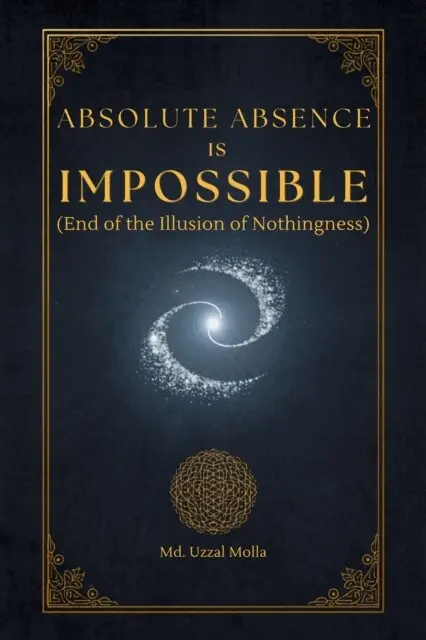
Absolute Absence Is Impossible: End of the Illusion of NothingnessWhat does it mean for something to be absolutely absent? Can true nothingness exist, or is the very concept self-contradictory?In Absolute Absence Is Impossible, Md. Uzzal Molla explores one of the deepest questions in philosophy, metaphysics, cosmology, and theology: whether absolute nonexistence is possible. Drawing upon logic, ontology, causality, information theory, contemporary physics, and philosophical analysis, the book argues that the notion of complete nothingness collapses under careful examination.The work investigates the relationship between existence, dependency, structure, information, and reality itself. It challenges the common assumption that existence emerged from an absolute void and examines whether the universe, natural laws, information, and consciousness point toward a deeper ontological foundation. Through rigorous reasoning, the book proposes that reality is fundamentally structured and that absolute absence is not a genuine possibility but an illusion created by linguistic and conceptual abstraction.Building upon the author's broader philosophical framework, including the Unified Principle (𝓤) and the principle Structure Shows the Meaning, this book examines the implications of an impossible nothingness for cosmology, the origin of the universe, the nature of time, consciousness, causality, and the question of a necessary foundation of existence.Rather than presenting a purely theological or purely scientific argument, the book seeks a synthesis between reason, observation, and metaphysical inquiry. It invites readers to reconsider some of humanity's most fundamental assumptions and to explore whether existence itself is the primary reality from which all structures, events, and meanings emerge.For philosophers, researchers, students, and seekers of truth, Absolute Absence Is Impossible offers a thought-provoking journey to the limits of human understanding and beyond the illusion of nothingness.
E-bok
Engelska, 202624 kr
Läs direkt efter köp
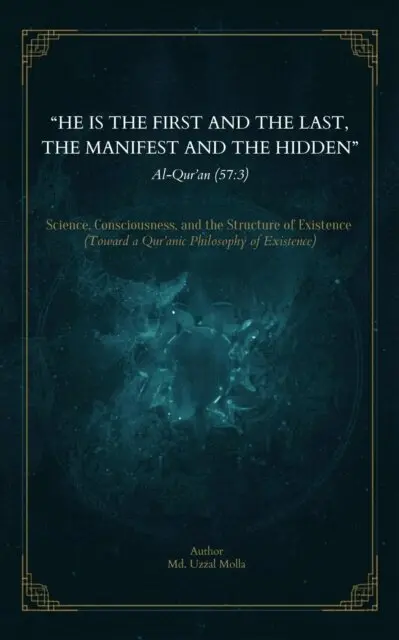
What is existence?Why is there something rather than nothing?Why does the universe possess intelligible order, mathematical structure, and conscious experience?This book develops a rigorous philosophical framework addressing these questions through a unified ontology of existence inspired by the Qur'anic statement:"e;He is the First and the Last,the Manifest and the Hidden."e;Qur'an 57:3Rather than treating this verse as only a theological expression, the work interprets it as a profound ontological structure describing reality itself.The book integrates:philosophy of existence,philosophy of science,consciousness studies,metaphysics,and structural ontologyinto a single coherent framework.At the center of the work is the argument that observable reality is not self-sufficient. Every manifest structure exists within networks of dependency, while scientific laws describe stable relations rather than creating them. Time is reinterpreted as an ordered structure of dependent change, not an independently flowing substance. Consciousness is examined not as a secondary accident of matter, but as a necessary condition for observation and experiential disclosure.The framework develops a fourfold ontology:The First — the non-dependent ground of existenceThe Last — continuity of existence beyond changing formsThe Manifest — the observable and measurable structure of realityThe Hidden — the deeper ontological depth beyond direct observationThese dimensions are presented not as separate metaphysical realms, but as interdependent aspects of one unified reality.The book argues that science, while extraordinarily powerful, remains a partial reading of existence because scientific knowledge depends upon observation, intelligibility, and conscious access. Observable reality therefore points beyond itself toward deeper grounding conditions that cannot be reduced to physical description alone.To support this framework, the work introduces formal ontological notation and symbolic expressions describing dependency, grounding, manifestation, continuity, and consciousness. These formulations are used not as conventional physical equations, but as structural representations of ontological relations.Positioned as a contemporary Qur'anic philosophy of existence, this work seeks to establish a non-reductionist vision of reality in which science, consciousness, and metaphysical inquiry converge into a unified philosophical system.Rather than presenting existence as a collection of isolated objects or forces, the book proposes that reality is fundamentally:grounded,continuous,intelligible,manifested,and transcendent beyond complete objectification.This work is intended for readers interested in ontology, metaphysics, philosophy of science, consciousness studies, cosmology, and the deeper philosophical foundations of reality itself.
Häftad, Engelska, 2026
152 kr
Skickas inom 5-8 vardagar
Häftad, Engelska, 2026
127 kr
Skickas inom 5-8 vardagar
Häftad, Engelska, 2026
128 kr
Skickas inom 5-8 vardagar
E-bok
Engelska, 202624 kr
Läs direkt efter köp
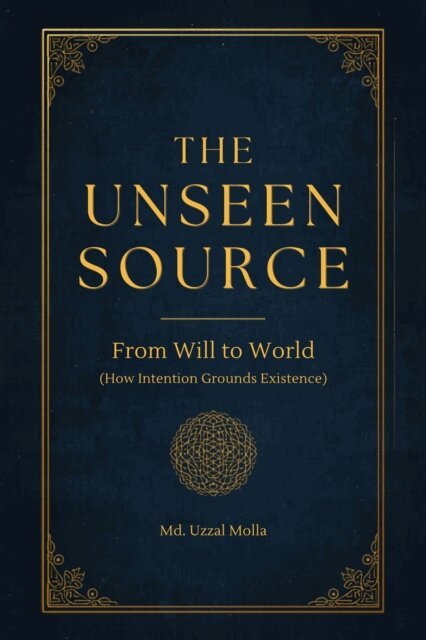
The Unseen Source: From Will to World (How Intention Grounds Existence) is a profound philosophical and structural inquiry into one of the deepest questions in metaphysics and existence: Why does structured reality exist at all? Rather than beginning from matter, space, or time as ultimate foundations, this work investigates the unseen principle that makes determination, order, and manifestation possible in the first place.Modern scientific models successfully describe patterns, transformations, and relational behavior within the universe, yet they often remain silent regarding the origin of determination itself. Physical laws may explain how states evolve from prior states, but they do not fully explain why a determinate structure exists rather than indeterminacy. Likewise, causal chains may extend indefinitely, yet an infinite regress of dependent explanations does not resolve the necessity of grounding. This book addresses that unresolved boundary.At the center of the framework is the concept of I₀, the Non-Temporal Directive Ground - a non-dependent, non-physical, and non-sequential principle of determination. I₀ is not presented as an object, force, or entity located somewhere within the universe. It is not composed of matter, energy, or temporal process. Rather, it is developed as the foundational condition that allows realization itself to occur. In this framework, reality does not emerge from randomness or passive existence alone, but from a principle of structural determination through which possibility becomes actuality.The work systematically argues that passive ground cannot generate structured existence without directive specification. A universe governed solely by undirected potential cannot account for stable lawfulness, coherent relational order, or intelligible structure. From this analysis, the book develops a unified relational system denoted as 𝓤, composed of four interconnected layers:Li (Laws / Constraints): the stable structural limits defining possibility and consistencyEj (Events): structured transitions and realized variations within constraintOk (Observers): reflective systems capable of relational distinction and internal registrationMl (Directional Coherence): the principle of alignment, stability, and structural continuity across transformationsTogether, these layers form a complete architecture of reality grounded in non-temporal determination rather than sequential emergence.The work also reexamines causality, time, observation, and manifestation. Time is treated not as an independently flowing dimension, but as a derived ordering of structured events. Observation is understood not as external access to reality, but as internal reflection occurring within the unified structure. Manifestation itself is interpreted as realized determination rather than temporal production.Blending metaphysics, formal logic, systems thinking, ontology, and structural philosophy, The Unseen Source develops a rigorous non-dual framework in which reality is understood as a coherent relational expression grounded in an unseen directive principle beyond physical sequence and material composition.Ultimately, the book proposes that existence is not self-grounded randomness, nor merely mechanical unfolding, but the realized expression of a foundational determination through which world, law, structure, and intelligibility become possible at all.
Häftad, Engelska, 2026
142 kr
Skickas inom 5-8 vardagar
Häftad, Engelska, 2026
122 kr
Skickas inom 5-8 vardagar
E-bok
Engelska, 202624 kr
Läs direkt efter köp
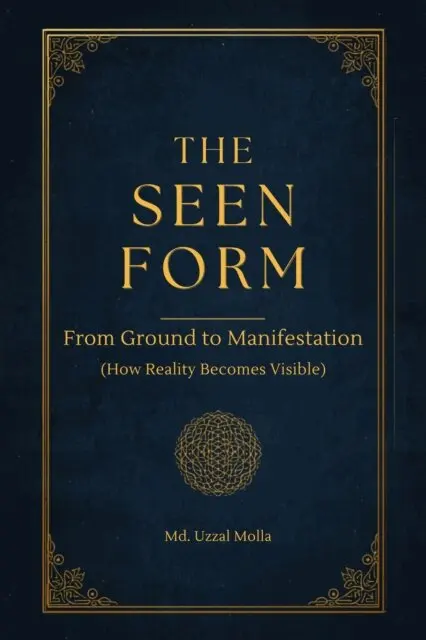
The Seen Form: From Ground to Manifestation (How Reality Becomes Visible) is a profound philosophical and structural inquiry into the deepest problem underlying existence: not merely what reality is, but how reality becomes manifest, intelligible, and visible at all. Moving beyond conventional divisions between metaphysics, ontology, science, and systems theory, the work develops a unified framework in which existence is understood not as a collection of independent objects, but as a continuous relational structure grounded in non-temporal determination.Modern thought often explains reality through matter, energy, causality, and temporal evolution. Yet beneath every scientific description remains an unresolved question: why does structured existence appear rather than indeterminate possibility? Physical laws may describe transformations of states, but they do not fully explain why coherent lawfulness, intelligibility, and manifestation exist in the first place. Likewise, observation reveals patterns, but observation itself presupposes a deeper structural condition through which visibility becomes possible.This work begins precisely at that boundary.At the center of the book is the concept of 𝓤 - Unified Structured Reality, a total relational system composed of four inseparable structural layers:L- Laws / Constraints: the stable structural principles defining the boundaries of possibility and preserving consistencyE - Events: realized transitions and transformations unfolding within the limits of structureO - Observation: reflective systems through which relational distinctions become internally registeredM - Moral Coherence / Moral Constraint: the principle of directional alignment, stability, and structural harmony across transformationsTogether these form a single integrated architecture of reality, not as separate substances, but as functional expressions of one coherent system grounded in a non-temporal directive principle denoted as I₀.Within this framework, time is reinterpreted not as an independently flowing dimension, but as the ordered interpretation of structured events under observation. Causality is reconsidered not as ultimate explanation, but as relational dependency operating within already-existing structure. Manifestation itself is no longer treated as surface appearance hiding a deeper world beyond perception. Instead, form becomes the intelligible articulation of relational structure itself.As the argument unfolds, the book systematically dissolves classical separations that have shaped human understanding for centuries: subject and object, observer and observed, matter and meaning, form and ground, seen and unseen. These distinctions are shown not to be absolute divisions in reality, but relational differentiations within one internally coherent structure. The visible world therefore ceases to appear as fragmented multiplicity and instead emerges as structured expression of unified relational existence.A central contribution of the work lies in its reinterpretation of visibility itself. What is "e;seen"e; is not a detached representation of an inaccessible hidden reality. The seen is reality becoming expressible within its own structural conditions. Visibility is therefore not accidental perception, but the necessary manifestation of coherent relational order.
E-bok
Engelska, 202623 kr
Läs direkt efter köp
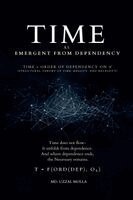
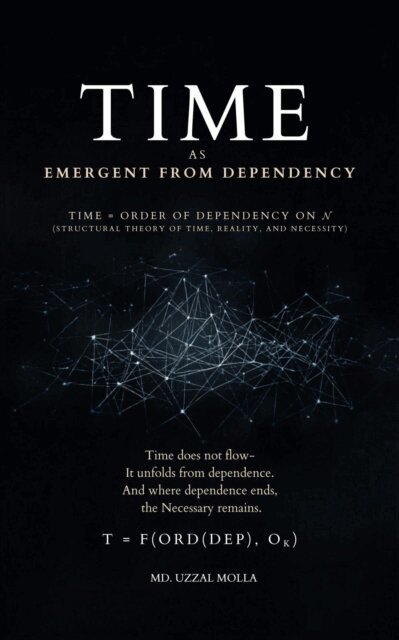
Time as Emergent from Dependency presents a bold rethinking of one of the most fundamental assumptions in science and philosophy: the nature of time. Instead of treating time as a primary dimension in which reality unfolds, this work argues that time is not fundamental-it is emergent.The central thesis is simple:Time does not carry existence.Time emerges from it.At the foundation of this framework lies dependency (Dep)-a structural relation in which one element exists only if another is ontologically prior. From this principle, reality is reconstructed not as a temporal sequence, but as a relational structure.To formalize this, the book introduces a unified system:𝓤 = {Li, Ej, Ok, Ml}Where laws, events, observers, and moral constraints form a complete structural field. Within this system, time arises as an ordering of dependency:T = Ord(Dep)T = f(Dep, Ok)Thus, time is not an independent entity but an interpreted ordering of relations, completed through observation.This leads to several key conclusions:Time does not flowTime is not a dimensionTime does not cause changeTime is observer-dependentInstead, what we experience as time is the interpretation of structural change:Memory = resolved dependencyFuture = unresolved dependencyBecoming = reconfiguration of relationsA central philosophical result is the rejection of infinite regress in dependency chains. This leads to the necessity of a non-dependent ground:∃𝓝 such that Dep(𝓝) = ∅This ground (𝓝) is not within reality but the condition of its possibility-beyond time, change, and dependency.The full structure can be expressed as:𝓝 → 𝓤 → Dep → Ord(Dep) → TThis is not a temporal sequence, but a hierarchy of emergence.Ultimately, the book proposes a shift from temporal ontology to structural ontology. Reality is not something that unfolds in time; rather, time is the final interpretive layer of a deeper relational structure.Reality is not in time.Time is in reality.This work offers a unified framework connecting physics, philosophy, and metaphysics—challenging deeply held assumptions and presenting a coherent alternative grounded in dependency, structure, and necessity.
E-bok
Engelska, 202624 kr
Läs direkt efter köp
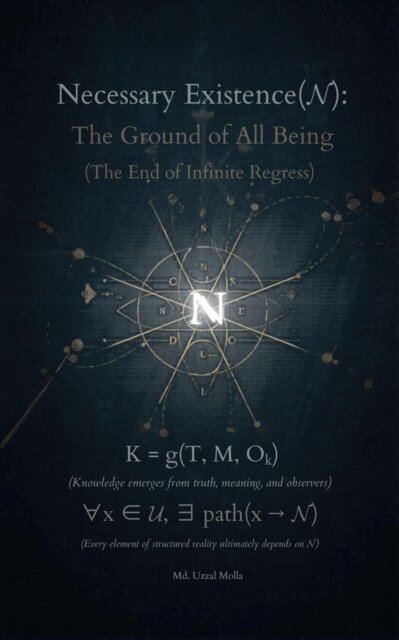
Necessary Existence (𝓝): The Ground of All Being(The End of Infinite Regress)Introduction: The Question Behind All QuestionsEvery field of human inquiry—science, philosophy, mathematics, and even everyday reasoning—rests upon a silent assumption: that reality exists and is, in some sense, intelligible. Yet beneath this assumption lies a deeper and more fundamental question:Why does anything exist at all?This is not a question that can be postponed or bypassed. It is not merely one problem among others; it is the condition that makes all other problems possible. Every explanation presupposes that something exists to be explained. Every theory assumes a reality that can be described. Every act of knowledge relies on a structure that makes knowing possible.But when we attempt to answer this question, we encounter a profound difficulty. Every explanation seems to lead to another explanation:A thing exists because of something else.That something else exists because of something prior.And so on, indefinitely.This leads to the classical problem of infinite regress—an endless chain of explanations with no ultimate foundation.This book begins with a decisive insight:Infinite regress is not an explanation—it is the absence of one.If explanation never terminates, then explanation never truly occurs. A chain without a foundation is not a solution; it is a postponement.From this realization, Necessary Existence (𝓝): The Ground of All Being develops a rigorous and unified framework to address the deepest question of existence. Dependency: The Hidden Logic of ExistenceAt the core of this framework lies a simple but powerful relation:D(x, y): x depends on yThis relation reveals that:Events depend on lawsObservers depend on structured existenceMeaning depends on interpretationKnowledge depends on truth and coherenceNothing exists in isolation.Everything is part of a dependency network.From this, we define:C(x) ⇔ ∃y D(x, y)A contingent entity is one that depends on something else for its existence.This leads to a universal principle:All contingent reality is dependent.Author: Md. Uzzal Molla is a Bangladeshi writer, independent researcher, and banker. His work primarily focuses on the intersection of spirituality, philosophy, and theoretical research into the nature of reality. He holds an MSS degree in Anthropology from the University of Dhaka. Key Published Works: 1. Unified Principle, 2. Structure Shows the Meaning, 3. Necessary Existence, 4. Spirituality and Humanity in Al-Qur'an, 5. The Secret and Significance of the 99 Names of Allah (Asma-ul-Husna)