Menno van Zaanen – författare
Visar alla böcker från författaren Menno van Zaanen. Handla med fri frakt och snabb leverans.
4 produkter
4 produkter
Häftad, Engelska, 2015
398 kr
Skickas inom 10-15 vardagar
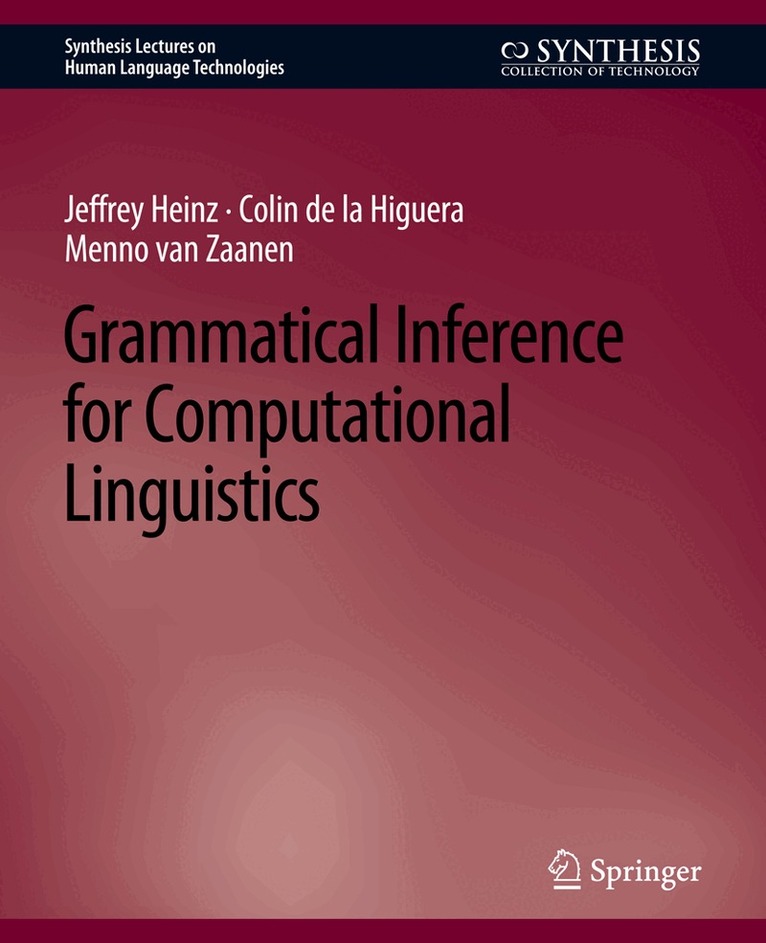
This book provides a thorough introduction to the subfield of theoretical computer science known as grammatical inference from a computational linguistic perspective. Grammatical inference provides principled methods for developing computationally sound algorithms that learn structure from strings of symbols. The relationship to computational linguistics is natural because many research problems in computational linguistics are learning problems on words, phrases, and sentences: What algorithm can take as input some finite amount of data (for instance a corpus, annotated or otherwise) and output a system that behaves "correctly" on specific tasks? Throughout the text, the key concepts of grammatical inference are interleaved with illustrative examples drawn from problems in computational linguistics. Special attention is paid to the notion of "learning bias." In the context of computational linguistics, such bias can be thought to reflect common (ideally universal) properties of natural languages. This bias can be incorporated either by identifying a learnable class of languages which contains the language to be learned or by using particular strategies for optimizing parameter values. Examples are drawn largely from two linguistic domains (phonology and syntax) which span major regions of the Chomsky Hierarchy (from regular to context-sensitive classes). The conclusion summarizes the major lessons and open questions that grammatical inference brings to computational linguistics. Table of Contents: List of Figures / List of Tables / Preface / Studying Learning / Formal Learning / Learning Regular Languages / Learning Non-Regular Languages / Lessons Learned and Open Problems / Bibliography / Author Biographies
E-bok
PDF, Engelska, 2022472 kr
Läs direkt efter köp
This book provides a thorough introduction to the subfield of theoretical computer science known as grammatical inference from a computational linguistic perspective. Grammatical inference provides principled methods for developing computationally sound algorithms that learn structure from strings of symbols. The relationship to computational linguistics is natural because many research problems in computational linguistics are learning problems on words, phrases, and sentences: What algorithm can take as input some finite amount of data (for instance a corpus, annotated or otherwise) and output a system that behaves "correctly" on specific tasks? Throughout the text, the key concepts of grammatical inference are interleaved with illustrative examples drawn from problems in computational linguistics. Special attention is paid to the notion of "learning bias." In the context of computational linguistics, such bias can be thought to reflect common (ideally universal) properties of natural languages. This bias can be incorporated either by identifying a learnable class of languages which contains the language to be learned or by using particular strategies for optimizing parameter values. Examples are drawn largely from two linguistic domains (phonology and syntax) which span major regions of the Chomsky Hierarchy (from regular to context-sensitive classes). The conclusion summarizes the major lessons and open questions that grammatical inference brings to computational linguistics. Table of Contents: List of Figures / List of Tables / Preface / Studying Learning / Formal Learning / Learning Regular Languages / Learning Non-Regular Languages / Lessons Learned and Open Problems / Bibliography / Author Biographies
Häftad, Engelska, 2002
565 kr
Skickas inom 10-15 vardagar
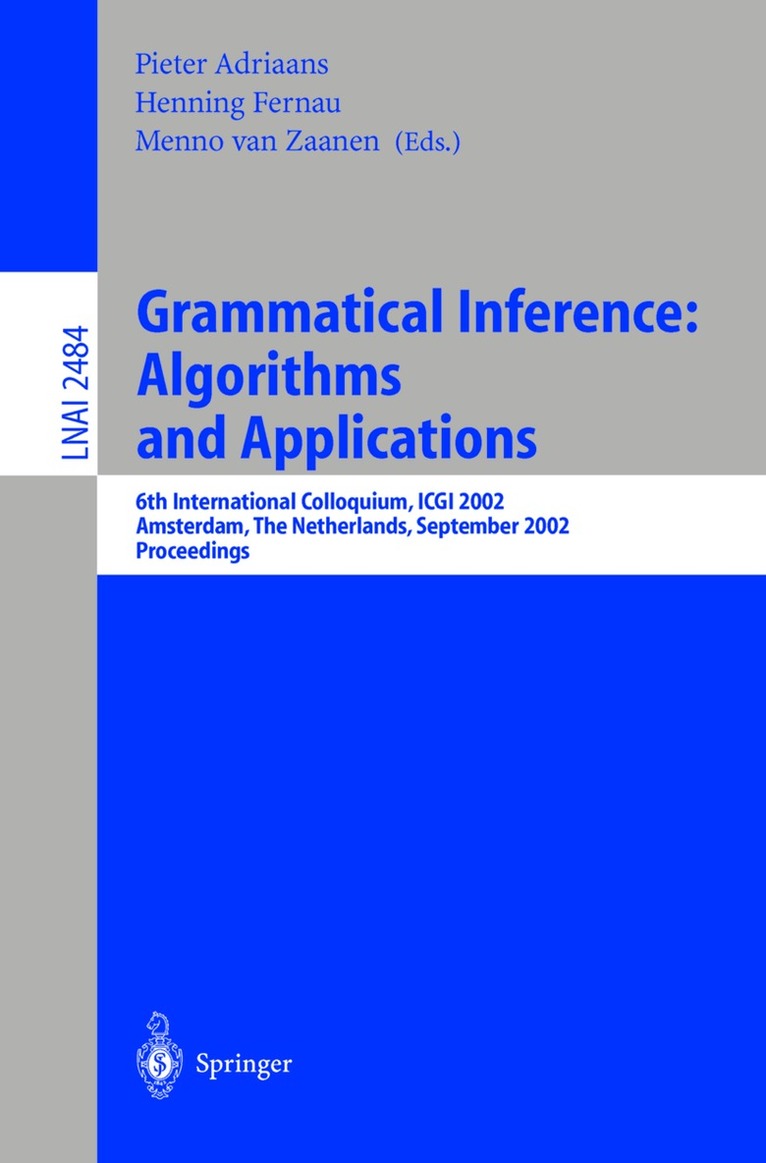
The Sixth International Colloquium on Grammatical Inference (ICGI2002) was held in Amsterdam on September 23-25th, 2002. ICGI2002 was the sixth in a series of successful biennial international conferenceson the area of grammatical inference. Previous meetings were held in Essex, U.K.; Alicante, Spain; Mo- pellier, France; Ames, Iowa, USA; Lisbon, Portugal. This series of meetings seeks to provide a forum for the presentation and discussion of original research on all aspects of grammatical inference. Gr- matical inference, the process of inferring grammars from given data, is a ?eld that not only is challenging from a purely scienti?c standpoint but also ?nds many applications in real-world problems. Despite the fact that grammatical inference addresses problems in a re- tively narrow area, it uses techniques from many domains, and is positioned at the intersection of a number of di?erent disciplines. Researchers in grammatical inference come from ?elds as diverse as machine learning, theoretical computer science, computational linguistics, pattern recognition, and arti?cial neural n- works. From a practical standpoint, applications in areas like natural language - quisition, computational biology, structural pattern recognition, information - trieval, text processing, data compression and adaptive intelligent agents have either been demonstrated or proposed in the literature. The technical program included the presentation of 23 accepted papers (out of 41 submitted). Moreover, for the ?rst time a software presentation was or- nized at ICGI. Short descriptions of the corresponding software are included in these proceedings, too.
E-bok
PDF, Engelska, 2003708 kr
Läs direkt efter köp
The Sixth International Colloquium on Grammatical Inference (ICGI2002) was held in Amsterdam on September 23-25th, 2002. ICGI2002 was the sixth in a series of successful biennial international conferenceson the area of grammatical inference. Previous meetings were held in Essex, U.K.; Alicante, Spain; Mo- pellier, France; Ames, Iowa, USA; Lisbon, Portugal. This series of meetings seeks to provide a forum for the presentation and discussion of original research on all aspects of grammatical inference. Gr- matical inference, the process of inferring grammars from given data, is a ?eld that not only is challenging from a purely scienti?c standpoint but also ?nds many applications in real-world problems. Despite the fact that grammatical inference addresses problems in a re- tively narrow area, it uses techniques from many domains, and is positioned at the intersection of a number of di?erent disciplines. Researchers in grammatical inference come from ?elds as diverse as machine learning, theoretical computer science, computational linguistics, pattern recognition, and arti?cial neural n- works. From a practical standpoint, applications in areas like natural language - quisition, computational biology, structural pattern recognition, information - trieval, text processing, data compression and adaptive intelligent agents have either been demonstrated or proposed in the literature. The technical program included the presentation of 23 accepted papers (out of 41 submitted). Moreover, for the ?rst time a software presentation was or- nized at ICGI. Short descriptions of the corresponding software are included in these proceedings, too.