Mesrob K. Krikorian - Böcker
Visar alla böcker från författaren Mesrob K. Krikorian. Handla med fri frakt och snabb leverans.
3 produkter
3 produkter
1 676 kr
Skickas inom 10-15 vardagar
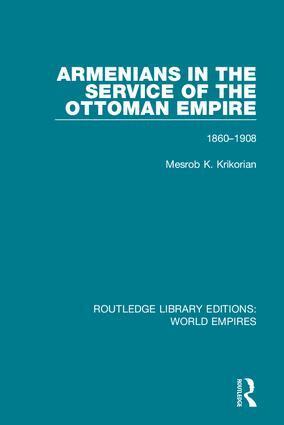
First published in 1977. Although hundreds of books have been published on the Armenian question and massacres, very little is known about their services in the cultural, economic and administrative life and development of the Ottoman Empire. This study is an investigation into the contribution by Armenians to Ottoman public life from 1860, when the Armenian community in Turkey was given a new legislative Constitution on the basis of Tanzimat (Reforms) until 1908, when the young Turks seized power and there followed a bitterly fanatic policy of intolerance which had tragic consequences for both the Armenians and the Turks. The author has concentrated his investigations on the eastern provinces of Anatolia, which earlier formed the western part of historic Armenia and which in the diplomatic language of the nineteenth century were referred to as ‘provinces inhabited by Armenians’. To these he has added the provinces of Syria, close to the neighbouring Armenian Kingdom of Cilicia, and where, especially in and around Aleppo, old Armenian communities had settled. Both in Anatolia and Syria, the Armenians were employed in various administrative, judicial, economic and secretarial fields and, to a lesser extent, in technical affairs, agriculture, education and public health. The author shows how this contribution was made in spite of the fact that for the Armenians these were years of transition from their established status as a favoured Christian millet to the tragic insecurity of a hunted people.
508 kr
Skickas inom 10-15 vardagar
First published in 1977. Although hundreds of books have been published on the Armenian question and massacres, very little is known about their services in the cultural, economic and administrative life and development of the Ottoman Empire. This study is an investigation into the contribution by Armenians to Ottoman public life from 1860, when the Armenian community in Turkey was given a new legislative Constitution on the basis of Tanzimat (Reforms) until 1908, when the young Turks seized power and there followed a bitterly fanatic policy of intolerance which had tragic consequences for both the Armenians and the Turks. The author has concentrated his investigations on the eastern provinces of Anatolia, which earlier formed the western part of historic Armenia and which in the diplomatic language of the nineteenth century were referred to as ‘provinces inhabited by Armenians’. To these he has added the provinces of Syria, close to the neighbouring Armenian Kingdom of Cilicia, and where, especially in and around Aleppo, old Armenian communities had settled. Both in Anatolia and Syria, the Armenians were employed in various administrative, judicial, economic and secretarial fields and, to a lesser extent, in technical affairs, agriculture, education and public health. The author shows how this contribution was made in spite of the fact that for the Armenians these were years of transition from their established status as a favoured Christian millet to the tragic insecurity of a hunted people.
Christology of the Oriental Orthodox Churches
Christology in the Tradition of the Armenian Apostolic Church
Häftad, Engelska, 2010
740 kr
Skickas inom 5-8 vardagar
The book offers to the reader a deep and ample knowledge about the theological tradition of the Oriental Orthodox Churches in general and of the Armenian Apostolic Church in particular. Since this small family of Orthodox Churches is not very known to the public, the book provides exact, reliable and scholarly first-hand theological information which is of immense value and importance. The Family of the Oriental Orthodox Churches acknowledges only the first three Ecumenical Councils, those of Nicaea (325), Constantinople (381) and Ephesus (431), and thus maintains the pure theology of the early Church without addition or changes. The book contains theological studies which without exception were read at international Conferences or symposia and consequently and naturally are written in a spirit of tolerance and reconciliation. This ecumenical aspect is an important contribution to the rapprochement and reunion of the Churches. Tolerance and understanding of other theological positions and phrasings are remarkable throughout the book and in this sense an additional advantage in studying the theology of the Oriental Orthodox Churches.