Michael Rapoport – författare
Visar alla böcker från författaren Michael Rapoport. Handla med fri frakt och snabb leverans.
6 produkter
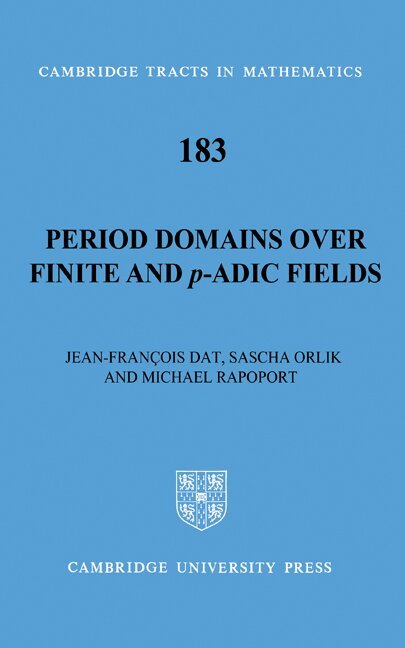
Period Domains over Finite and p-adic Fields
Av Jean-François Dat, Sascha Orlik m. fl.
Inbunden, 2010
2312 kr
Lägg i varukorg
This book is, on the one hand, a pedagogical introduction to the formalism of slopes, of semi-stability and of related concepts in the simplest possible context. It is therefore accessible to any graduate student with a basic knowledge in algebraic geometry and algebraic groups. On the other hand, …
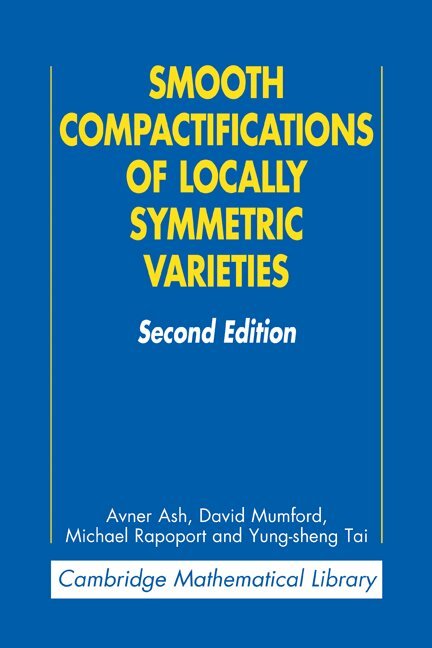
Smooth Compactifications of Locally Symmetric Varieties
Av Avner Ash, David Mumford m. fl.
Häftad, 2010
1009 kr
Lägg i varukorg
The new edition of this celebrated and long-unavailable book preserves the original book's content and structure and its unrivalled presentation of a universal method for the resolution of a class of singularities in algebraic geometry. At the same time, the book has been completely re-typeset, …
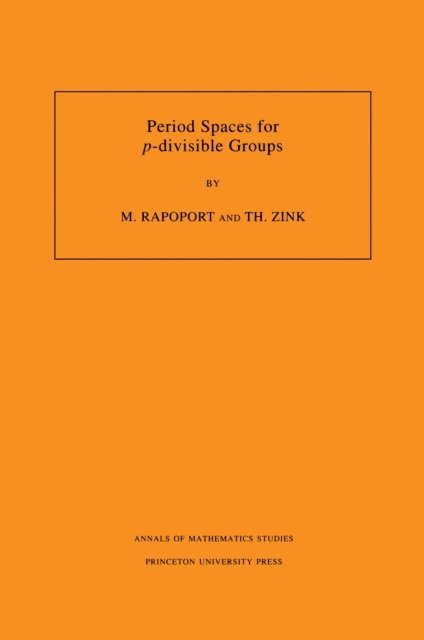
Period Spaces for p-divisible Groups
Av Michael Rapoport, Thomas Zink
Häftad, 1996
1258 kr
Lägg i varukorg
In this monograph p-adic period domains are associated to arbitrary reductive groups. Using the concept of rigid-analytic period maps the relation of p-adic period domains to moduli space of p-divisible groups is investigated. In addition, non-archimedean uniformization theorems for general Shimura …
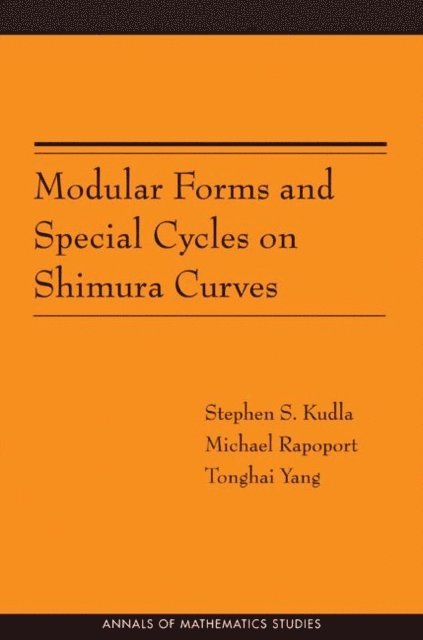
Modular Forms and Special Cycles on Shimura Curves
Av Stephen S. Kudla, Michael Rapoport m. fl.
Häftad, 2006
1028 kr
Lägg i varukorg
Modular Forms and Special Cycles on Shimura Curves is a thorough study of the generating functions constructed from special cycles, both divisors and zero-cycles, on the arithmetic surface "M" attached to a Shimura curve "M" over the field of rational numbers. These generating functions are shown …
Modular Forms and Special Cycles on Shimura Curves
Av Tonghai Yang, Michael Rapoport m. fl.
E-bok, 2006
1426 kr
Lägg i varukorg
Modular Forms and Special Cycles on Shimura Curves is a thorough study of the generating functions constructed from special cycles, both divisors and zero-cycles, on the arithmetic surface "M" attached to a Shimura curve "M" over the field of rational numbers. These generating functions are shown …
Period Spaces for p-divisible Groups
Av Thomas Zink, Michael Rapoport
E-bok, 2016
1754 kr
Lägg i varukorg
In this monograph p -adic period domains are associated to arbitrary reductive groups. Using the concept of rigid-analytic period maps the relation of p -adic period domains to moduli space of p -divisible groups is investigated. In addition, non-archimedean uniformization theorems for general …