Michael Regan – författare
Visar alla böcker från författaren Michael Regan. Handla med fri frakt och snabb leverans.
16 produkter
16 produkter
Inbunden, Engelska, 2026
2 726 kr
Kommande
Can roads truly be made safer? Yes, they can, and this handbook shows road designers and traffic engineers how, through a better understanding of road users – the “human factor”.Over a million people are killed every year on the world’s roads. Road user error is often concluded to be one of the main factors contributing to road crashes, and many in the road safety world believe that road user error is inevitable. But it need not be inevitable in a transport system that is designed around the needs and capabilities of its users. This is where road designers and traffic engineers have a vital role to play. Over many years, they have developed their skills to optimise traffic movement and maximise safety. But they don’t always get it right. One likely reason is that they may lack a basic understanding of the abilities, limitations and needs of the very people they are designing for – road users.The scientific discipline of “Human Factors” exists to support road designers and traffic engineers, so that they can put road users at the centre of their design thinking. It provides them with data, principles and knowledge that can be applied to designs to optimise human performance, minimise error and make the road transport system safer and more user-friendly. Human factors is not just of interest to professionals involved in behavioural programmes for road safety, it is also vital for the development of the professional skills that road designers and traffic engineers need, to do their job effectively.This handbook – the first of its kind – seeks to show how an understanding of human factors can be applied in practical ways to the day-to-day tasks of designing and managing the road system to make it a safer and more user-friendly place to travel. The handbook is structured in a way that takes the reader through the fundamentals of road safety and human-centred design and then looks at road user capabilities, limitations and design needs before the majority of the chapters look at the practical application of this knowledge to the various aspects of road design and traffic management that professionals are involved in.This handbook is also designed as a textbook, putting the human factor at the heart of basic education and training in road and traffic design for undergraduate and postgraduate students.Here is the how and why of human factors for road designers and traffic engineers in one convenient volume based on the authors’ extensive knowledge, experience and expertise. Packed with case studies, human factors checklist questions, photos, do’s and don’ts, examples and practical exercises, it is a must-have for students and professionals alike.
E-bok
PDF, Engelska, 201790 kr
Läs direkt efter köp
Everyone makes mistakes, but they''re not often on display for the whole world to see. These blunders in science and invention have gone down in history and will never be forgotten.
E-bok
PDF, Engelska, 2016668 kr
Läs direkt efter köp
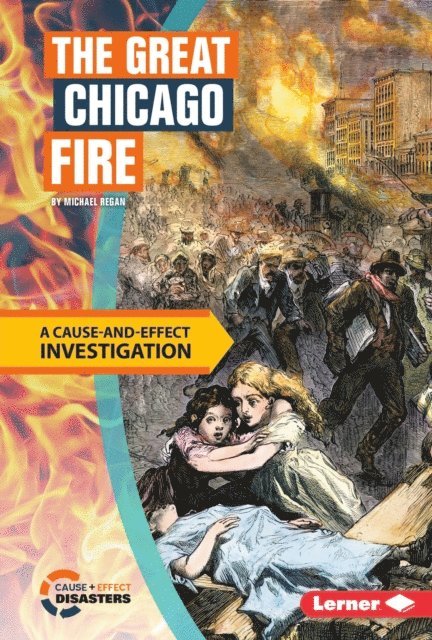
On October 8, 1871, a fierce fire broke out in the bustling city of Chicago. Jumping rivers and burning miles of buildings and homes, the flames raged for more than two days. More than a hundred people died, and thousands were left homeless. Could the city have prevented this blaze?To understand the impact of a disaster, you must understand its causes. How did Chicago''s building methods add fuel to the fire? How did human error delay help when the fire broke out? Investigate the disaster from a cause-and-effect perspective and find out!
E-bok
Engelska, 201669 kr
Läs direkt efter köp
On October 8, 1871, a fierce fire broke out in the bustling city of Chicago. Jumping rivers and burning miles of buildings and homes, the flames raged for more than two days. More than a hundred people died, and thousands were left homeless. Could the city have prevented this blaze?To understand the impact of a disaster, you must understand its causes. How did Chicago''s building methods add fuel to the fire? How did human error delay help when the fire broke out? Investigate the disaster from a cause-and-effect perspective and find out!
Inbunden, Engelska, 2018
503 kr
Skickas inom 3-6 vardagar
Inbunden, Engelska, 2021
408 kr
Skickas inom 11-20 vardagar
This title introduces readers to the region of South America. Concise text, thought-provoking discussion questions, and compelling photos give the reader an insightful look into South America’s rich and complex histories, natural environments, economies, governments, and peoples.
E-bok
PDF, Engelska, 201078 kr
Läs direkt efter köp
Essay from the year 2010 in the subject Musicology - Miscellaneous, grade: none, , language: English, abstract: Franz Liszt, remains an enigmatic figure. Probably no other major composer of the 19th century, with the possible exception of Berlioz, has aroused such contradictory opinions. That he was a major figure there can be no doubt- the B minor sonata and the Faust symphony testify to that. But that he was a genius, as Alfred Brendel, and, no doubt, others suggest, is more debatable. Geniuses produce works which (1), withstand the test of time, often of very long periods of time, and (2), are perceived as flawless masterpieces (or as near to it as is humanly possible). Now, although Liszt passes on the first point- his work is still very much with us both in live and recorded form- I do not think it can be said that any of Liszt's works, even the very best, are flawless. Even the great B minor Sonata has at least two dud bars (708-9), and does not that great tune marked grandioso, and first heard in bar 105, come just a little too many times for the effect that Liszt was aiming at to be fully realised? On the other hand he cannot be dismissed lightly. His enormous output contains many works, which may not be masterpieces but can still have an uncanny power over unprejudiced audiences. I remember Claudio Arrau s magisterial readings of some of the Transcendental Studies which almost convinced one that these were indeed masterpieces, and Kempff s poetic and almost impressionistic touch with some of the pieces from Anees de Pelerinage. But whatever we may think about his final place in the pantheon of composers, there can hardly be any dispute over the position of the late works, those written after 1860 in which Liszt, virtually on his own, foreshadowed many of the new directions explored by composers in the 20th century. In mostly short pieces, and in the main for his own instrument, we find Liszt anticipating impressionism, atonality, unorthodox chords and progressions, and scales outside of the customary major and minor, all of which did not become common until well after 1910.
E-bok
PDF, Engelska, 201176 kr
Läs direkt efter köp
Essay from the year 2011 in the subject Musicology - Miscellaneous, grade: none, , language: English, abstract: My dictionary defines meaning as "e;what somebody wants to express"e; and "e;what something signifies"e;. As a teacher I used to ask my composition students why they wanted to write music, to which question the most frequently occurring answer, and one that I suspected they had usually not fully thought-out, was "e;To express myself."e; But how do composers express themselves in music, and is self-expression, or for that matter, any clear-cut expression really possible, or just an illusion. Can music, of itself, really express or signify anything, and if so, how?Because it seems that of all the arts it is music that is the least amenable to attempts at explaining its meaning. With literature and the representative visual arts meaning is usually obvious and intended by the author or artist. However, music does share its reticence as to meaning with abstract art and with some experimental literature. Or it could be said that the latter two art forms have taken on the imprecision of meaning possessed by music.
E-bok
PDF, Engelska, 201178 kr
Läs direkt efter köp
Essay from the year 2011 in the subject Musicology - Miscellaneous, grade: none, , language: English, abstract: Chopin may not have mastered every aspect of the craft of composition. His orchestration is just adequate, for example, and he seldom ventured into longer forms. But he was a master of harmony of the most subtle and original kind, and incidentally (although this is beyond the brief for this essay) of an un-academic counterpoint too, as a glance at some of the late works, such as the Nocturne Op 62 No 1, will demonstrate. His harmonic style is unique to himself and has the distinction of being not only "e;academically correct"e; when he employs familiar chord progressions-i.e. leading notes rise and 7ths fall according to the "e;rules"e; of traditional harmony, but of going beyond the norms for the early 19th century in the number of unexpected passing modulations, often to remote keys, and often employing enharmonic note-spellings; and in the dissonance level in certain examples which I will come to later.
E-bok
PDF, Engelska, 201176 kr
Läs direkt efter köp
Essay from the year 2011 in the subject Musicology - Miscellaneous, , language: English, abstract: In this brief survey I do not want to go much into the thorny problems of the origins of jazz, or of whether it is European or African or both. Those questions have been exhaustively dealt with by scores of earlier commentators, without definite unassailable answers ever being produced. There seem to be as many views on this subject as there are jazz experts ready to expound on them. All that I will say is that to me, jazz does not sound either European or African, but seems to be American in its sonorities, its harmonic language, and its treatment of rhythm. In the same way that America assimilated cultural influences from both Europe and elsewhere to produce a distinctive style in its architecture, its language and its art, so it blended disparate musical elements to produce a quintessentially American music- i.e. what we now call Jazz.
E-bok
PDF, Engelska, 201276 kr
Läs direkt efter köp
Essay from the year 2012 in the subject Sociology - Media, Art, Music, , language: English, abstract: "e;...music grew too proud to be the garment of words."e; (W.B. Yeats) This, by a poet who was, allegedly, tone deaf, is nevertheless a concise but very astute summing up of what has happened to music since about the end of the 16th century. Yeats' definition of music as "e;the garment"e; of words suggests admirably an earlier relationship of music to text- both adorning it and taking its form from it, as we can observe in the mass, motet, madrigal and other Medieval and Renaissance vocal forms in which the musical structures are largely determined by the words set. But after about 1600 music began to dissociate itself from words in earnest and go its own way, and the main cause of this was the rise in popularity of music purely for instruments. Of course there was instrumental music before 1600- lute and keyboard pieces for example, but it had been subsidiary and had never taken the chief place in the output of composers as it was increasingly to do in later times. Also it was very much bound up with the dances of the period- pavanes, galliards and so on- and therefore not so much music for listening to as for directing and co-ordinating bodily movements. What was new in the history of Western music after 1600 was the rapid rise of what another profound thinker about music, Ernst Krenek refers to as "e;autonomous music"e;- symphonies, concertos, string quartets, sonatas and fantasies etc., expressly written to be listened to and appreciated as things of beauty and value in their own right, and serving no extra- musical purpose.
E-bok
PDF, Engelska, 201276 kr
Läs direkt efter köp
Essay from the year 2012 in the subject Sociology - Media, Art, Music, , language: English, abstract: Music, in all its multifarious styles and idioms, is everywhere, 24 hours a day. It never rests, and we can hear just about everything of significance ever composed, performed and improvised, at the touch of a button, on recordings and on the radio. If we live in or near a large town or city, we can attend a concert (or two) every day of our lives if we have the inclination. In this brief investigation into the effects of all this I will be concentrating on classical- or "e;serious"e; music, but the same points made here could be made of popular music, jazz and "e;world"e; music -they are all continuously available on the air, on disc, on line and in "e;live"e; performance. Thus, regarding classical music, we may perceive several differing, and sometimes opposed effects of its proliferation and availability. On the positive side, we are now in the situation where we can get to know very much more than our predecessors. Next to nothing is now out of our reach, whether it be some obscure Medieval motet, a 19th century piano piece by a forgotten minor composer, or the very latest work by a composer living and working in say, Lithuania or some equally remote region. All the great masterpieces of the past five or more centuries are regularly performed, or failing that, recorded, often numerous times. Works of lesser stature by minor composers continue to be rescued from oblivion and given their chance on disc and in the concert hall. In addition to this a steady stream of new music by composers from all six inhabited continents is performed and recorded.
E-bok
PDF, Engelska, 2012188 kr
Läs direkt efter köp
Essay from the year 2012 in the subject Musicology - Miscellaneous, University of West London, language: English, abstract: The essays are divided into three sections: those featuring some of the composers whose music has been of particular significance to me; then a group of pieces on compositional matters including aspects of style and form such as minimalism, improvisation and repeats; and finally a miscellaneous group on diverse topics including education, the sonic environment and the meaning of music and art in general. The final essay entitled Explorations is a summary of those many enthusiasms that I have indulged in over the years, but actually, all the essays are attempts at sharing my love of music, sound, literature and places without in any way pretending to be authoritative. In fact I discovered that the more I try to write about a subject dear to me, the more aware I am of not knowing nearly enough about it. Therefore I plead guilty if it is levelled at these pages that enthusiasm outpaces concrete knowledge, although I would hope that it could not be said of them, as John Butler Yeats once said of his more famous son s opinions, that they are drawn from the depths of (my) ignorance . I have tried not to theorise, feeling that there are altogether too many theories in the world. Some of these items celebrate, some explore. They are simply the results of numerous interests which I just do not want to keep to myself any longer. Whether this is wise or not - let the reader judge. The least I can hope is that I might stimulate others to explore some of the subjects which have inspired and indeed kept me going (mentally that is) through six decades.
Häftad, Engelska, 2012
436 kr
Skickas inom 5-8 vardagar
E-bok
PDF, Engelska, 201516 kr
Läs direkt efter köp
Essay from the year 2015 in the subject Art - Visual artists, , language: English, abstract: The artist Sali Herman was born in Switzerland in 1898 and studied at the Zurich Technical School. His first exhibition (of watercolours) was in 1918. In 1920 he won a Carnegie Fund grant for a portrait of his sister. After travelling in West Africa, South America and Europe, and having been twice married - he separated from his first wife in 1926 - he emigrated to Australia in 1937 to escape what was becoming a Nazi-dominated Europe. After further studies at the George Bell Studio in Melbourne he rapidly became established as one of Australia's most well-known and admired artists.
Häftad, Engelska, 2025
208 kr
Skickas inom 5-8 vardagar