Michele Loporcaro – författare
Visar alla böcker från författaren Michele Loporcaro. Handla med fri frakt och snabb leverans.
9 produkter
9 produkter
E-bok
PDF, Engelska, 20171 734 kr
Läs direkt efter köp
This book explores grammatical gender in the Romance languages and dialects and its evolution from Latin. Michele Loporcaro investigates the significant diversity found in the Romance varieties in this regard; he draws on data from the Middle Ages to the present from all the Romance languages and dialects, discussing examples from Romanian to Portuguese and crucially also focusing on less widely-studied varieties such as Sursilvan, Neapolitan, and Asturian. Theinvestigation first reveals that several varieties display more complex systems than the binary masculine/feminine contrast familiar from modern French or Italian. Moreover, it emerges that traditional accounts, whereby neuter gender was lost in the spoken Latin of the late Empire, cannot be correct:instead, the neuter gender underwent a range of different transformations from Late Latin onwards, which are responsible for the different systems that can be observed today across the Romance languages. The volume provides a detailed description of many of these systems, which in turns reveals a wealth of fascinating data, such as varieties where ''husbands'' are feminine and others where ''wives'' are masculine; dialects in which nouns overtly mark gender, but only in certain syntactic contexts;and one Romance variety (Asturian) in which it appears that grammatical gender has split into two concurrent systems.The volume will appeal to linguists from a range of backgrounds, including Romance linguistics, historical linguistics, typology, and morphosyntax, and is also of relevance to those working in sociology, gender studies, and psychology.
E-bok
PDF, Engelska, 20151 604 kr
Läs direkt efter köp
This book investigates the changes that affected vowel length during the development of Latin into the Romance languages and dialects. In Latin, vowel length was contrastive (e.g. pila ''ball'' vs. pila ''pile'', like English bit vs. beat), but no modern Romance language has retained that same contrast. However, many non-standard Romance dialects (as well as French, up to the early 20th century) have developed novel vowel length contrasts, which are investigated in detail here.Unlike previous studies of this phenomenon, this book combines detailed historical evidence spanning three millennia (as attested by extant texts) with extensive data from present-day Romance varieties collected from first-hand fieldwork, which are subjected to both phonological and experimental phonetic analysis. Professor Loporcaro puts forward a detailed account of the loss of contrastive vowel length in late Latin, showing that this happened through the establishment of a process which lengthened all stressed vowels in open syllables, as in modern Italian casa [''ka:sa]. His analysis has implications for many of the most widely-debated issues relating to the origin of novel vowel length contrasts in Romance, which are also shown to have been preserved to different degrees in different areas. The detailed investigation of the rise and fall of vowel length in dozens of lesser-known (non-standard) varieties is crucial in understanding the development of this aspect of Romance historical phonology, and will be of interest not only to researchers and students in comparative Romance linguistics, but also, more generally, to phonologists and those interested in historical linguistics beyond the Latin-Romance language family.
Del 27 - Oxford Studies in Diachronic and Historical Linguistics
Gender from Latin to Romance
History, Geography, Typology
Inbunden, Engelska, 2017
2 093 kr
Skickas inom 5-8 vardagar
This book explores grammatical gender in the Romance languages and dialects and its evolution from Latin. Michele Loporcaro investigates the significant diversity found in the Romance varieties in this regard; he draws on data from the Middle Ages to the present from all the Romance languages and dialects, discussing examples from Romanian to Portuguese and crucially also focusing on less widely-studied varieties such as Sursilvan, Neapolitan, and Asturian. The investigation first reveals that several varieties display more complex systems than the binary masculine/feminine contrast familiar from modern French or Italian. Moreover, it emerges that traditional accounts, whereby neuter gender was lost in the spoken Latin of the late Empire, cannot be correct: instead, the neuter gender underwent a range of different transformations from Late Latin onwards, which are responsible for the different systems that can be observed today across the Romance languages. The volume provides a detailed description of many of these systems, which in turns reveals a wealth of fascinating data, such as varieties where 'husbands' are feminine and others where 'wives' are masculine; dialects in which nouns overtly mark gender, but only in certain syntactic contexts; and one Romance variety (Asturian) in which it appears that grammatical gender has split into two concurrent systems.The volume will appeal to linguists from a range of backgrounds, including Romance linguistics, historical linguistics, typology, and morphosyntax, and is also of relevance to those working in sociology, gender studies, and psychology.
Del 10 - Oxford Studies in Diachronic and Historical Linguistics
Vowel Length From Latin to Romance
Inbunden, Engelska, 2015
1 483 kr
Skickas inom 5-8 vardagar
This book investigates the changes that affected vowel length during the development of Latin into the Romance languages and dialects. In Latin, vowel length was contrastive (e.g. pila 'ball' vs. pila 'pile', like English bit vs. beat), but no modern Romance language has retained that same contrast. However, many non-standard Romance dialects (as well as French, up to the early 20th century) have developed novel vowel length contrasts, which are investigated in detail here.Unlike previous studies of this phenomenon, this book combines detailed historical evidence spanning three millennia (as attested by extant texts) with extensive data from present-day Romance varieties collected from first-hand fieldwork, which are subjected to both phonological and experimental phonetic analysis. Professor Loporcaro puts forward a detailed account of the loss of contrastive vowel length in late Latin, showing that this happened through the establishment of a process which lengthened all stressed vowels in open syllables, as in modern Italian casa ['ka:sa]. His analysis has implications for many of the most widely-debated issues relating to the origin of novel vowel length contrasts in Romance, which are also shown to have been preserved to different degrees in different areas. The detailed investigation of the rise and fall of vowel length in dozens of lesser-known (non-standard) varieties is crucial in understanding the development of this aspect of Romance historical phonology, and will be of interest not only to researchers and students in comparative Romance linguistics, but also, more generally, to phonologists and those interested in historical linguistics beyond the Latin-Romance language family.
Inbunden, Italienska, 2020
1 789 kr
Skickas inom 5-8 vardagar
This volume gathers etymological, lexicological, and lexicographical studies of the Romanesco dialect, written by the most renowned experts in Romanesco and/or Italian linguistics. Considering all historical phases of Romanesco, past and present, they discuss a great number of words and word forms in relation to standard Italian and other varieties of Italian.
E-bok
PDF, Italienska, 20201 807 kr
Läs direkt efter köp
Il volume, diviso in due parti e articolato in 17 capitoli, è il primo interamente dedicato al lessico del dialetto di Roma e a problemi di etimologia romanesca, affrontati a seconda dell’argomento da prospettive e con metodi diversi. Nella maggior parte dei contributi si discutono singoli lessemi o espressioni; in altri si muove invece da testi antichi, meno antichi, o recenti. Altri ancora si esercitano su questioni generali quali l’ambito operativo dell’etimologia capitolina o la patente di «romaneschità» attribuita a questa o quella parola da scriventi del passato. Alcuni saggi, sempre in relazione a lessemi specifici, esplorano temi strutturali quali il cambio di categoria lessicale in contesto di grammaticalizzazione o l’integrazione dei prestiti; in un caso si retrodata l’emersione di una parola funzionale quale la particella allocutiva «a». Centro dell’interesse del volume è, ovviamente, il dialetto dell’Urbe, cui però ci si accosta senza trascurare mai il panorama (italo-)romanzo. Si fornisce così agli studiosi un originale punto di osservazione delle complesse vicende «interne» ed «esterne» della lingua di Roma, già oggetto di analisi approfondite, ma finora mai sistematicamente indagate in prospettiva lessicologica ed etimologica.
E-bok
Italienska, 20201 807 kr
Läs direkt efter köp
Il volume, diviso in due parti e articolato in 17 capitoli, è il primo interamente dedicato al lessico del dialetto di Roma e a problemi di etimologia romanesca, affrontati a seconda dell’argomento da prospettive e con metodi diversi. Nella maggior parte dei contributi si discutono singoli lessemi o espressioni; in altri si muove invece da testi antichi, meno antichi, o recenti. Altri ancora si esercitano su questioni generali quali l’ambito operativo dell’etimologia capitolina o la patente di «romaneschità» attribuita a questa o quella parola da scriventi del passato. Alcuni saggi, sempre in relazione a lessemi specifici, esplorano temi strutturali quali il cambio di categoria lessicale in contesto di grammaticalizzazione o l’integrazione dei prestiti; in un caso si retrodata l’emersione di una parola funzionale quale la particella allocutiva «a». Centro dell’interesse del volume è, ovviamente, il dialetto dell’Urbe, cui però ci si accosta senza trascurare mai il panorama (italo-)romanzo. Si fornisce così agli studiosi un originale punto di osservazione delle complesse vicende «interne» ed «esterne» della lingua di Roma, già oggetto di analisi approfondite, ma finora mai sistematicamente indagate in prospettiva lessicologica ed etimologica.
Inbunden, Engelska, 2025
1 582 kr
Skickas inom 5-8 vardagar
This volume gathers a thematic selection of scientific contributions presented at the 17th Cambridge Italian Dialect Syntax-Morphology Meeting (Zurich, 11–13 September 2023). The chapters address linguistic phenomena at the intersection of syntax, morphology and pragmatics and apply formal analyses on both northern and central-southern Italo-Romance varieties. Specifically, a great amount of data is provided for Lombardy, Trentino-Alto Adige and Istria in the North and for Campania, Calabria and Puglia (including Salento) in the South. Most chapters offer newly discovered information from first-hand fieldwork or diachronic investigations. As for the problems examined, the authors focus on aspects such as argument structure, interrogatives, the behaviour of clitics, the structure of the noun phrase and topics of simple sentence syntax. Through close analyses of issues related to these (and other) aspects, the book significantly enriches our knowledge of Italo-Romance varieties.
E-bok
PDF, Tyska, 2011472 kr
Läs direkt efter köp
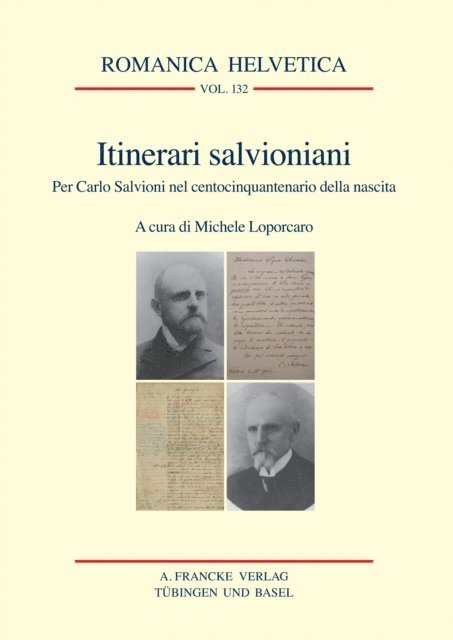
Il volume propone al lettore un accostamento alla figura e allopera di Carlo Salvioni (Bellinzona 1858-Milano 1920), affrontando diversi aspetti della sua vicenda biografica e intellettuale e della sua produzione scientifica. Allievo a Lipsia dei neogrammatici, poi collaboratore di Graziadio Isaia Ascoli all"Archivio Glottologico Italiano" rivista con cui Ascoli gettò le basi della moderna linguistica italiana allAscoli succedette nella direzione dell"Archivio" e poi sulla cattedra milanese, dopo aver insegnato a Torino e Pavia. Accademico della Crusca e Linceo, membro di varie società scientifiche e accademie europee, Salvioni è figura chiave per la linguistica in Italia a cavallo tra Otto e Novecento, e non è meno importante per la nativa Svizzera, dove fondò nel 1907 il Vocabolario dei dialetti della Svizzera italiana. Lasciò centinaia di studi che tuttora fanno testo sui più diversi aspetti della storia linguistica italiana e della struttura dellitaliano letterario e dei suoi dialetti, nonché studi di argomento gallo- ed iberoromanzo, tutti ripubblicati negli Scritti linguistici stampati dalle Edizioni dello Stato del Cantone Ticino per il centocinquantenario della nascita (2008).