Mihoko Otake - Böcker
Visar alla böcker från författaren Mihoko Otake. Handla med fri frakt och snabb leverans.
3 produkter
3 produkter
Del 10091 - Lecture Notes in Computer Science
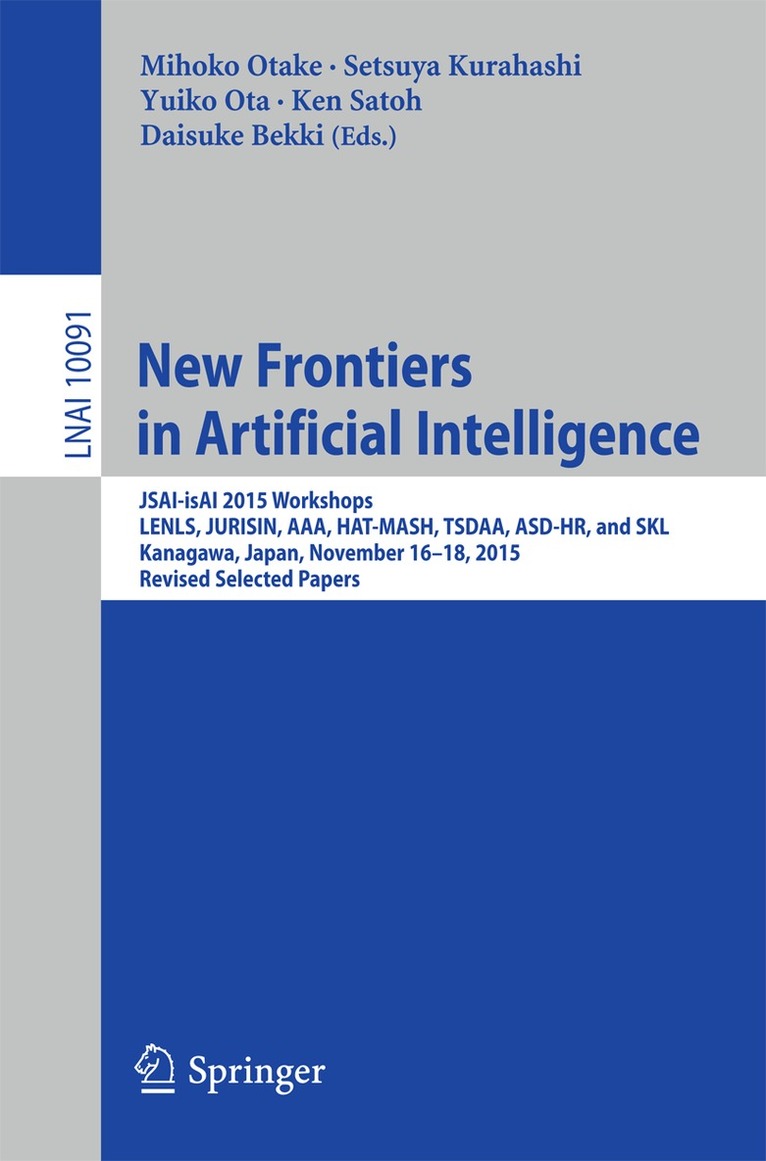
New Frontiers in Artificial Intelligence
JSAI-isAI 2015 Workshops, LENLS, JURISIN, AAA, HAT-MASH, TSDAA, ASD-HR, and SKL, Kanagawa, Japan, November 16-18, 2015, Revised Selected Papers
Häftad, Engelska, 2017
556 kr
Skickas inom 10-15 vardagar
This book constitutes the thoroughly refereed post-conference proceedings of the JSAI-isAI 2015 Workshops LENLS 12, JURISIN 9, AAA 2015, HAT-MASH 2015, TSDAA 2015, ASD-HR 2015, and SKL 2015, held in Kanagawa, Japan, in November 2015.
1 590 kr
Skickas inom 10-15 vardagar
This monograph presents new developments and advances of deformable robots made of electroactive polymer (EAP) gel, which is a promising new material for artificial muscles. "Electroactive Polymer Gel Robots" presents the design, development and experimental control of deformable machines consisting of EAP gel on the basis of a theoretical deformation model. Experimental results are demonstrated including beam-shaped gels curling around an object and starfish-shaped gel robots turning over. Future direction of gel robots are presented such as polymer robots assisting human with physical interaction or muscle suits wrapping around the elders or athletes to support their movements.
1 590 kr
Skickas inom 10-15 vardagar
By the dawn of the new millennium, robotics has undergone a major tra- formation in scope and dimensions. This expansion has been brought about bythematurityofthe?eldandtheadvancesinitsrelatedtechnologies.From a largely dominant industrial focus, robotics has been rapidly expanding into the challenges of the human world. The new generation of robots is expected to safely and dependably co-habitat with humans in homes, workplaces, and communities,providingsupportinservices,entertainment,education,heal- care, manufacturing, and assistance. Beyond its impact on physical robots, the body of knowledge robotics has produced is revealing a much wider range of applications reaching across - verse research areas and scienti?c disciplines, such as: biomechanics, haptics, neurosciences, virtual simulation, animation, surgery, and sensor networks among others. In return, the challenges of the new emerging areas are pr- ing an abundant source of stimulation and insights for the ?eld of robotics. It is indeed at the intersection of disciplines that the most striking advances happen. The goal of the series of Springer Tracts in Advanced Robotics (STAR) is to bring, in a timely fashion, the latest advances and developments in robotics on the basis of their signi?cance and quality. It is our hope that the wider dissemination of research developments will stimulate more exchanges and collaborations among the research community and contribute to further advancement of this rapidly growing ?eld.