Misiurewicz Michal Misiurewicz – författare
Visar alla böcker från författaren Misiurewicz Michal Misiurewicz. Handla med fri frakt och snabb leverans.
3 produkter
3 produkter
E-bok
PDF, Engelska, 2000559 kr
Läs direkt efter köp
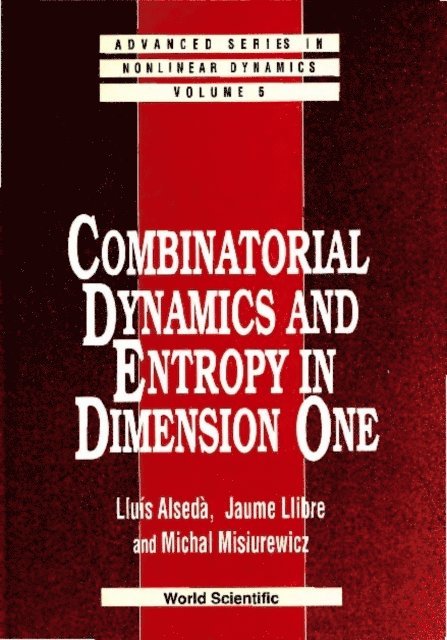
This book introduces the reader to the two main directions of one-dimensional dynamics. The first has its roots in the Sharkovskii theorem, which describes the possible sets of periods of all cycles (periodic orbits) of a continuous map of an interval into itself. The whole theory, which was developed based on this theorem, deals mainly with combinatorial objects, permutations, graphs, etc.; it is called combinatorial dynamics. The second direction has its main objective in measuring the complexity of a system, or the degree of "e;chaos"e; present in it; for that the topological entropy is used. The book analyzes the combinatorial dynamics and topological entropy for the continuous maps of either an interval or the circle into itself.
E-bok
PDF, Engelska, 1996214 kr
Läs direkt efter köp
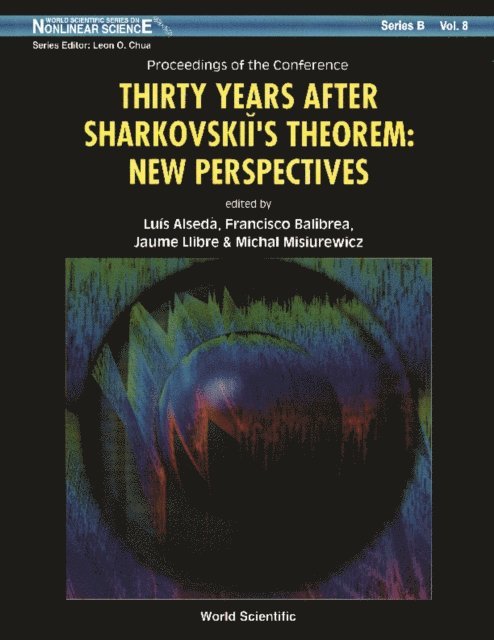
These proceedings contain a collection of papers on Combinatorial Dynamics, from the lectures that took place during the international symposium, Thirty Years after Sharkovskiĭ''s Theorem: New Perspectives, which was held at La Manga del Mar Menor, Murcia, Spain, from June 13 to June 18, 1994.Since Professor A N Sharkovskiĭ''s landmark paper on the coexistence of periods for interval maps, several lines of research have been developed, opening applications of models to help understand a number of phenomena from a wide variety of fields, such as biology, economics, physics, etc. The meeting served to summarize the progress made since Professor Sharkovskiĭ''s discovery, and to explore new directions.
E-bok
PDF, Engelska, 1993458 kr
Läs direkt efter köp
In last thirty years an explosion of interest in the study of nonlinear dynamical systems occured. The theory of one-dimensional dynamical systems has grown out in many directions. One of them has its roots in the Sharkovski0 Theorem. This beautiful theorem describes the possible sets of periods of all cycles of maps of an interval into itself. Another direction has its main objective in measuring the complexity of a system, or the amount of chaos present in it. A good way of doing this is to compute topological entropy of the system. The aim of this book is to provide graduate students and researchers with a unified and detailed exposition of these developments for interval and circle maps. Many comments are added referring to related problems, and historical remarks are made.