Mohamed Daoud – författare
Visar alla böcker från författaren Mohamed Daoud. Handla med fri frakt och snabb leverans.
8 produkter
8 produkter
E-bok
PDF, Engelska, 20131 367 kr
Läs direkt efter köp
In a liquid crystal watch, the molecules contained within a thin film of the screen are reorientated each second by extremely weak electrical signals. Here is a fine example of soft matter: molecular systems giving a strong response to a very weak command signal. They can be found almost everywhere. Soft magnetic materials used in transformers exhibit a strong magnetic moment under the action of a weak magnetic field. Take a completely different domain: gelatin, formed from col lagen fibres dissolved in hot water. When we cool below 37°C, gelation occurs, the chains joining up at various points to form a loose and highly deformable network. This is a natural example of soft matter. Going further, rather than consider a whole network, we could take a single chain of flexible polymer, such as polyoxyethylene [POE = (CH CH O)N, 2 2 5 where N rv 10 ], for example, in water. Such a chain is fragile and may break under flow. Even though hydrodynamic forces are very weak on the molecular scale, their cumulated effect may be significant. Think of a rope pulled from both ends by two groups of children. Even if each girl and boy cannot pull very hard, the rope can be broken when there are enough children pulling.
Häftad, Engelska, 2013
1 084 kr
Skickas inom 10-15 vardagar
In a liquid crystal watch, the molecules contained within a thin film of the screen are reorientated each second by extremely weak electrical signals. Here is a fine example of soft matter: molecular systems giving a strong response to a very weak command signal. They can be found almost everywhere. Soft magnetic materials used in transformers exhibit a strong magnetic moment under the action of a weak magnetic field. Take a completely different domain: gelatin, formed from col lagen fibres dissolved in hot water. When we cool below 37°C, gelation occurs, the chains joining up at various points to form a loose and highly deformable network. This is a natural example of soft matter. Going further, rather than consider a whole network, we could take a single chain of flexible polymer, such as polyoxyethylene [POE = (CH CH O)N, 2 2 5 where N rv 10 ], for example, in water. Such a chain is fragile and may break under flow. Even though hydrodynamic forces are very weak on the molecular scale, their cumulated effect may be significant. Think of a rope pulled from both ends by two groups of children. Even if each girl and boy cannot pull very hard, the rope can be broken when there are enough children pulling.
Häftad, Portugisiska, 2025
411 kr
Skickas inom 5-8 vardagar
Häftad, Polska, 2025
411 kr
Skickas inom 5-8 vardagar
Häftad, Italienska, 2025
411 kr
Skickas inom 5-8 vardagar
Häftad, Franska, 2025
411 kr
Skickas inom 5-8 vardagar
Häftad, Tyska, 2025
397 kr
Skickas inom 5-8 vardagar
Inbunden, Engelska, 2002
2 274 kr
Tillfälligt slut
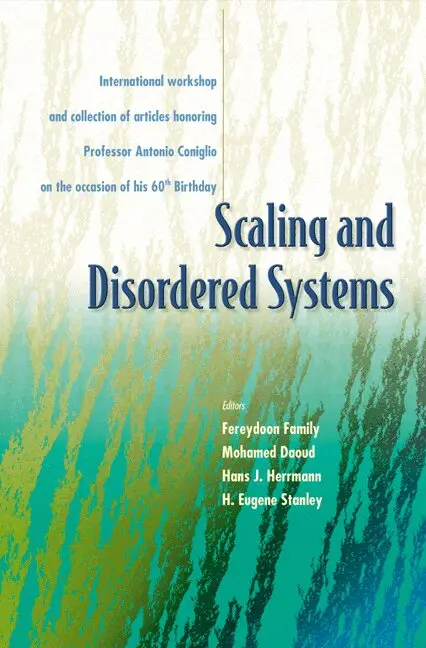
Investigation of the fractal and scaling properties of disordered systems has recently become a focus of great interest in research. Disordered or amorphous materials, like glasses, polymers, gels, colloids, ceramic superconductors and random alloys or magnets, do not have a homogeneous microscopic structure. The microscopic environment varies randomly from site to site in the system and this randomness adds to the complexity and the richness of the properties of these materials. A particularly challenging aspect of random systems is their dynamical behavior. Relaxation in disordered systems generally follows an unusual time-dependent trajectory. Applications of scaling and fractal concepts in disordered systems have become a broad area of interdisciplinary research, involving studies of the physics, chemistry, mathematics, biology and engineering aspects of random systems.This book is intended for specialists as well as graduate and postdoctoral students working in condensed-matter or statistical physics. It provides state-of-the-art information on the latest developments in this important and timely topic. The book is divided into three parts: Part I deals with critical phenomena, Part II is devoted to discussion of slow dynamics and Part III involves the application of scaling concepts to random systems. The effects of disorder at the mesoscopic scale as well as the latest results on the dynamical properties of disordered systems are presented. In particular, recent developments in static and dynamic scaling theories and applications of fractal concepts to disordered systems are discussed.