
Mohammad H. Tamdgidi – författare
1 261 kr
Läs direkt efter köp
1 261 kr
Läs direkt efter köp
3 280 kr
Skickas inom 10-15 vardagar
1 051 kr
Skickas inom 10-15 vardagar

1 455 kr
Skickas inom 3-6 vardagar
1 023 kr
Skickas inom 5-8 vardagar
2 051 kr
Läs direkt efter köp
Omar Khayyam''s Secret: Hermeneutics of the Robaiyat in Quantum Sociological Imagination is a twelve-book series of which this book, subtitled New Khayyami Studies: Quantumizing the Newtonian Structures of C. Wright Mills''s Sociological Imagination for A New Hermeneutic Method, is the first volume. Each book is independently readable, although it will be best understood as a part of the whole series.
In the overall series, the transdisciplinary sociologist Mohammad H. Tamdgidi shares the results of his decades-long research on Omar Khayyam, the enigmatic 11th/12th centuries Persian Muslim sage, philosopher, astronomer, mathematician, physician, writer, and poet from Neyshabour, Iran, whose life and works still remain behind a veil of deep mystery. Tamdgidi''s purpose has been to find definitive answers to the many puzzles still surrounding Khayyam, especially regarding the existence, nature, and purpose of the Robaiyat in his life and works. To explore the questions posed, he advances a new hermeneutic method of textual analysis, informed by what he calls the quantum sociological imagination, to gather and study all the attributed philosophical, religious, scientific, and literary writings of Khayyam.
In this first book of the series, following a common preface and introduction to the series, Tamdgidi develops the quantum sociological imagination method framing his hermeneutic study in the series as a whole. In the prefatory note he shares the origins of this series and how the study is itself a moment in the trajectory of a broader research project. In his introduction, he describes how centuries of Khayyami studies, especially during the last two, have reached an impasse in shedding light on his enigmatic life and works, especially his attributed Robaiyat.
The four chapters of the book are then dedicated to developing the quantum sociological imagination as a new hermeneutic method framing the Khayyami studies in the series. The method builds, in an applied way, on the results of Tamdgidi''s recent work in the sociology of scientific knowledge, Liberating Sociology: From Newtonian Toward Quantum Imagination: Volume 1: Unriddling the Quantum Enigma (2020), where he explored extensively, in greater depth, and in the context of understanding the so-called "quantum enigma," the Newtonian and quantum ways of imagining reality. In this first book, he shares the findings of that research in summary amid new applied insights developed in relation to Khayyami studies.
In the first chapter, Tamdgidi raises a set of eight questions about the structure of C. Wright Mills''s sociological imagination as a potential framework for Khayyami studies. In the second chapter, he shows how the questions are symptomatic of Newtonian structures that still continue to frame Mills''s sociological imagination. In the third chapter, the author explores how the sociological imagination can be reinvented to be more in tune with the findings of quantum science. In the last chapter, the implications of the quantum sociological imagination for devising a hermeneutic method for new Khayyam and Robaiyat studies are outlined. In conclusion, the findings of this first book of the Omar Khayyam''s Secret series are summarized.
2 010 kr
Läs direkt efter köp
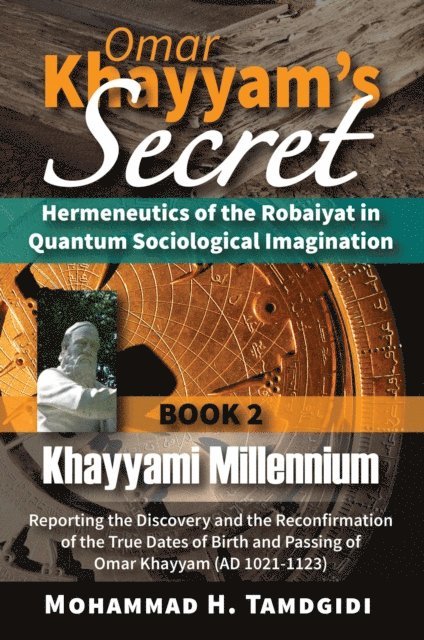
Omar Khayyam''s Secret: Hermeneutics of the Robaiyat in Quantum Sociological Imagination is a twelve-book series of which this book is the second volume, subtitled Khayyami Millennium: Reporting the Discovery and the Reconfirmation of the True Dates of Birth and Passing of Omar Khayyam (AD 1021-1123). Each book is independently readable, although it will be best understood as a part of the whole series.
In the overall series, the transdisciplinary sociologist Mohammad H. Tamdgidi shares the results of his decades-long research on Omar Khayyam, the enigmatic 11th/12th centuries Persian Muslim sage, philosopher, astronomer, mathematician, physician, writer, and poet from Neyshabour, Iran, whose life and works still remain behind a veil of deep mystery. Tamdgidi''s purpose has been to find definitive answers to the many puzzles still surrounding Khayyam, especially regarding the existence, nature, and purpose of the Robaiyat in his life and works. To explore the questions posed, he advances a new hermeneutic method of textual analysis, informed by what he calls the quantum sociological imagination, to gather and study all the attributed philosophical, religious, scientific, and literary writings of Khayyam.
In this second book of the series, Tamdgidi lays down an essential foundation for the series by revisiting the unresolved questions surrounding the dates of birth and passing of Omar Khayyam. Critically reexamining the manner in which Omar Khayyam''s birth horoscope as reported in Zahireddin Abolhassan Beyhaqi''s Tatemmat Sewan al-Hekmat (Supplement to the Chest of Wisdom) was used by Swāmi Govinda Tīrtha in his The Nectar of Grace: Omar Khayyam''s Life and Works (1941) to determine Khayyam''s birth date, Tamdgidi uncovers a number of serious internal inconsistencies and factual inaccuracies that prevented Tīrtha (and, since then, other scholars more or less taking for granted his results) from arriving at a reliable date for Khayyam''s birth, hurling Khayyami studies into decades of confusion regarding Khayyam''s life and works. Tamdgidi then shares in the book the detailed account of his own discovery of Khayyam''s true date of birth for the first time, a finding that eluded Khayyami studies for centuries and is bound to revolutionize the studies for decades to come.
Tamdgidi then turns his attention to the task of definitively establishing the true date of passing of Omar Khayyam. Conducting an in-depth, superposed analysis of Beyhaqi''s Tatemmat Sewan el-Hekmat (Supplement to the Chest of Wisdom), Abdorrahman Khazeni''s Mizan ol-Hekmat (Balance of Wisdom), Nezami Arouzi''s Chahar Maqaleh (Four Discourses), and Yar Ahmad Rashidi Tabrizi''s Tarabkhaneh (House of Joy), amid other relevant texts, he succeeds in firmly reconfirming and further discovering, in a textually reliable way, not only the year, the season, the month, and the day, but even the most likely time of day at which the poet mathematician, astronomer, and calendar reformer died as a solar centenarian, completing his 102nd solar year age.
Strange is that these discoveries are made just in time as we approach the first solar millennium of Omar Khayyam''s birth date on June 10, AD 1021, at sunrise of Neyshabour, Iran, and the ninth solar centennial of his passing on June 10, AD 1123, on the eve also of his birthday, closing the circle of his life''s "coming and going."
1 486 kr
Skickas inom 5-8 vardagar
1 265 kr
Skickas inom 3-6 vardagar
1 075 kr
Läs direkt efter köp
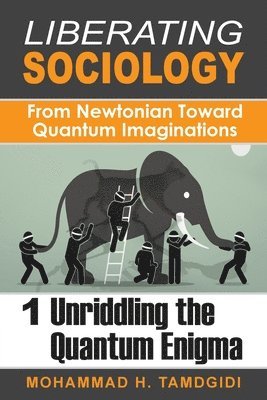
In this major new study in the sociology of scientific knowledge, social theorist Mohammad H. Tamdgidi reports having unriddled the so-called ‘quantum enigma.’
This book opens the lid of the Schrödinger’s Cat box of the ‘quantum enigma’ after decades and finds something both odd and familiar: Not only the cat is both alive and dead, it has morphed into an elephant in the room in whose interpretation Einstein, Bohr, Bohm, and others were each both right and wrong because the enigma has acquired both localized and spread-out features whose unriddling requires both physics and sociology amid both transdisciplinary and transcultural contexts. The book offers, in a transdisciplinary and transcultural sociology of self-knowledge framework, a relativistic interpretation to advance a liberating quantum sociology.
Deeper methodological grounding to further advance the sociological imagination requires investigating whether and how relativistic and quantum scientific revolutions can induce a liberating reinvention of sociology in favor of creative research and a just global society. This, however, necessarily leads us to confront an elephant in the room, the ‘quantum enigma.’
In Unriddling the Quantum Enigma, the first volume of the series commonly titled Liberating Sociology: From Newtonian toward Quantum Imaginations, sociologist Mohammad H. Tamdgidi argues that unriddling the ‘quantum enigma’ depends on whether and how we succeed in dehabituating ourselves in favor of unified relativistic and quantum visions from the historically and ideologically inherited, classical Newtonian modes of imagining reality that have subconsciously persisted in the ways we have gone about posing and interpreting (or not) the enigma itself for more than a century. Once this veil is lifted and the enigma unriddled, he argues, it becomes possible to reinterpret the relativistic and quantum ways of imagining reality (including social reality) in terms of a unified, nonreductive, creative dialectic of part and whole that fosters quantum sociological imaginations, methods, theories, and practices favoring liberating and just social outcomes.
The essays in this volume develop a set of relativistic interpretive solutions to the quantum enigma. Following a survey of relevant studies, and an introduction to the transdisciplinary and transcultural sociology of self-knowledge framing the study, overviews of Newtonianism, relativity and quantum scientific revolutions, the quantum enigma, and its main interpretations to date are offered. They are followed by a study of the notion of the “wave-particle duality of light” and the various experiments associated with the quantum enigma in order to arrive at a relativistic interpretation of the enigma, one that is shown to be capable of critically cohering other offered interpretations. The book concludes with a heuristic presentation of the ontology, epistemology, and methodology of what Tamdgidi calls the creative dialectics of reality. The volume essays involve critical, comparative/integrative reflections on the relevant works of founding and contemporary scientists and scholars in the field.
This study is the first in the monograph series "Tayyebeh Series in East-West Research and Translation" of Human Architecture: Journal of the Sociology of Self-Knowledge (XIII, 2020), published by OKCIR: Omar Khayyam Center for Integrative Research in Utopia, Mysticism, and Science (Utopystics). OKCIR is dedicated to exploring, in a simultaneously world-historical and self-reflective framework, the human search for a just global society.
1 309 kr
Skickas inom 5-8 vardagar
1 029 kr
Skickas inom 5-8 vardagar
2 083 kr
Läs direkt efter köp
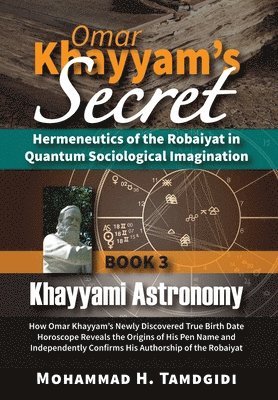
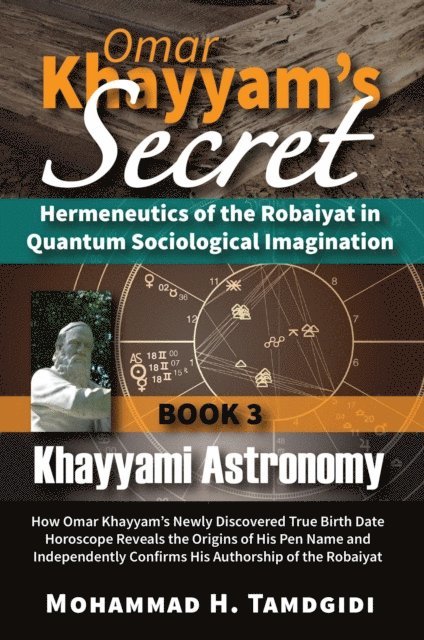
Omar Khayyam''s Secret: Hermeneutics of the Robaiyat in Quantum Sociological Imagination is a twelve-book series of which this book is the third volume, subtitled Khayyami Astronomy: How Omar Khayyam''s Newly Discovered True Birth Date Horoscope Reveals the Origins of His Pen Name and Independently Confirms His Authorship of the Robaiyat. Each book is independently readable, although it will be best understood as a part of the whole series.
In the overall series, the transdisciplinary sociologist Mohammad H. Tamdgidi shares the results of his decades-long research on Omar Khayyam, the enigmatic 11th/12th centuries Persian Muslim sage, philosopher, astronomer, mathematician, physician, writer, and poet from Neyshabour, Iran, whose life and works still remain behind a veil of deep mystery. Tamdgidi''s purpose has been to find definitive answers to the many puzzles still surrounding Khayyam, especially regarding the existence, nature, and purpose of the Robaiyat in his life and works. To explore the questions posed, he advances a new hermeneutic method of textual analysis, informed by what he calls the quantum sociological imagination, to gather and study all the attributed philosophical, religious, scientific, and literary writings of Khayyam.
Omar Khayyam''s true birth date horoscope, as newly discovered in this series, is comprised of a dazzling number of Air Triplicities sharing a vertex on a Sun-Mercury Cazimi point on the same Ascendant degree 18 of Gemini. Among other features, his Venus, Sextile with Moon, also plays a lifelong, secretively creative role to intentionally balance his chart. These features would not have escaped the attention of Omar Khayyam, a master astronomer and expert in matters astrological, no matter how much he embraced, doubted, or rejected astrological interpretations.
In this third book of the series, conducting an in-depth hermeneutic analysis of Khayyam''s horoscope, Tamdgidi reports having discovered the origins of Khayyam''s pen name in his horoscope. The long-held myth that "Khayyam" was a parental name, even if true, in no way takes away from the new finding; it only adds to its intrigue.
Tamdgidi''s hermeneutic analysis of Khayyam''s horoscope in intersection with extant Khayyami Robaiyat also leads him to discover an entirely neglected signature quatrain that he proves could not be from anyone but Khayyam, one that provides a reliably independent confirmation of his authorship of the Robaiyat. He also shows how another neglected quatrain reporting its poet to have aged to a hundred is from Khayyam. This means all the extant Khayyami quatrains are now in need of hermeneutic reevaluation.
Tamdgidi''s further study of a sample of fifty Khayyami Robaiyat leads him to conclude that their poet definitively intended the poems to remain in veil, that they were considered to be a collection of interrelated quatrains and not sporadic separate quatrains written marginally in pastime, that they were meant to offer a life''s intellectual journey as in a "book of life," that the poems'' critically nuanced engagement with astrology was not incidental but essential throughout the collection, and that, judging from the signature quatrain discovered, 1000 quatrains were intended to comprise the collection.
Oddly it appears that, after all, "The Khayyam who stitched his tents of wisdom" was a trope that had its origins in Omar Khayyam''s horoscope heavens.
1 233 kr
Skickas inom 5-8 vardagar
993 kr
Skickas inom 5-8 vardagar
583 kr
Skickas inom 5-8 vardagar

347 kr
Skickas inom 5-8 vardagar
1 344 kr
Skickas inom 5-8 vardagar
1 107 kr
Skickas inom 5-8 vardagar
1 962 kr
Läs direkt efter köp
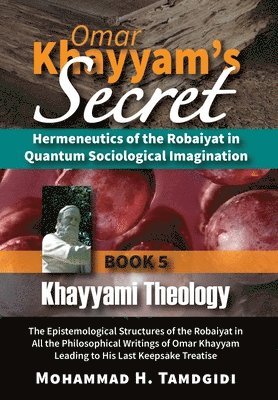
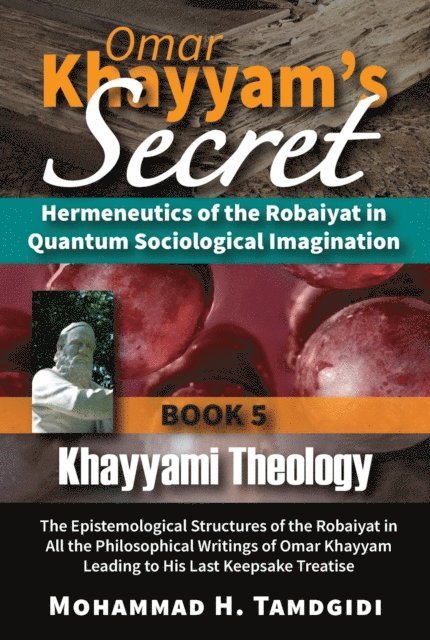
Omar Khayyam''s Secret: Hermeneutics of the Robaiyat in Quantum Sociological Imagination, by Mohammad H. Tamdgidi, is a twelve-book series of which this book is the fifth volume, subtitled Khayyami Theology: The Epistemological Structures of the Robaiyat in All the Philosophical Writings of Omar Khayyam Leading to His Last Keepsake Treatise. Each book, independently readable, can be best understood as a part of the whole series.
In Book 5, to understand the theological epistemology (or, way of knowing God) framing Khayyam''s Robaiyat as spread out in all his philosophical works, Tamdgidi further offers the texts and his updated Persian and new English translations and analyses of six primary writings that preceded Khayyam''s last keepsake treatise on the universals of existence: 1: Khayyam''s annotated Persian translation of Avicenna''s sermon in Arabic on God and creation; 2: Khayyam''s treatise in Arabic addressed to Nasawi (wrongly regarded as an Avicenna pupil) on the created world and worship duty; 3-5: Khayyam''s three treatises in Arabic (all addressed to Abu Taher, to whom Khayyam also dedicated his treatise on algebra) that are separate chapters of a three-part treatise on existence on topics ranging from the necessity of contradiction, determinism, survival, attributes of existents, and the light of intellect on ''existent'' as the subject matter of universal science; and 6: Khayyam''s treatise in Arabic addressed to Moshkavi (a supportive Shia intellectual) in response to three questions on soul''s survival, on the necessity of accidents, and on the nature of time.
The most fruitful way of understanding Khayyam''s six texts is by regarding them as efforts made at defending his "succession order" thesis implicitly revealed when commenting on Avicenna''s sermon and finalized in his last keepsake treatise. The texts served to offer the theological epistemology behind Khayyam''s thesis, revealing his creative conceptualist view of existence that informed his poetic way of going about knowing God, creation, and himself within a unitary Islamic creationist-evolutionary worldview. Khayyam''s way of knowing God and existence is non-dualistic, non-atomistic, and unitary in worldview, allowing for subject-included objectivity, probabilistic determinism, transcontinuous (or ''discontinuous'') creative causality, transdisciplinarity, and transculturalism; it thus fulfils in a prescient way all the eight attributes of the quantum vision. Poetry is most conducive to unitary knowing, and subject-included objectivity must necessarily be self-reflective and thus engage intellective, emotional, and sensible modes of knowing. This explains why Khayyam transcended scholastic learning in favor of a poetic encounter with reality. What he meant by ''Drunkenness,'' calling it the highest state of mind known to him, can thus be best understood as a unitary, quantum state of mind achieved by way of his poetry as a meditative art of self-purification. The goal, metaphorically, is to move from a way of knowing things as divisible grapes to a pure and unitary way of knowing them as indivisible Wine -- paralleling what we call today moving from chunky Newtonian toward unitary quantum visions of reality.
The key for entering Khayyam''s secret tent is realizing that what he primarily meant by ''Wine'' in his Robaiyat was self-referentially his Robaiyat itself, a key openly hidden therein thanks to his theological epistemology. For him, the Robaiyat was a lifelong work on himself, serving also human spiritual awakening to its place and duty in the succession order of God''s creation. It also served his aspiration for a lasting soul. He knew the now-proven worth of his secret magnum opus, and that is why he so much praised his ''Wine.''
1 486 kr
Skickas inom 5-8 vardagar
1 201 kr
Skickas inom 5-8 vardagar
1 962 kr
Läs direkt efter köp
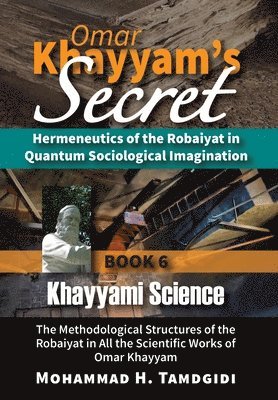
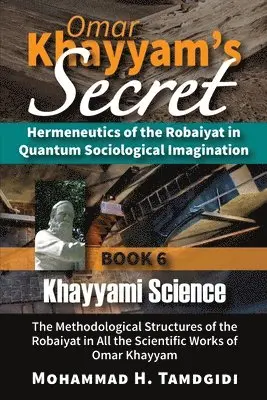
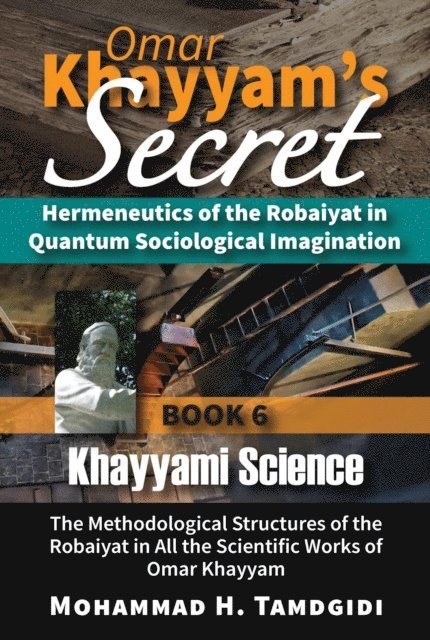
Omar Khayyam''s Secret: Hermeneutics of the Robaiyat in Quantum Sociological Imagination, by Mohammad H. Tamdgidi, is a twelve-book series of which this book is the sixth volume, subtitled Khayyami Science: The Methodological Structures of the Robaiyat in All the Scientific Works of Omar Khayyam. Each book, independently readable, can be best understood as a part of the whole series.
In Book 6, Tamdgidi shares the Arabic texts, his new English translations (based on others'' or his new Persian translations, also included in the volume), and hermeneutic analyses of five extant scientific writings of Khayyam: a treatise in music; a treatise on balance to weigh precious metals in a body composed of them; a treatise on dividing a circle quadrant to achieve a certain proportionality; a treatise on solving all cubic (and lower degree) algebraic equations using geometric methods; and a treatise on explaining three postulation problems in Euclid''s book Elements. Khayyam wrote three other non-extant scientific treatises on nature, geography, and music, while a treatise in arithmetic is differently extant since it influenced the work of later Islamic and Western scientists. His work in astronomy on solar calendar reform is also differently extant in the calendar used in Iran today. A short tract on astrology attributed to him has been neglected.
Tamdgidi studies the scientific works in relation to Khayyam''s own theological, philosophical, and astronomical views. The study reveals that Khayyam''s science was informed by a unifying methodological attention to ratios and proportionality. So, likewise, any quatrain he wrote cannot be adequately understood without considering its place in the relational whole of its parent collection. Khayyam''s Robaiyat is found to be, as a critique of fatalistic astrology, his most important scientific work in astronomy rendered in poetic form.
Studying Khayyam''s scientific works in relation to those of other scientists out of the context of his own philosophical, theological, and astronomical views, would be like comparing the roundness of two fruits while ignoring that they are apples and oranges. Khayyam was a relational, holistic, and self-including objective thinker, being systems and causal-chains discerning, creative, transdisciplinary, transcultural, and applied in method. He applied a poetic geometric imagination to solving algebraic problems and his logically methodical thinking did not spare even Euclid of criticism. His treatise on Euclid unified numerical and magnitudinal notions of ratio and proportionality by way of broadening the notion of number to include both rational and irrational numbers, transcending its Greek atomistic tradition.
Khayyam''s classification of algebraic equations, being capped at cubic types, tells of his applied scientific intentions that can be interpreted, in the context of his own Islamic philosophy and theology, as an effort in building an algebraic and numerical theory of everything that is not only symbolic of body''s three dimensions, but also of the three-foldness of intellect, soul, and body as essential types of a unitary substance created by God to evolve relatively on its own in a two-fold succession order of coming from and going to its Source. Although the succession order poses limits, as captured in the astrological imagination, existence is not fatalistic. Khayyam''s conceptualist view of the human subject as an objective creative force in a participatory universe allows for the possibility of human self-determination and freedom depending on his or her self-awakening, a cause for which the Robaiyat was intended. Its collection would be a balanced unity of wisdom gems ascending from multiplicity toward unity using Wine and various astrological, geometrical, numerical, calendrical, and musical tropes in relationally classified quatrains that follow a logical succession order.
1 709 kr
Skickas inom 5-8 vardagar
1 414 kr
Skickas inom 5-8 vardagar