Moises Santillan – författare
Visar alla böcker från författaren Moises Santillan. Handla med fri frakt och snabb leverans.
5 produkter
Mathematical Modeling for Life Sciences: A Primer
Inbunden, 2026
608 kr
Kommande
This textbook introduces mathematical modelling in life sciences in an interdisciplinary setting for students whose backgrounds range from medicine to mathematics, focusing on a set of topics that introduce mathematical thinking through biological questions. Each chapter begins with a clear …
Chemical Kinetics, Stochastic Processes, and Irreversible Thermodynamics
Häftad, 2014
443 kr
Lägg i varukorg
This book brings theories in nonlinear dynamics, stochastic processes, irreversible thermodynamics, physical chemistry and biochemistry together in an introductory but formal and comprehensive manner. Coupled with examples, the theories are developed stepwise, starting with the simplest concepts …
Chemical Kinetics, Stochastic Processes, and Irreversible Thermodynamics
E-bok, 2014
603 kr
Lägg i varukorg
This book brings theories in nonlinear dynamics, stochastic processes, irreversible thermodynamics, physical chemistry and biochemistry together in an introductory but formal and comprehensive manner. Coupled with examples, the theories are developed stepwise, starting with the simplest concepts …
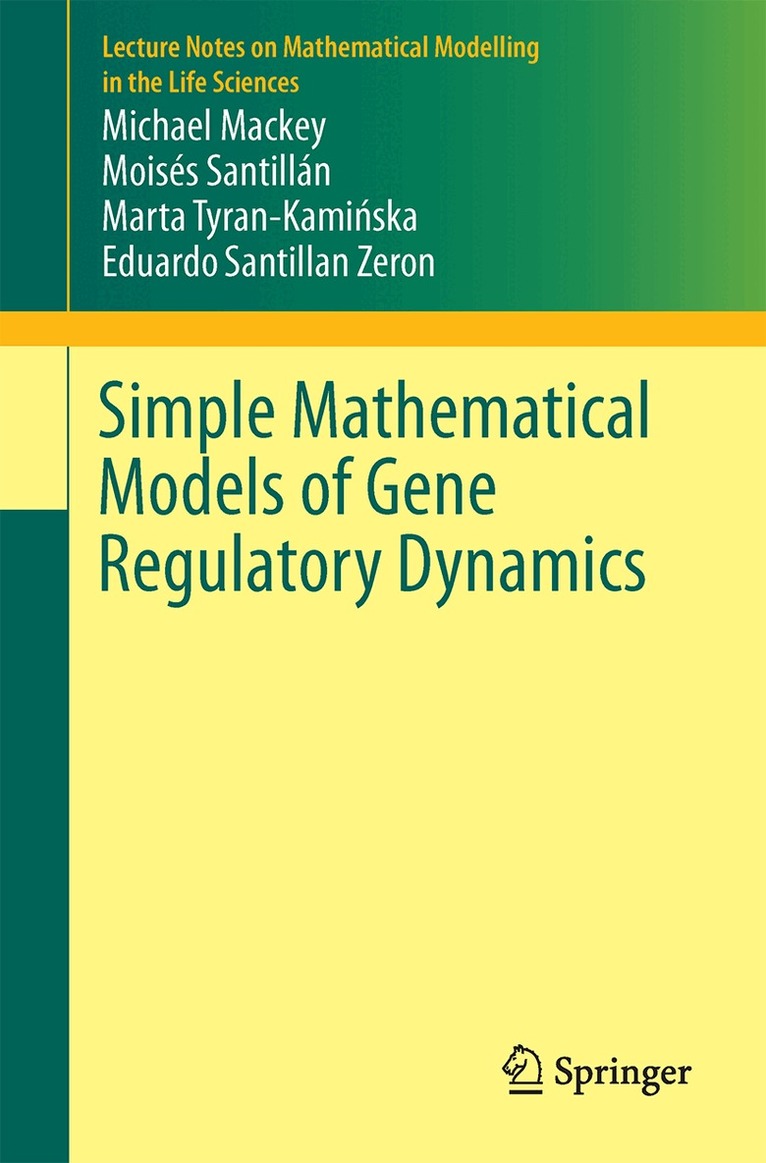
Simple Mathematical Models of Gene Regulatory Dynamics
Av Michael C. Mackey, Moisés Santillán m. fl.
Häftad, 2016
568 kr
Lägg i varukorg
This is a short and self-contained introduction to the field of mathematical modeling of gene-networks in bacteria. As an entry point to the field, we focus on the analysis of simple gene-network dynamics. The notes commence with an introduction to the deterministic modeling of gene-networks, with …
Simple Mathematical Models of Gene Regulatory Dynamics
Av Eduardo S. Zeron, Marta Tyran-Kaminska m. fl.
E-bok, 2016
718 kr
Lägg i varukorg
This is a short and self-contained introduction to the field of mathematical modeling of gene-networks in bacteria. As an entry point to the field, we focus on the analysis of simple gene-network dynamics. The notes commence with an introduction to the deterministic modeling of gene-networks, with …