Moonis Raza – författare
Visar alla böcker från författaren Moonis Raza. Handla med fri frakt och snabb leverans.
3 produkter
3 produkter
E-bok
Engelska, 19901 145 kr
Läs direkt efter köp
There is conflict, tension, despair in the midst of rising income, productivity and material welfare. Man''s search for peace and security through weapons and wars, through science and technology, and through centralisation and domination, has made him now an endangered species needing protection from his own creation. He has become his own enemy. The growing realisation that we must learn to balance the material wonders of technology with the spiritual demands of our human nature is the main thrust of this volume. It uses the Gandhian idiom of Truth and Non-violence -as the end as well the means to achieve this balance, and pin-points the role of education in creating conditions for a re-assessement of the way we have acted in the past to arrive at the present juncture of unease, helplessness and wide-ranging monstrarities. The first volume consists of fourteen papers by eminent persons like D.S. Kothan, N. Radhakrishnan. Ramji Singh, and, L Dossey on conflict between science and spirituality and the role of education in bridging the widening gap The second volume contains fourteen papers by equally eminent writers on conflicts generated by developmental processes, their causes and consequences; and non-violence as the weapon of the courageous and brave to -esolve these conflicts. Here is a set of two volumes which shows the Gandhian way to peace and harmony.
E-bok
Engelska, 1990295 kr
Läs direkt efter köp
This study is an attempt to explain the changes in public policy in democratic systems. It presents an argument that there is an interdependent or exchange relationship between the choices of the policy-makers and trie policy -takers. Periodic elections and the political parties arc important institutional mechanisms which make the exchange relationship possible. The policy-makers use the policy as an instrument to provide inducements to their own supporters. The structure of the market for political exchange is characterised as monopolistic competition. The policy-makers are assumed to maximise the probability of re election while the policy-takers are assumed to maximise the benefit and minimise the costs from a policy. These assumptions lead to a number of propositions about the conditions of a policy change. These propositions alongwith those emerging from the socio-economic and the political factors arc tested using data from twenty-one contemporary democratic regimes between 1952-1980. These analyses confirm the contention that political exchange plays an important part as a determinant of policy outcomes.
E-bok
Engelska, 20162 156 kr
Läs direkt efter köp
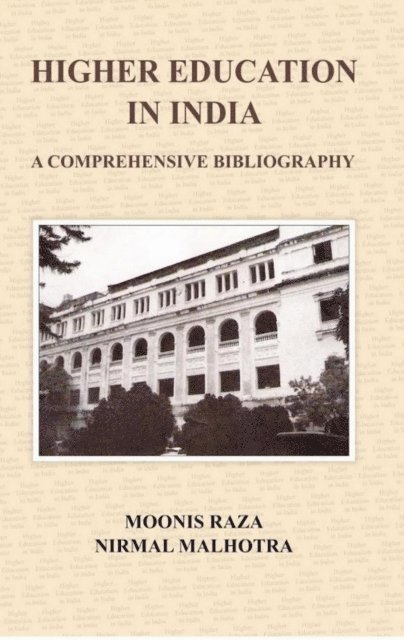
This book provides the first comprehensive bibliography of higher education in India. It constitutes a useful resource for scholars, policy makers, planners and administrators concerned with higher education in India. This bibliography consists of 2,485 entries. Source material is arranged under 50 theme. Each theme is classified into four types of material: Books, Articles, Committee/Commission Reports and Research Studies.