
Moradi Sedigheh Moradi – författare
Visar alla böcker från författaren . Handla med fri frakt och snabb leverans.
2 produkter
2 produkter
E-bok
Engelska, 20211 434 kr
Läs direkt efter köp
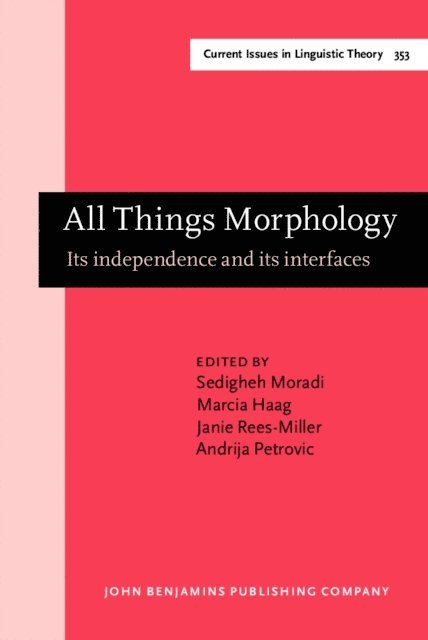
This book provides a view of where the field of morphology has been and where it is today within a particular theoretical framework, gathering up new and representative work in morphology by both eminent and emerging scholars, and touching on a very wide range of topics, approaches, and theoretical points of view. These seemingly disparate articles have a common touchstone in their focus on a word-based, paradigmatic approach to morphology.The chapters in this book elaborate on these basic themes, from the further exploration of paradigms, to studies involving words, stems, and affixes, to examinations of competition, inheritance, and defaults, to investigations of morphomes, to ways that morphology interacts with other parts of the language from phonology to sociolinguistics and applied linguistics. The editors and contributors dedicate this volume to Prof. Mark Aronoff for his profound influence on the field.
E-bok
Engelska, 20201 499 kr
Läs direkt efter köp
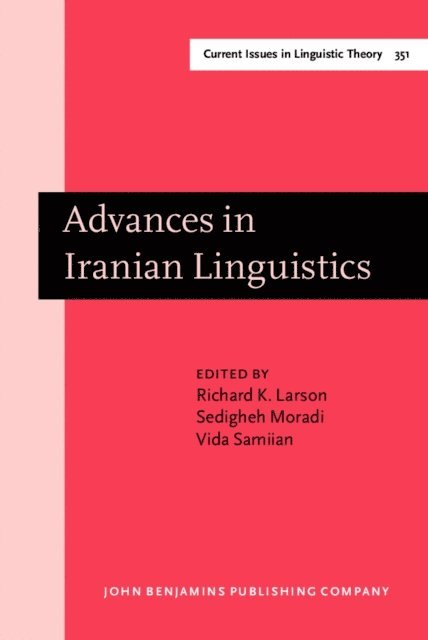
This volume brings together selected papers from the first North American Conference in Iranian Linguistics, which was organized by the linguistics department at Stony Brook University. Papers were selected to illustrate the range of frameworks, diverse areas of research and how the boundaries of linguistic analysis of Iranian languages have expanded over the years. The contributions collected in this volume address advancing research and complex methodological explorations in a broad range of topics in Persian syntax, morphology, phonology, semantics, typology and classification, as well as historical linguistics. Some of the papers also investigate less-studied and endangered Iranian languages such as Tat, Gilaki and Mazandarani, Sorani and Kurmanji Kurdish, and Zazaki. The volume will be of value to scholars in theoretical frameworks as well as those with typological and diachronic perspectives, and in particular to those working in Iranian linguistics.