Mordecai Avriel – författare
Visar alla böcker från författaren Mordecai Avriel. Handla med fri frakt och snabb leverans.
4 produkter
4 produkter
Häftad, Engelska, 2003
327 kr
Skickas inom 3-6 vardagar
Häftad, Engelska, 2010
1 054 kr
Skickas inom 5-8 vardagar
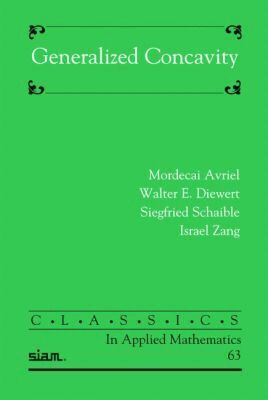
Originally published in 1988, this enduring text remains the most comprehensive book on generalized convexity and concavity. The authors present generalized concave functions in a unified framework, exploring them primarily from the domains of optimization and economics.Concavity of a function is a common property used in most of the important theorems concerning properties of optimization problems in mathematical economics, operations research, mathematical programming, engineering, and management science. Generalized concavity deals with the many nonconcave functions that have properties similar to those of concave functions.Specific topics covered in this book include:a review of concavity and the basics of generalized concavity; applications of generalized concavity to economics; special function forms such as composite forms, products, ratios, and quadratic functions; fractional programming; and concave transformable functions.
E-bok
PDF, Engelska, 2013687 kr
Läs direkt efter köp
In 1961, C. Zener, then Director of Science at Westinghouse Corpora tion, and a member of the U. S. National Academy of Sciences who has made important contributions to physics and engineering, published a short article in the Proceedings of the National Academy of Sciences entitled" A Mathe matical Aid in Optimizing Engineering Design. " In this article Zener considered the problem of finding an optimal engineering design that can often be expressed as the problem of minimizing a numerical cost function, termed a "generalized polynomial," consisting of a sum of terms, where each term is a product of a positive constant and the design variables, raised to arbitrary powers. He observed that if the number of terms exceeds the number of variables by one, the optimal values of the design variables can be easily found by solving a set of linear equations. Furthermore, certain invariances of the relative contribution of each term to the total cost can be deduced. The mathematical intricacies in Zener''s method soon raised the curiosity of R. J. Duffin, the distinguished mathematician from Carnegie Mellon University who joined forces with Zener in laying the rigorous mathematical foundations of optimizing generalized polynomials. Interes tingly, the investigation of optimality conditions and properties of the optimal solutions in such problems were carried out by Duffin and Zener with the aid of inequalities, rather than the more common approach of the Kuhn-Tucker theory.
Del 21 - Mathematical Concepts and Methods in Science and Engineering
Advances in Geometric Programming
Häftad, Engelska, 2012
544 kr
Skickas inom 10-15 vardagar
In 1961, C. Zener, then Director of Science at Westinghouse Corpora tion, and a member of the U. S. National Academy of Sciences who has made important contributions to physics and engineering, published a short article in the Proceedings of the National Academy of Sciences entitled" A Mathe matical Aid in Optimizing Engineering Design. " In this article Zener considered the problem of finding an optimal engineering design that can often be expressed as the problem of minimizing a numerical cost function, termed a "generalized polynomial," consisting of a sum of terms, where each term is a product of a positive constant and the design variables, raised to arbitrary powers. He observed that if the number of terms exceeds the number of variables by one, the optimal values of the design variables can be easily found by solving a set of linear equations. Furthermore, certain invariances of the relative contribution of each term to the total cost can be deduced. The mathematical intricacies in Zener's method soon raised the curiosity of R. J. Duffin, the distinguished mathematician from Carnegie Mellon University who joined forces with Zener in laying the rigorous mathematical foundations of optimizing generalized polynomials. Interes tingly, the investigation of optimality conditions and properties of the optimal solutions in such problems were carried out by Duffin and Zener with the aid of inequalities, rather than the more common approach of the Kuhn-Tucker theory.