Morris Sloman – författare
Visar alla böcker från författaren Morris Sloman. Handla med fri frakt och snabb leverans.
4 produkter
4 produkter
Häftad, Engelska, 2003
562 kr
Skickas inom 10-15 vardagar
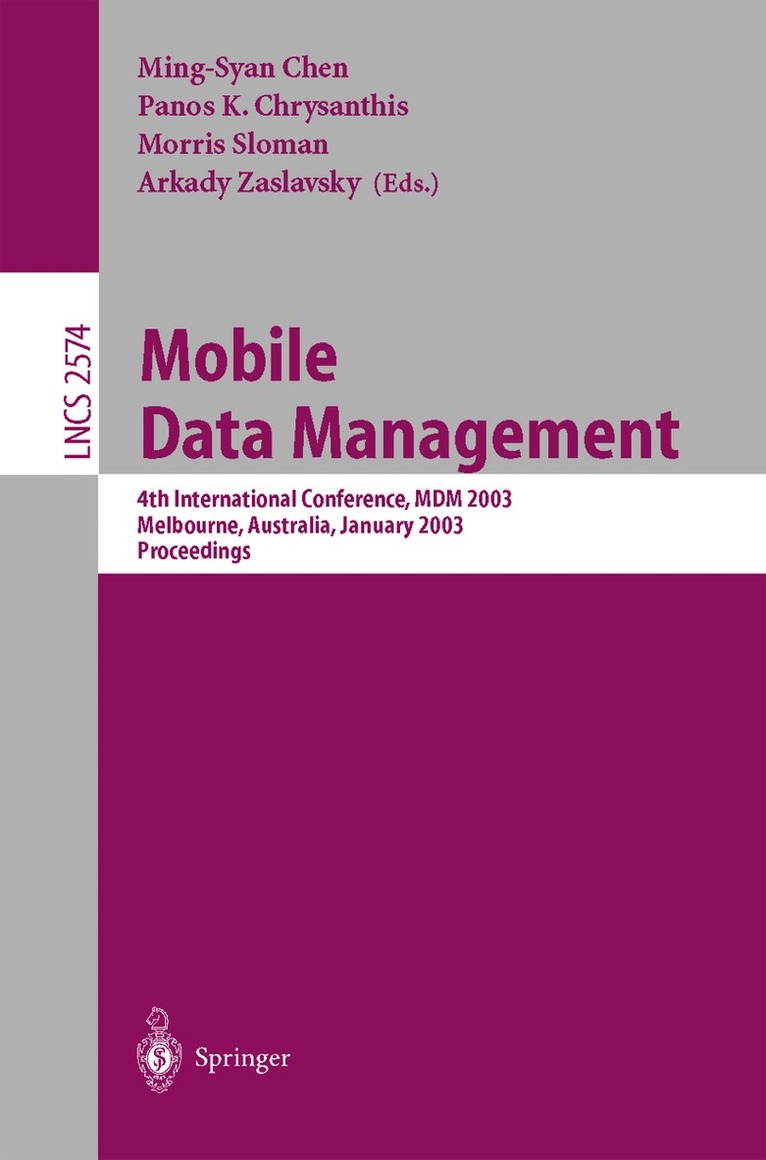
We are rapidly heading towards a world in which the computing infrastructure will contain billions of devices, which will interact with other computing/communications devices that are carried or worn by users as they go through their daily routines. Such devices will provide data access to mobile users as they move within buildings, cities, or across the globe. This new infrastructure presents tremendous challenges for data management technology, including: huge scale; variable and intermittent connectivity; location and context-aware applications; bandwidth, power, and devi- size limitations; and multimedia data delivery across hybrid networks and systems. Traditional data management technologies such as query processing, transaction management, workflow, business process management, and metadata management must all be reevaluated in this emerging environment. Furthermore, nontraditional issues such as the semantics of mobile data, location-dependent querying, broadcast and multicast delivery, and caching/prefetching techniques must all be addressed. The ability to track people as they move about their daily tasks raises serious issues of security and privacy. This conference is the fourth in the Mobile Data Management series, focusing on the challenges and opportunities for the management of data in mobile, pervasive, and wearable computing. MDM 2000 and 2001 were in Hong Kong and MDM 2002 was in Singapore. Eighty-seven papers were submitted to the conference from 23 countries and were subject to a rigorous review procedure. Every paper had three or four independent reviews. Twenty-one full papers and 15 short papers from both academia and industry were selected for publication in this volume of proceedings.
E-bok
PDF, Engelska, 2003734 kr
Läs direkt efter köp
We are rapidly heading towards a world in which the computing infrastructure will contain billions of devices, which will interact with other computing/communications devices that are carried or worn by users as they go through their daily routines. Such devices will provide data access to mobile users as they move within buildings, cities, or across the globe. This new infrastructure presents tremendous challenges for data management technology, including: huge scale; variable and intermittent connectivity; location and context-aware applications; bandwidth, power, and devi- size limitations; and multimedia data delivery across hybrid networks and systems. Traditional data management technologies such as query processing, transaction management, workflow, business process management, and metadata management must all be reevaluated in this emerging environment. Furthermore, nontraditional issues such as the semantics of mobile data, location-dependent querying, broadcast and multicast delivery, and caching/prefetching techniques must all be addressed. The ability to track people as they move about their daily tasks raises serious issues of security and privacy. This conference is the fourth in the Mobile Data Management series, focusing on the challenges and opportunities for the management of data in mobile, pervasive, and wearable computing. MDM 2000 and 2001 were in Hong Kong and MDM 2002 was in Singapore. Eighty-seven papers were submitted to the conference from 23 countries and were subject to a rigorous review procedure. Every paper had three or four independent reviews. Twenty-one full papers and 15 short papers from both academia and industry were selected for publication in this volume of proceedings.
Häftad, Engelska, 2001
562 kr
Skickas inom 10-15 vardagar
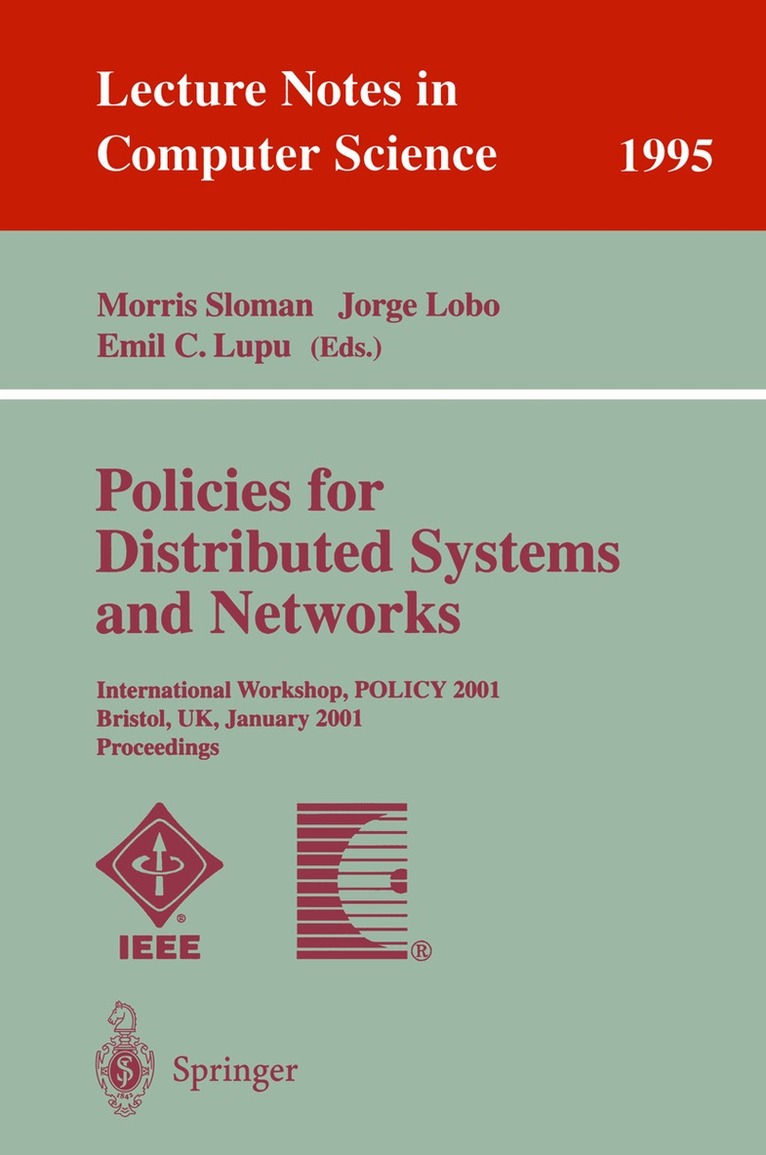
Policy based systems are the subject of a wide range of activities in univer- ties, standardisation bodies, and within industry. They have a wide spectrum of applications ranging from quality of service management within networks to - curity and enterprise modelling. This Lecture Notes volume collects the papers presented at the workshop on Policies for Distributed Systems and Networks held at the Hewlett-Packard Laboratories in Bristol, UK in January 2001. After a rigorous review process 16 papers were selected from 43 submissions. Within the Internet community there is considerable interest in policy based networking. A number of companies have announced tools to support the sp- i?cation and deployment of policies. Much of this work is focused on policies for quality of service management within networks and the Internet Engineering and Distributed Management Task Force (IETF/DMTF) is actively working on standards related to this area. The security community has focused on the speci?cation and analysis of - cess control policy which has evolved into the work on Role-Based Access Control (RBAC). There has been work over a number of years in the academic c- munity on speci?cation and analysis of policies for distributed systems mostly concentrating on authorisation policies. Although there are strong similarities in the concepts and techniques used by the di?erent communities there is no commonly accepted terminology or notation for specifying policies.
E-bok
PDF, Engelska, 2003708 kr
Läs direkt efter köp
Policy based systems are the subject of a wide range of activities in univer- ties, standardisation bodies, and within industry. They have a wide spectrum of applications ranging from quality of service management within networks to - curity and enterprise modelling. This Lecture Notes volume collects the papers presented at the workshop on Policies for Distributed Systems and Networks held at the Hewlett-Packard Laboratories in Bristol, UK in January 2001. After a rigorous review process 16 papers were selected from 43 submissions. Within the Internet community there is considerable interest in policy based networking. A number of companies have announced tools to support the sp- i?cation and deployment of policies. Much of this work is focused on policies for quality of service management within networks and the Internet Engineering and Distributed Management Task Force (IETF/DMTF) is actively working on standards related to this area. The security community has focused on the speci?cation and analysis of - cess control policy which has evolved into the work on Role-Based Access Control (RBAC). There has been work over a number of years in the academic c- munity on speci?cation and analysis of policies for distributed systems mostly concentrating on authorisation policies. Although there are strong similarities in the concepts and techniques used by the di?erent communities there is no commonly accepted terminology or notation for specifying policies.