M.S. Sriram – författare
Visar alla böcker från författaren M.S. Sriram. Handla med fri frakt och snabb leverans.
4 produkter
4 produkter
1 072 kr
Skickas inom 10-15 vardagar
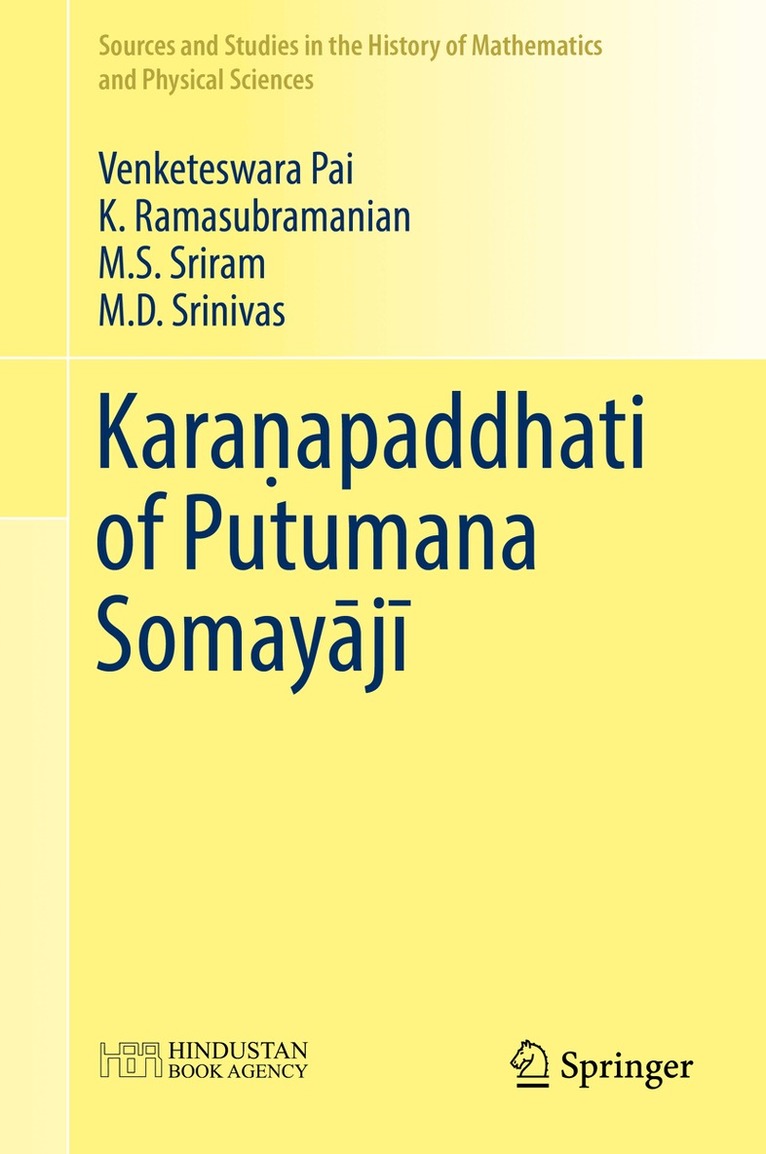
This book is an important text of the Kerala school of astronomy and mathematics, probably composed in the 16th century. In the Indian astronomical tradition, the karaṇa texts are essentially computational manuals, and they often display a high level of ingenuity in coming up with simplified algorithms for computing planetary longitudes and other related quantities. Karaṇapaddhati, however, is not a karaṇa text. Rather, it discusses the paddhati or the rationale for arriving at suitable algorithms that are needed while preparing a karaṇa text for a given epoch. Thus the work is addressed not to the almanac maker but to the manual maker.Karaṇapaddhati presents the theoretical basis for the vākya system, where the true longitudes of the planet are calculated directly by making use of certain auxiliary notions such as the khaṇḍa, maṇḍala and dhruva along with tabulated values of changes in the true longitude over certain regular intervals which are expressed in the form of vākyas or mnemonic phrases. The text also discusses the method of vallyupasaṃhāra, which is essentially a technique of continued fraction expansion for obtaining optimal approximations to the rates of motion of planets and their anomalies, involving ratios of smaller numbers. It also presents a new fast convergent series for π which is not mentioned in the earlier works of the Kerala school. As this is a unique text presenting the rationale behind the vākya system and the computational procedures used in the karaṇa texts, it would serve as a useful companion for all those interested in the history of astronomy. The authors have provided a translation of the text followed by detailed notes which explain all the computational procedures, along with their rationale, by means of diagrams and equations.
965 kr
Skickas inom 10-15 vardagar
This book is an important text of the Kerala school of astronomy and mathematics, probably composed in the 16th century. In the Indian astronomical tradition, the karaṇa texts are essentially computational manuals, and they often display a high level of ingenuity in coming up with simplified algorithms for computing planetary longitudes and other related quantities. Karaṇapaddhati, however, is not a karaṇa text. Rather, it discusses the paddhati or the rationale for arriving at suitable algorithms that are needed while preparing a karaṇa text for a given epoch. Thus the work is addressed not to the almanac maker but to the manual maker.Karaṇapaddhati presents the theoretical basis for the vākya system, where the true longitudes of the planet are calculated directly by making use of certain auxiliary notions such as the khaṇḍa, maṇḍala and dhruva along with tabulated values of changes in the true longitude over certain regular intervals which are expressed in the form of vākyas or mnemonic phrases. The text also discusses the method of vallyupasaṃhāra, which is essentially a technique of continued fraction expansion for obtaining optimal approximations to the rates of motion of planets and their anomalies, involving ratios of smaller numbers. It also presents a new fast convergent series for π which is not mentioned in the earlier works of the Kerala school. As this is a unique text presenting the rationale behind the vākya system and the computational procedures used in the karaṇa texts, it would serve as a useful companion for all those interested in the history of astronomy. The authors have provided a translation of the text followed by detailed notes which explain all the computational procedures, along with their rationale, by means of diagrams and equations.
Bhāskarācārya's Siddhāntaśiromaṇi – Grahagaṇita with the Vāsanābhāṣya: Translation with Explanatory Notes
Volume 2: Parvasambhava to Pāta Adhikāras
Inbunden, Engelska, 2026
2 025 kr
Kommande
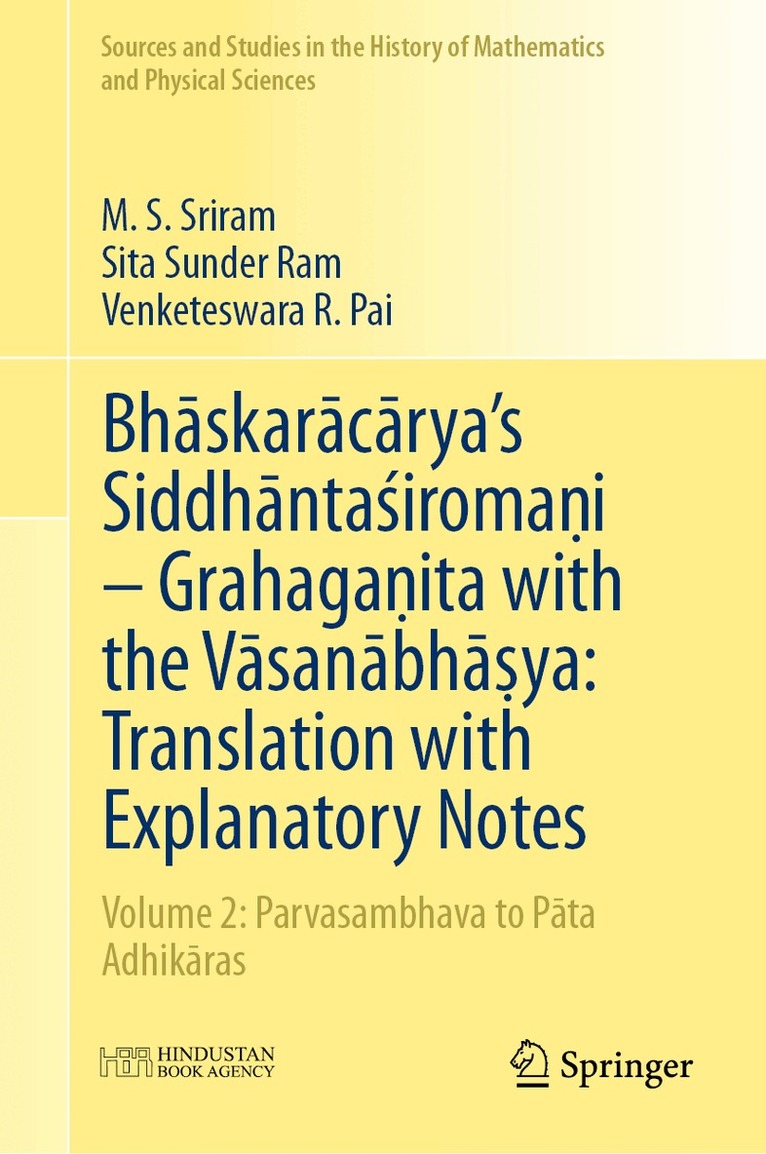
The Siddhāntaśiromaṇi was composed in 1150 CE by the celebrated mathematician–astronomer Bhāskarācārya. In the Grahagaṇitādhyāya part of it, most of the standard calculations and algorithms in Indian astronomy of his times are included. All these are explained in detail with commentary on the text, namely, the Vāsanābhāṣya or Mitākṣarā. This book is on this part only. All the 460 verses of this part have been translated afresh in this work. Now, it is in the Vāsanābhāṣya that the contents of the verses are expounded in detail. In addition, the detailed derivations and proofs of the statements and algorithms are presented in the upapattis. Study of the vāsanā is indispensable for understanding the methodology of, in particular, and thereby, of Indian astronomers in general. The distinct scientific method of Bhāskara (indeed of the Indian astronomical tradition in general, of which he was a leading exponent), his approach to problems and the ways to solve them, can be understood only when one goes through the commentary and understands it. It is for this reason that the Vāsanābhāṣya has been translated into English for all the verses, for the first time. Explanatory notes based on the vāsanā of Bhāskara have been provided for all the verses in modern notation, with a large number of diagrams to facilitate the understanding.The Grahagaṇitādhyāya has 12 chapters, which is divided into two volumes: Volume 1: Madhyama, Spaṣṭa, Tripraśna and Volume 2: Parvasambhava to Pāta Adhikāras. Volume 1 has three chapters—the Madhyamādhikāra, Spaṣṭādhikāra and the Tripraśnādhikāra. This volume has a comprehensive introduction and two appendices on the Indian planetary model and elements of spherical trigonometry, which make this book reasonably self-contained. Volume 2 has the nine chapters—Parvasambhava, Candragrahaṇa, Sūryagrahaṇa, Grahacchāyā, Udayāsta, Śṛṅgonnati, Grahayuti, Bhagrahayuti and the Pāta adhikāras.
Bhāskarācārya's Siddhāntaśiromaṇi – Grahagaṇita with the Vāsanābhāṣya: Translation with Explanatory Notes
Volume 1: Madhyama, Spaṣṭa, Tripraśna
Inbunden, Engelska, 2026
1 813 kr
Kommande
The Siddhāntaśiromaṇi was composed in 1150 CE by the celebrated mathematician–astronomer Bhāskarācārya. In the Grahagaṇitādhyāya part of it, most of the standard calculations and algorithms in Indian astronomy of his times are included. All these are explained in detail with commentary on the text, namely, the Vāsanābhāṣya or Mitākṣarā. This book is on this part only. All the 460 verses of this part have been translated afresh in this work. Now, it is in the Vāsanābhāṣya that the contents of the verses are expounded in detail. In addition, the detailed derivations and proofs of the statements and algorithms are presented in the upapattis. Study of the vāsanā is indispensable for understanding the methodology of, in particular, and thereby, of Indian astronomers in general. The distinct scientific method of Bhāskara (indeed of the Indian astronomical tradition in general, of which he was a leading exponent), his approach to problems and the ways to solve them, can be understood only when one goes through the commentary and understands it. It is for this reason that the Vāsanābhāṣya has been translated into English for all the verses, for the first time. Explanatory notes based on the vāsanā of Bhāskara have been provided for all the verses in modern notation, with a large number of diagrams to facilitate the understanding. The first volume of the book comprises the three chapters on Madhayama (Mean longitudes), Spaṣṭa (True longitudes) and Tripraśna (the three problems) with about 300 verses.Scholars working in the area of history of Indian astronomy and mathematics will find the present work on this major text of Bhāskarācārya with his auto-commentary, very valuable . In fact, anyone with an undergraduate-level knowledge of mathematics and serious interest in Indian astronomy will find this work very useful for understanding the subject, as it is reasonably self-contained.