Mushtaque Khan – författare
4 450 kr
Läs direkt efter köp
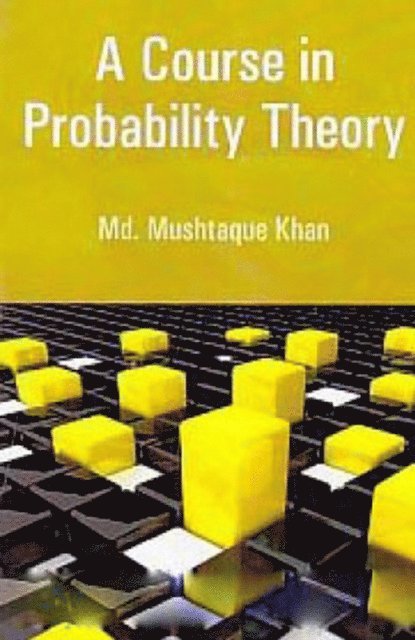
Probability theory is a branch of mathematics that concerned with the analysis of random phenomena. The outcome of a random event cannot be determined before it occurs, but it may be any one of several possible outcomes. The actual outcome is considered to be determined by chance. The word probability has several meanings in ordinary conversation. Two of these are particularly important for the development and applications of the mathematical theory of probability. This culminated in modern probability theory, on foundations laid by Andrey Nikolaevich Kolmogorov. Kolmogorov combined the notion of sample space, introduced by Richard von Mises, and measure theory and presented his axiom system for probability theory in 1933. Fairly quickly this became the mostly undisputed axiomatic basis for modern probability theory but alternatives exist, in particular the adoption of finite rather than countable additivity by Bruno de Finetti. Particular emphasis is placed upon stopping times, both as tools in proving theorems and as objects of interest themselves. The book covers a comprehensive course in probability for the students of economics, statistics and the physical sciences. It presents a thorough treatment of probability ideas and techniques necessary for a firm understanding of the subject and has been designed in such a way that a previous acquaintance with mathematics and statistics is not necessary.
4 450 kr
Läs direkt efter köp
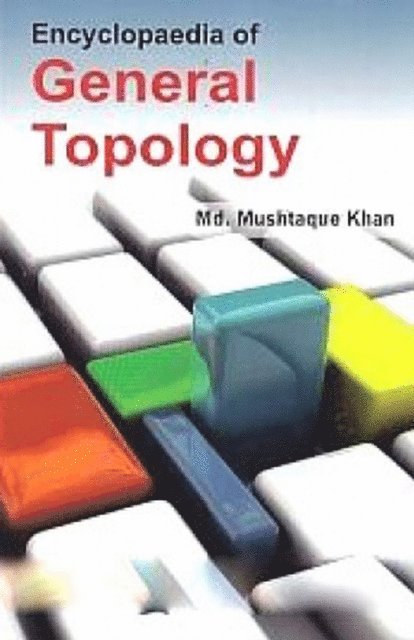
In mathematics, general topology or point-set topology is the branch of topology which studies properties of topological spaces and structures defined on them. It is distinct from other branches of topology in that the topological spaces may be very general, and do not have to be at all similar to manifolds. General topology provides the most general framework where fundamental concepts of topology such as open/closed sets, continuity, interior/exterior/boundary points, and limit points could be defined. Ideas that are now classified as topological were expressed as early as 1736. Toward the end of the 19th century, a distinct discipline developed, which was referred to in Latin as the geometria situs or analysis situs. This later acquired the modern name of topology. By the middle of the 20th century, topology had become an important area of study within mathematics. The word topology is used both for the mathematical discipline and for a family of sets with certain properties that are used to define a topological space, a basic object of topology. Of particular importance are homeomorphisms, which can be defined as continuous functions with a continuousinverse. Topology includes many subfields. The most basic and traditional division within topology is point-set topology, which establishes the foundational aspects of topology and investigates concepts inherent to topological spaces; algebraic topology, which generally tries to measure degrees of connectivity using algebraic constructs such as homotopy groups and homology; and geometric topology, which primarily studies manifolds and their embeddings in other manifolds. Some of the most active areas, such as low dimensional topology and graph theory, do not fit neatly in this division. Knot theory studies mathematical knots. The encyclopaedia provides the students current information on the different areas of this subject. The publication is useful not only to the students but also to the research scholars and academic professionals.
4 450 kr
Läs direkt efter köp
In mathematics, general topology or point-set topology is the branch of topology which studies properties of topological spaces and structures defined on them. It is distinct from other branches of topology in that the topological spaces may be very general, and do not have to be at all similar to manifolds. General topology provides the most general framework where fundamental concepts of topology such as open/closed sets, continuity, interior/exterior/boundary points, and limit points could be defined. Ideas that are now classified as topological were expressed as early as 1736. Toward the end of the 19th century, a distinct discipline developed, which was referred to in Latin as the geometria situs or analysis situs. This later acquired the modern name of topology. By the middle of the 20th century, topology had become an important area of study within mathematics. The word topology is used both for the mathematical discipline and for a family of sets with certain properties that are used to define a topological space, a basic object of topology. Of particular importance are homeomorphisms, which can be defined as continuous functions with a continuousinverse. Topology includes many subfields. The most basic and traditional division within topology is point-set topology, which establishes the foundational aspects of topology and investigates concepts inherent to topological spaces; algebraic topology, which generally tries to measure degrees of connectivity using algebraic constructs such as homotopy groups and homology; and geometric topology, which primarily studies manifolds and their embeddings in other manifolds. Some of the most active areas, such as low dimensional topology and graph theory, do not fit neatly in this division. Knot theory studies mathematical knots. The encyclopaedia provides the students current information on the different areas of this subject. The publication is useful not only to the students but also to the research scholars and academic professionals.
6 154 kr
Läs direkt efter köp
2 576 kr
Läs direkt efter köp
The present book ‘Fundamentals of Differential Equation’ presents the basic theory of differential equations and offers a variety of modern applications in science and engineering. This introductory differential equations textbook presents a convenient way to integrate symbolic computing into the study of differential equations and linear algebra.
2 750 kr
Läs direkt efter köp
This book advocates the study of algorithm design techniques by presenting most of the useful algorithm design techniques and illustrating them through numerous examples. The book gives instructors the flexibility to emphasize different aspects—design, analysis, or computer implementation—of numerical algorithms, depending on the background and interests of students. Designed for upper-division undergraduates in mathematics or computer science classes, the textbook assumes that students have prior knowledge of linear algebra and calculus, although these topics are reviewed in the text.