N. Brown – författare
Visar alla böcker från författaren N. Brown. Handla med fri frakt och snabb leverans.
3 produkter
3 produkter
1 622 kr
Skickas inom 10-15 vardagar
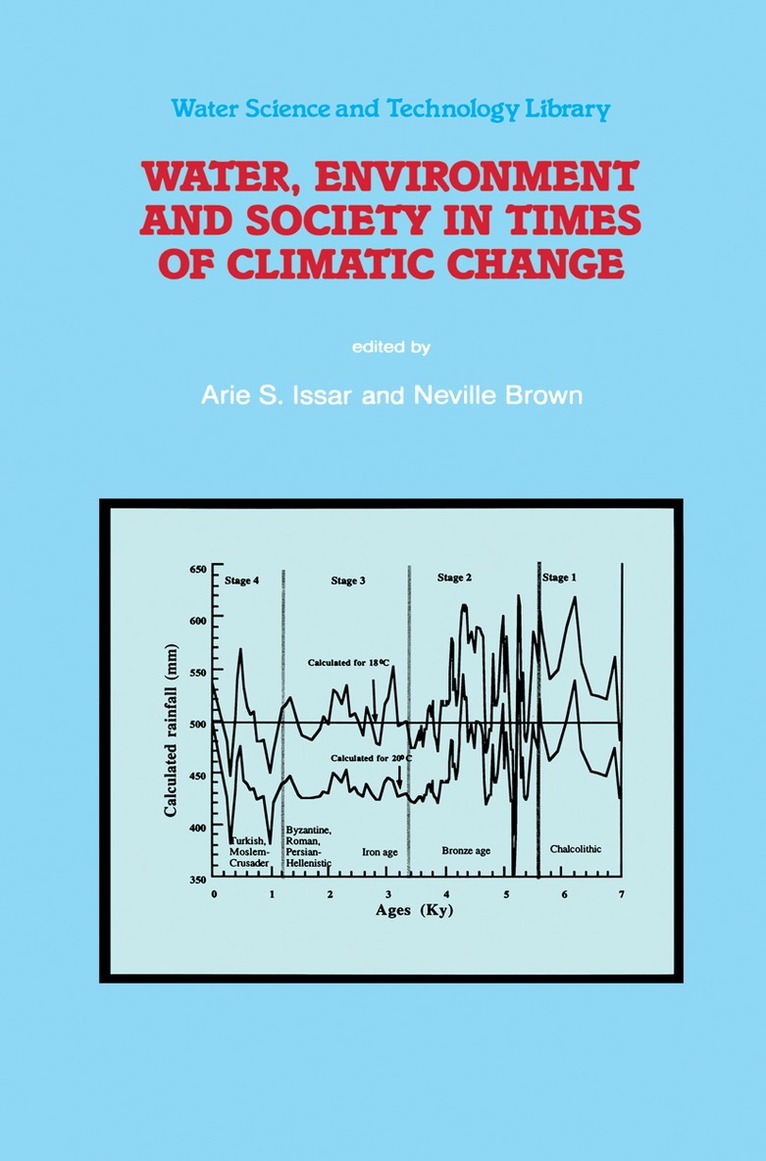
This text addresses climate variability and its human impact during the Holocene. The various contributions were presented during the July 1996 Negev University workshop and provide an interdisciplinary, integrative overview. Some chapters document and discuss climate variability and paleo-hydrology using stable isotopes, radiocarbon, pollen and other proxy data. The mechanisms causing climate variability are also discussed. The response of historical human communities to change in climate (temperature and hydrological) is documented for a number of geographical areas and time periods using historical and archaeological data. The paleo-climate and paleo-hydrology results may help us constrain and improve predictive models. The historical record of societal response to climate variability may provide information on the adaptability of societies to future global and climatic change. This text should be of interest to paleo-hydrologists, paleo-climatologists, palynologists, Quaternary geologists, physical geographers, archaeologists, and other scientists interested in climatic change and history.
Del 31 - Water Science and Technology Library
Water, Environment and Society in Times of Climatic Change
Contributions from an International Workshop within the framework of International Hydrological Program (IHP) UNESCO, held at Ben-Gurion University, Sede Boker, Israel from 7–12 July 1996
Häftad, Engelska, 2010
1 622 kr
Skickas inom 10-15 vardagar
Since the greenhouse effect emerged as a predictable threat, necessitating the evalu ation of its future impact on the environment in the various parts of the globe, interest in the climate changes during the Holocene has gained momentum. The background can be summarized by the sentence: The past is a key to the future. As a matter of fact, this sentence is in the opposite direction, on the dimension of time, to the principle adopted by the founders of the science of geology. They proposed that geological processes in the present should be used as a key for understanding the past. Another reason for the interest in the history of the climate of the Holocene can be described as the renaissance of a modified deterministic approach to the inter relation between physical and human geography. This relates in the first place to the fact that various investigations, especially as carried out by Hubert Lamb, showed that the sequence of climate changes previously suggested by Blytt and Sernander for Europe and adopted by most Holocene climatologists was far too general, and that there were more climate changes during recent history than previously taken account of. In the second place it was found out that these changes had had an impact on the history of human communities. Thus, one can conclude that once the taboo on geographical determinism (i. e.
2 049 kr
Läs direkt efter köp
Since the greenhouse effect emerged as a predictable threat, necessitating the evalu ation of its future impact on the environment in the various parts of the globe, interest in the climate changes during the Holocene has gained momentum. The background can be summarized by the sentence: The past is a key to the future. As a matter of fact, this sentence is in the opposite direction, on the dimension of time, to the principle adopted by the founders of the science of geology. They proposed that geological processes in the present should be used as a key for understanding the past. Another reason for the interest in the history of the climate of the Holocene can be described as the renaissance of a modified deterministic approach to the inter relation between physical and human geography. This relates in the first place to the fact that various investigations, especially as carried out by Hubert Lamb, showed that the sequence of climate changes previously suggested by Blytt and Sernander for Europe and adopted by most Holocene climatologists was far too general, and that there were more climate changes during recent history than previously taken account of. In the second place it was found out that these changes had had an impact on the history of human communities. Thus, one can conclude that once the taboo on geographical determinism (i. e.