N. Christian Smoot – författare
Visar alla böcker från författaren N. Christian Smoot. Handla med fri frakt och snabb leverans.
7 produkter
7 produkter
Del 9 - Solid Earth Sciences Library
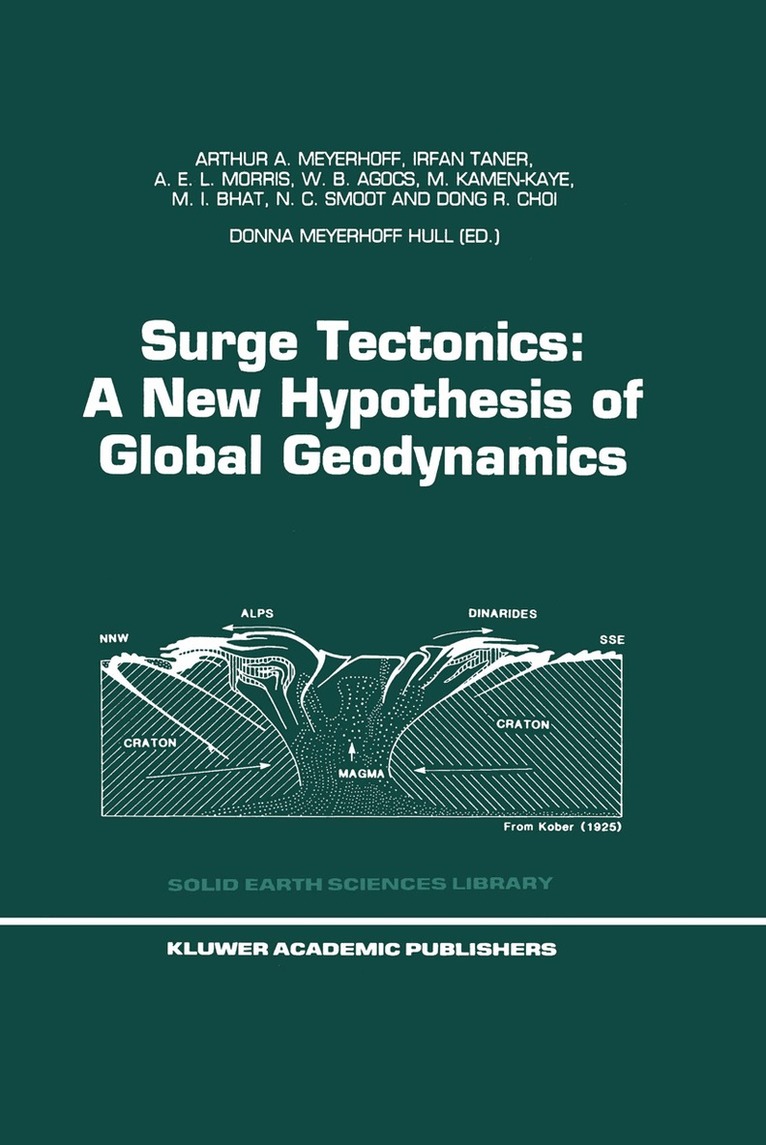
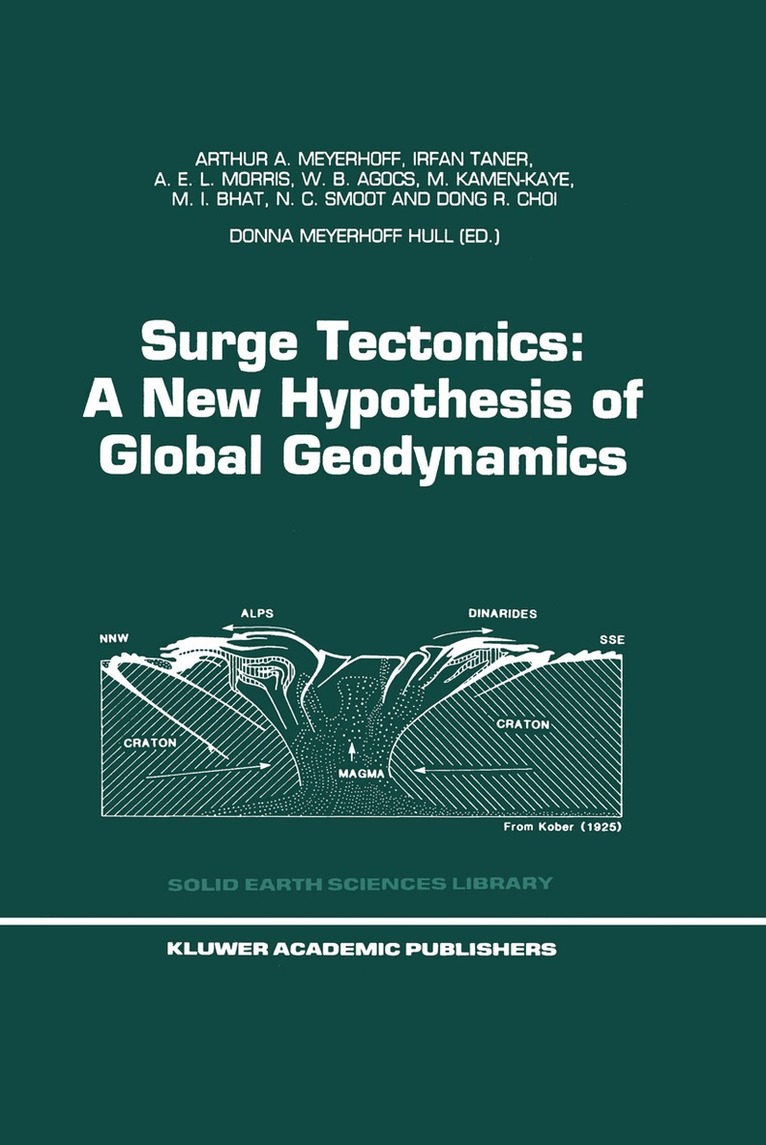
Surge Tectonics: A New Hypothesis of Global Geodynamics
Inbunden, Engelska, 1996
1 631 kr
Skickas inom 10-15 vardagar
This monograph presents an integrated view of the origin of continents, ocean basins, mountain belts and other tectonic features. It is shown that all tectonic belts originate through a single mechanism and that this mechanism can be described in terms of the laws of physics, especially Newton's three laws of motion, and their derivatives - Pascal's law, Stokes's law, the Peach-Kohler force (a derivative of the law of gravity), Poiseuille's law, the Navier-Stokes equations and the Navier-Coulomb maximum stress theory. This book should be of interest to scientists and researchers in many disciplines, not just geology and geophysics, but also fluid mechanics and related fields. The targeted audience includes advanced geology and geophysics majors, graduate students at all levels and all persons involved in structural geology, tectonics, igneous geochemistry and mineral exploration.
Inbunden, Engelska, 2015
390 kr
Skickas inom 5-8 vardagar
Häftad, Engelska, 2007
229 kr
Skickas inom 5-8 vardagar
Häftad, Engelska, 2012
534 kr
Skickas inom 5-8 vardagar
E-bok
Engelska, 201250 kr
Läs direkt efter köp
Forty-five years after the synthesis of the plate tectonic hypothesis, much newer and better information has been gathered by the seagoers of the world. Contrary to popular opinion among earth scientists, the purveyors of plate tectonics are the present-day snake oil salesmen. This null hypothesis is fraught with misinformation and misconceptions. It is in need of a massive make-over. Midocean ridge spreading does not occur universally, especially in Iceland and the North Pacific basin. Deep earthquakes do not define a descending slab; in fact, do not even occur in most places along the trenches. Therefore, subduction does not occur. Continental drift is a figment of overly active imaginations, and Gondwana is an even greater figment. India has been in place for several billion years rather than wandering around. Index fossils like Lystrosaurus and Cynognathus are misused, misdated, and show nothing. Land bridges have surfaced and been submerged many times over the years allowing for free passage of fauna and flora. Fracture zones, rather than showing the direction of seafloor spreading, leave nothing more than a pattern of at least four different directions on the ocean floor as they intersect in a random fashion. The Chicxulub crater is not the result of a bolide strike, and this was known from the get-go. In 2004 the first edition of Tectonic Globaloney was published. Since that time much new information has been gathered and published. The Ocean Drilling Program has gone defunct as the owners of that program finally realized/admitted that they were not recovering basement material, self-admitting that only eight off-ridge cores had ever reached real basement. Therefore, the age of the ocean floor was unknown and the magnetic anomalies are not ground-truthed. The time has come for the field hands to take over and replace the ideas mostly derived by the geophysicists. Plate tectonics does not work.
E-bok
PDF, Engelska, 20121 977 kr
Läs direkt efter köp
TECTONlCS AND PHYSICS Geology, although rooted in the laws of physics, rarely has been taught in a manner designed to stress the relations between the laws and theorems of physics and the postulates of geology. The same is true of geophysics, whose specialties (seismology, gravimetIy, magnetics, magnetotellurics) deal only with the laws that govern them, and not with those that govern geology''s postulates. The branch of geology and geophysics called tectonophysics is not a formalized discipline or subdiscipline, and, therefore, has no formal laws or theorems of its own. Although many recent books claim to be textbooks in tectonophysics, they are not; they are books designed to explain one hypothesis, just as the present book is designed to explain one hypothesis. The textbook that comes closest to being a textbook of tectonophysics is Peter 1. Wyllie''s (1971) book, The Dynamic Earth. Teachers, students, and practitioners of geology since the very beginning of earth science teaching have avoided the development of a rigorous (but not rigid) scientific approach to tectonics, largely because we earth scientists have not fully understood the origin of the features with which we are dealing. This fact is not at all surprising when one considers that the database for hypotheses and theories of tectonics, particularly before 1960, has been limited to a small part of the exposed land area on the Earth''s surface.
Häftad, Engelska, 2011
1 631 kr
Skickas inom 10-15 vardagar
TECTONlCS AND PHYSICS Geology, although rooted in the laws of physics, rarely has been taught in a manner designed to stress the relations between the laws and theorems of physics and the postulates of geology. The same is true of geophysics, whose specialties (seismology, gravimetIy, magnetics, magnetotellurics) deal only with the laws that govern them, and not with those that govern geology's postulates. The branch of geology and geophysics called tectonophysics is not a formalized discipline or subdiscipline, and, therefore, has no formal laws or theorems of its own. Although many recent books claim to be textbooks in tectonophysics, they are not; they are books designed to explain one hypothesis, just as the present book is designed to explain one hypothesis. The textbook that comes closest to being a textbook of tectonophysics is Peter 1. Wyllie's (1971) book, The Dynamic Earth. Teachers, students, and practitioners of geology since the very beginning of earth science teaching have avoided the development of a rigorous (but not rigid) scientific approach to tectonics, largely because we earth scientists have not fully understood the origin of the features with which we are dealing. This fact is not at all surprising when one considers that the database for hypotheses and theories of tectonics, particularly before 1960, has been limited to a small part of the exposed land area on the Earth's surface.