Nancy Van Deusen – författare
Visar alla böcker från författaren Nancy Van Deusen. Handla med fri frakt och snabb leverans.
6 produkter
6 produkter
694 kr
Skickas inom 10-15 vardagar
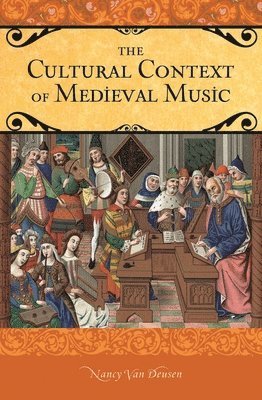
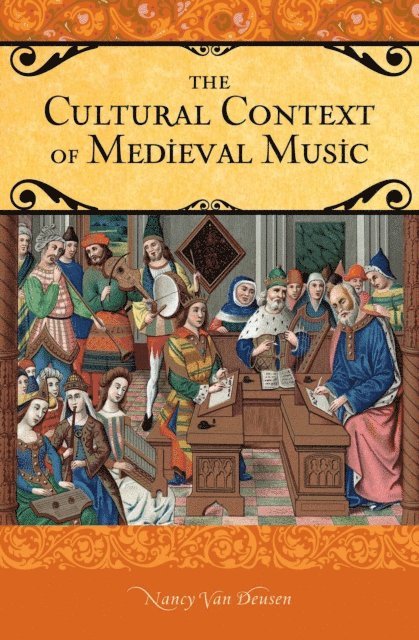
An urgently needed guide to understanding medieval music to be used as a text for the university undergraduate, graduate students in music and interdisciplinary medieval studies, and for the professional musicologist and medievalist. This book will also be appreciated by everyone interested in early music.Nancy van Deusen's The Cultural Context of Medieval Music addresses the mental landscape surrounding music that, especially, was sung and experienced in the Middle Ages. Largely anonymous in its composition, and apparently lacking the motivation of fame and commerce, music within a well thought-out system of education served a purpose that goes far beyond casual entertainment or personal professional advancement. Offering experience through performance, music exemplified the basic principles not only of the material and possible measurements of the visible world—such as of objects, relationships, and movement—but also of the invisible materials of sound and time, making it an ideal medium for working with unseen substances such as concepts, imaginations, and ideas. St. Augustine in the late fourth century reinforced the importance of music for the process of learning when he wrote that nothing could be truly understood without music. This book shows how this, in fact, is the case—a message of great relevance today.
377 kr
Tillfälligt slut
Surveys the influence of the Psalms in the Middle Ages, giving a unique window into the intellectual, spiritual, and emotional culture of the period.The Psalms were an important part of the education, daily life, and spiritual development of medieval clerics and monks, and they had a significant impact on lay culture as well. The Place of the Psalms in the Intellectual Culture of the Middle Ages surveys their influence, giving a unique window into the intellectual, spiritual, and emotional culture of the period.[Contributors include George Brown, Marcia L. Colish, Mary Kay Duggan, Joseph Dyer, Theresa Gross-Diaz, Michael P. Kuczynski, Marie Anne Mayeski, James W. McKinnon, Joseph Falaky Nagy, Nancy van Deusen.]
Del 39 - Studies in Medieval Culture
Intellectual Climate of the Early University
Essays in Honor of Otto Gründler
Inbunden, Engelska, 1997
321 kr
Skickas inom 5-8 vardagar
Despite a good deal of research and writing concerning the development and intellectual transformation in the period of the early university, the subject remains in many respects enigmatic. This collection of essays in honor of Otto Gründler tackles many of the questions that run to the heart of the early university. The volume will be of interest to scholars of the period as well as anyone familiar with issues of today's academic profession, as the questions that confronted the early university are not so unfamiliar today: What exactly is the "life of the mind"? What should one learn in a university? What is learning itself "good for"? What is a discipline, and is it possible for disciplines to reinforce each other? Can some university disciplines be identified as givens, as forming an unquestionably self-evident basis for university study? And even that most basic question: What is a university after all? This collection of essays from experts in a range of fields confronts these questions in a broad, satisfying way that expands and clarifies the questions that are as relevant today as they were in the thirteenth century.
Del 39 - Studies in Medieval Culture
Intellectual Climate of the Early University
Essays in Honor of Otto Gründler
Häftad, Engelska, 1997
255 kr
Skickas inom 5-8 vardagar
Despite a good deal of research and writing concerning the development and intellectual transformation in the period of the early university, the subject remains in many respects enigmatic. This collection of essays in honor of Otto Gründler tackles many of the questions that run to the heart of the early university. The volume will be of interest to scholars of the period as well as anyone familiar with issues of today's academic profession, as the questions that confronted the early university are not so unfamiliar today: What exactly is the "life of the mind"? What should one learn in a university? What is learning itself "good for"? What is a discipline, and is it possible for disciplines to reinforce each other? Can some university disciplines be identified as givens, as forming an unquestionably self-evident basis for university study? And even that most basic question: What is a university after all? This collection of essays from experts in a range of fields confronts these questions in a broad, satisfying way that expands and clarifies the questions that are as relevant today as they were in the thirteenth century.
Del 6 - Studies in the History of Daily Life (800-1600)
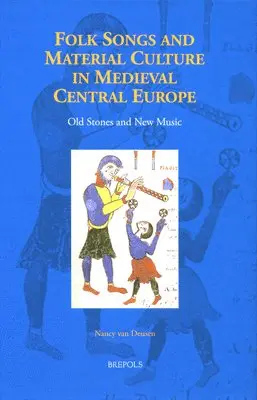
Folk Songs and Material Culture in Medieval Central Europe
Old Stones and New Music
Inbunden, Engelska, 2019
1 825 kr
Skickas inom 5-8 vardagar
Del 57 - Brill's Studies in Intellectual History
Theology and Music at the Early University
The Case of Robert Grosseteste and Anonymous IV
Inbunden, Engelska, 1994
2 223 kr
Skickas inom 5-8 vardagar
At the climax of one of his most important and comprehensive works, De cessatione legalium, the thirteenth-century theologian and natural philosopher, Robert Grosseteste, uses a musical example to make a point fundamental to the treatise. Music, using time as its material, located between the abstract and the concrete, served as an analogy, thus making a difficult philosophical concept perceptible. In using music as an analogy, Gorsseteste drew upon a long tradition established by Augustine, confirmed within the new Aristotelian reception, and a newly-translated Platonic dialogue. But the first rector of the University of Oxford was also demonstrating music's place within the curriculum of the early university, namely, as a ministry discipline, efficiently and efficaciously exemplifying traditional Augustinian, as well as new Aristotelian principles.This book unites the most important theological-philosophical subjects discussed by Robert Grosseteste throughout his prodigious output, with those exemplified by an anonymous contemporary English writer on music. The work shows how music collaborated with the other liberal arts, operating within the early university curriculum as a ministry discipline. Music made accessible through the figurae of its notation, and through sound, otherwise nearly unapproachable, new Aristotelian concepts. The influence was reciprocal in that new Aristotelian tools and conceptualization greatly influenced music notation and style. Music theory has been studied in isolation, as pertaining only to music. This study is the first to relate music of the early thirteenth century to its intellectual context, overturning dogma, uncritically accepted since the beginning of this century, concerning so-called “modal rhythm,” and showing how “contrary motion,” rather than forming a musical convention, demonstrated a key Aristotelian concept.